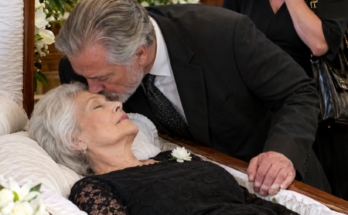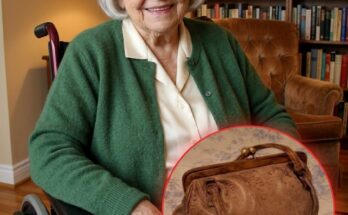
My fingers touched something cold, hard, and carefully wrapped in cloth.
For several seconds, I simply stood there with my hand buried inside Fiona’s old pillow.
The room was quiet except for the faint ticking of the clock above our dresser.
Downstairs, I could hear voices.
Fiona’s children were still in the house.
They had stayed after the funeral home came for her body, sitting around the kitchen table with cups of coffee they barely drank, talking in low voices about arrangements, paperwork, and what should happen to the few possessions Fiona had left behind.
No one had asked about the pillow.
Why would they?
It was old.
The fabric had faded from white to a dull yellow, and one corner had been patched twice.
For years, I had begged Fiona to let me replace it.
Every time, she refused.
“This one fits my head,” she would say.
I used to laugh.
Now I understood there had been another reason.
Slowly, I pulled my hand from the torn seam.
Feathers floated onto the bedspread.
In my palm was a small bundle wrapped in a square of faded blue cloth.
My heart began beating faster.
I sat on the edge of the bed.
Then I unfolded the cloth.
Inside was an old brass key.
That was all.
No jewelry.
No money.
No diamonds hidden by a secretly wealthy woman.
Just a key.
It was small, darkened with age, and attached to a thin piece of string.
A folded scrap of paper had been tied to the string.
My name was written on it.
Mabel.
I recognized Fiona’s handwriting immediately.
My hands started trembling.
I carefully opened the note.
There were only six words.
Under the floor where winter sleeps.
I read the sentence twice.
Then a third time.
Under the floor where winter sleeps.
At first, it made no sense.
Then I remembered something Fiona had said years earlier.
Our farmhouse had an old root cellar beneath the kitchen.
Before refrigerators became common, Fiona used it to store potatoes, onions, apples, jars of preserves, and vegetables during the winter.
When my husband, Thomas, was a child, Fiona apparently used to tell the children that the cellar was “where winter slept.”
The phrase had become a family joke.
My eyes moved toward the bedroom door.
The root cellar.
I wrapped the key and note in the cloth again and slipped them into the pocket of my cardigan.
I had barely stood when someone knocked.
“Mabel?”
It was my husband’s oldest sister, Claudia.
I opened the door.
She glanced past me toward the pillow on the bed.
Her eyebrows rose.
“You actually took it?”
I looked at her.
“Took what?”
“Mom’s pillow.”
There was something strange in her voice.
Not quite amusement.
Not quite suspicion.
“She gave it to me,” I said.
Claudia shrugged.
“I know. I just thought maybe you’d throw it away.”
“I haven’t decided what to do with it.”
Her eyes stayed on the pillow.
Then she smiled.
“You know Mom wasn’t completely herself at the end.”
The comment stung more than I expected.
“She knew exactly who was standing around her bed.”
“I’m sure she did.”
Claudia paused.
“I just mean, don’t attach too much meaning to it.”
I said nothing.
She lowered her voice.
“We’re talking downstairs about dividing some things. There isn’t much, obviously. Mom didn’t have money. But there’s her wedding ring, a few pieces of furniture, Dad’s tools, some dishes. You should come down.”
I nodded.
“I’ll be there in a minute.”
When she left, I closed the door and leaned against it.
For some reason, I suddenly felt guilty.
I was hiding something from the family.
But then I remembered Fiona’s final words.
It’s yours, Mabel.
Not Thomas’s.
Not the family’s.
Mine.
I went downstairs.
The atmosphere in the kitchen was uncomfortable.
Claudia sat at the table with her younger sister, Denise.
Their brothers, Thomas and Robert, stood near the counter.
Robert’s wife, Elaine, was opening cabinets.
I stared at her.
“What are you doing?”
Elaine turned around holding a set of china cups.
“Just checking what’s here.”
“Tonight?”
She looked embarrassed.
Robert stepped in.
“She doesn’t mean anything by it.”
I wanted to say that their mother had been dead for less than four hours.
Instead, I walked to Thomas.
He slipped an arm around my shoulders.
“You okay?”
I nodded.
But I wasn’t.
The house suddenly felt different.
For twelve years, it had been organized around Fiona’s needs.
Her medicine basket sat near the refrigerator.
Her walker rested against the hallway wall.
A blue sweater she wore almost every evening hung over the back of a chair.
Her favorite mug sat beside the sink.
And yet the people around me were already discussing who wanted the dining table.
It frightened me how quickly a life could become objects.
Denise unfolded a sheet of paper.
“I think we should make a list.”
Robert nodded.
“That makes sense.”
Claudia looked at Thomas.
“You want Dad’s tools?”
Thomas shrugged.
“If Robert wants them, he can take them.”
“I don’t need all of them,” Robert said.
Then Elaine spoke.
“What about the property?”
The room became silent.
Thomas frowned.
“What property?”
Elaine gestured around us.
“The house.”
I almost laughed.
“This is our house.”
Everyone looked at me.
Elaine blinked.
“I thought this was Fiona’s.”
“No,” Thomas said. “Mabel and I bought this place sixteen years ago.”
Elaine’s face reddened.
“I didn’t know.”
Claudia gave her a look.
“Mom sold the old farm ages ago.”
“Exactly,” Robert said.
That old farm.
For years, I had heard stories about it.
Fiona and her husband, Walter, had raised their children on seventy-three acres about twenty miles outside town.
After Walter died, Fiona struggled to manage the land alone.
Eventually, debts forced her to sell most of it.
By the time I met her, the farm belonged to another family.
At least that was what everyone believed.
The conversation continued.
But I barely listened.
Under the floor where winter sleeps.
The sentence repeated in my mind.
After another hour, Thomas finally ended the discussion.
“We don’t need to do this tonight.”
Claudia sighed.
“No one’s being disrespectful.”
“I didn’t say anyone was.”
“We all have jobs and families, Thomas. Some of us drove hours to get here.”
Thomas stared at her.
“Our mother died today.”
That ended it.
One by one, everyone left.
Robert and Elaine went to a motel.
Claudia stayed with Denise.
By eleven o’clock, the house was quiet.
Thomas sat on the couch staring at Fiona’s empty chair.
I sat beside him.
For a while, neither of us spoke.
Then he said, “You know what’s strange?”
“What?”
“I kept thinking I was prepared.”
I reached for his hand.
He swallowed.
“For years, every time the phone rang late, I thought this is it. Every time she got pneumonia. Every hospital trip. I kept telling myself one day she’d be gone.”
He looked at me.
“But the knowing doesn’t help.”
“No.”
He squeezed my fingers.
Then his eyes filled.
“I should’ve been here more.”
“You worked.”
“That’s an excuse.”
“You called her every day.”
“It isn’t the same.”
I turned toward him.
“Thomas, your mother knew you loved her.”
He looked down.
“I left too much on you.”
I knew what he meant.
The baths.
The medication.
The sleepless nights.
The doctor visits.
The accidents.
The laundry.
The days when Fiona was confused.
The days when she was angry at needing help.
The days when I felt ashamed of being tired.
But I also remembered laughter.
Fiona teaching my son Caleb how to shell peas.
The two of them watching old westerns.
Her complaining about the weather forecast.
Her pretending she hated Christmas music while humming every song.
“I chose to care for her,” I said.
Thomas shook his head.
“You did more than anyone had the right to expect.”
Before I could answer, he asked, “What did she mean about the pillow?”
My stomach tightened.
I could have shown him the key.
Thomas was my husband.
I trusted him.
But something stopped me.
Not because I thought he would take it.
Because Fiona had created this strange final moment deliberately.
I needed to understand it before involving anyone else.
“I don’t know,” I said.
That answer was technically true.
Thomas nodded.
“Mom loved that ugly thing.”
Despite everything, I smiled.
“She did.”
We went upstairs.
Thomas fell asleep from exhaustion.
I couldn’t.
At half past midnight, I slipped out of bed.
I took the brass key from the cardigan hanging over the chair.
Then I went to the kitchen.
The root cellar door was hidden beneath an old rug near the pantry.
I pulled the rug aside and lifted the wooden hatch.
Cold air rose from below.
I turned on the cellar light.
The bulb flickered.
A narrow staircase descended into darkness.
I had been down there hundreds of times.
There were shelves of mason jars, old gardening tools, empty baskets, and boxes of things Fiona insisted might someday be useful.
I reached the bottom.
The concrete floor covered most of the cellar.
But along the back wall was an older section of wooden planks.
My heart jumped.
Under the floor.
I knelt.
The boards looked ordinary.
Then I noticed one plank near the wall had a small metal ring recessed into it.
I had never seen it before.
I pulled.
Nothing happened.
Then I noticed a tiny keyhole beside the ring.
My hands began shaking again.
I inserted Fiona’s key.
It fit.
I turned it.
A soft click echoed through the cellar.
The plank lifted.
Beneath it was a narrow compartment.
Inside sat a metal box.
It was old, dark green, and scratched along the corners.
I lifted it out.
It was heavier than I expected.
For a moment, I simply stared.
Then I opened it.
The first thing I saw was an envelope.
Mabel.
Again, Fiona’s handwriting.
Underneath were documents.
Dozens of them.
Old deeds.
Tax receipts.
Letters.
Photographs.
A small velvet pouch.
And a sealed brown envelope marked with Thomas’s name.
I opened my letter first.
My dear Mabel,
If you are reading this, then I have finally gone where Walter has been waiting for me.
I know you will cry, so stop it.
I had a long life.
Not an easy one, but a long one.
And the last twelve years were gentler because of you.
I covered my mouth as tears came anyway.
I continued.
You once told me you were only my daughter-in-law.
I remembered that sentence because it was the dumbest thing I ever heard you say.
You washed my hair when my hands failed.
You cleaned me when I was ashamed.
You sat beside me when I was frightened.
You argued with doctors.
You learned how much sugar I liked in oatmeal even after the doctor told me I should not have any.
You stayed.
Children are born to us.
Sometimes daughters are sent later.
You were my daughter.
My tears fell onto the paper.
I wiped them quickly, terrified of smearing her words.
There is something my children do not know.
Walter and I lost almost everything after he died.
But not quite everything.
When I sold the farm, I kept twelve acres along the north ridge.
The land had little value then.
It was rocky and difficult to farm.
Everyone thought it had been included in the sale.
I allowed them to think so.
The deed is in this box.
So are the tax records.
I kept the taxes paid.
The land is mine free and clear.
And now it is yours.
I stopped breathing.
Twelve acres?
I looked through the papers.
There it was.
A deed.
Fiona Catherine Mercer.
Twelve acres.
County parcel numbers.
Maps.
Tax bills.
Everything.
I kept reading.
You may wonder why I hid this.
Because poverty teaches people strange things.
When Walter died, I learned how differently people look at a widow when they think she owns something.
Men who never visited suddenly offered advice.
Relatives suddenly remembered my telephone number.
People told me what I should sell and what I should keep.
So I kept one thing nobody knew about.
Not because it was valuable.
Because it was mine.
Years ago, a company contacted me about buying it.
I refused.
They returned several times.
I refused again.
Last year, another company contacted me.
The land is apparently worth more now.
I do not know exactly how much.
Maybe a little.
Maybe a lot.
That is not why I am giving it to you.
I am giving it to you because you never asked me for anything.
The words blurred.
I turned the page.
There is also something else.
Inside the velvet pouch is my wedding ring.
The one everyone thinks I still wear.
The ring on my finger during these last years was a copy.
I know Claudia wants the real one.
I know Denise probably does too.
They remember it from childhood.
I love them both.
But they remember the ring.
You remember me.
The real ring is yours.
Do not let guilt make you give it away.
I laughed through my tears.
That sounded exactly like Fiona.
Stubborn until the end.
Then came the final paragraph.
Give Thomas the brown envelope.
Do not show him your letter unless you want to.
And Mabel?
Do one thing for me.
Live after I am gone.
You have spent too many years arranging your days around an old woman’s needs.
Plant flowers.
Take Caleb somewhere ridiculous.
Sleep late.
Buy something you do not need.
And when anyone asks why I gave you the pillow, tell them the truth.
Because it was mine to give.
Love,
Mom.
I pressed the letter against my chest and cried so hard I had to sit on the cellar floor.
For twelve years, I had told myself caring for Fiona did not require recognition.
I believed that.
Mostly.
But there had been lonely moments.
Moments when her children thanked me casually as if I had watered a plant.
Moments when relatives praised me at Christmas, then disappeared for months.
Moments when I wondered whether Fiona herself understood what those years cost.
Now I knew.
She had understood everything.
After several minutes, I opened the velvet pouch.
Inside was a simple gold wedding ring.
The metal was worn smooth.
Nothing extravagant.
But I knew what it meant.
Walter had placed it on Fiona’s finger more than fifty years earlier.
I held it carefully.
Then I opened Thomas’s envelope.
I did not read the letter.
It was his.
I carried the box upstairs.
Thomas woke when I turned on the bedside lamp.
He blinked.
“Mabel?”
I placed the brown envelope in his hands.
“What’s this?”
“Your mother left it for you.”
He sat up.
His eyes moved to the metal box.
“Where did you find that?”
“In the root cellar.”
I showed him the key.
Then I explained everything.
Almost everything.
I told him about the land.
His face went completely still.
“What land?”
I handed him the deed.
He read it twice.
“This can’t be right.”
“It is.”
“Mom still owned part of the farm?”
“Twelve acres.”
He stared at me.
“How did none of us know?”
“Because she didn’t want you to.”
Thomas looked stunned.
Then he opened his letter.
I turned away to give him privacy.
After a minute, I heard him inhale sharply.
Then silence.
When I looked back, he was crying.
Thomas was not a man who cried easily.
He handed me the letter.
“You can read it.”
It began:
Thomas,
You married better than you deserved.
He laughed when I read that.
The letter was affectionate, sharp, and very Fiona.
She told him she loved him.
She told him to stop feeling guilty about working so much.
She said she had been proud of him since the day he came home at fourteen with twenty-three dollars earned from stacking hay and immediately gave her half for groceries.
Then she wrote:
I know Mabel will never tell you how tired she became.
I saw it.
Do not spend the rest of your life thanking her for taking care of me.
Thank her by taking care of her.
And when your sisters and brother learn about the land, there may be trouble.
Do not fight them.
Do not insult them.
But do not let them punish your wife for being loved.
My throat tightened.
Thomas folded the letter.
“She knew.”
“Yes.”
He looked at the deed again.
“I don’t want the land.”
I frowned.
“It isn’t yours.”
“I know.”
He smiled weakly.
“That came out wrong. I mean I don’t want anyone saying we wanted it.”
“I didn’t even know it existed.”
“Doesn’t matter.”
Unfortunately, he was right.
By ten the next morning, everyone knew.
I still don’t know exactly how.
Perhaps Robert overheard something.
Perhaps Thomas mentioned the parcel while calling the county recorder.
Or perhaps secrets simply have a way of becoming public once inheritance enters a family.
Claudia arrived first.
She didn’t knock.
She walked directly into the kitchen.
“Is it true?”
I looked up from the coffee maker.
“What?”
“Mom owned land.”
Thomas came in behind me.
“Claudia—”
“How much?”
“Twelve acres,” he said.
Her mouth fell open.
“Twelve acres?”
“Yes.”
“And she gave it to Mabel?”
I saw the anger appear immediately.
Not grief.
Anger.
“Mom made that decision,” Thomas said.
“When?”
“We don’t know yet.”
“Was there a will?”
“There are documents.”
“What documents?”
Before we could answer, a car pulled into the driveway.
Robert.
Then Denise.
Within twenty minutes, the kitchen was full again.
This time, no one cared about china cups.
Robert placed both hands on the table.
“I want to see the deed.”
I brought it.
He examined it.
“This only proves she owned the land.”
“Yes.”
“It doesn’t prove she gave it to you.”
I took a second document from the metal box.
Fiona had signed a transfer-on-death designation eighteen months earlier.
It named me.
Mabel Anne Mercer.
Not Thomas.
Me.
Denise went pale.
“She did this eighteen months ago?”
“Yes.”
“Was she competent?”
The question hit me like a slap.
Thomas stood.
“Be careful.”
Denise looked defensive.
“I’m asking a legitimate question.”
“You’re asking whether Mom was mentally incompetent because you don’t like what she decided.”
“I didn’t say that.”
“You didn’t have to.”
Robert shook his head.
“This is strange, Thomas.”
“What’s strange?”
“Mom secretly owns land for decades, nobody knows, then suddenly Mabel gets it?”
I stared at him.
“Suddenly?”
He looked at me.
“I didn’t mean—”
“Twelve years.”
“What?”
“I took care of your mother for twelve years.”
The room became quiet.
“I bathed her.”
No one spoke.
“I changed her clothes. I cooked for her. I took her to appointments. When she fell in the bathroom seven years ago, I was the one who slept in a hospital chair for two nights.”
“Mabel,” Claudia said.
“No. If we’re going to talk about what’s strange, let’s talk.”
I had never spoken to them like that.
My hands were trembling, but I continued.
“When Fiona developed pneumonia, I was there. When she forgot where she was one winter night and tried walking outside barefoot, I found her. When she became embarrassed because she needed help using the toilet, I was the one she allowed into the bathroom.”
Claudia looked down.
“I never asked her for money.”
“We know,” Denise said softly.
“Do you?”
I pointed toward the hallway.
“Your mother lived in this house for twelve years. You were welcome every day.”
No one answered.
Then Robert said the one thing I will never forget.
“We had lives.”
I stared at him.
“So did I.”
The silence afterward was enormous.
Robert looked away first.
Thomas put his hand on my shoulder.
Claudia folded her arms.
“This isn’t fair.”
Thomas’s voice sharpened.
“What isn’t?”
“She was our mother.”
“And?”
“That land came from our family farm.”
Denise nodded.
“Exactly.”
I understood then.
They were not thinking about Fiona’s property.
They were thinking about inheritance as something automatically owed.
Because they were her children.
Because they remembered running across those fields.
Because Walter had farmed there.
Because blood felt like a receipt.
“I’m not discussing this today,” I said.
Robert laughed bitterly.
“Convenient.”
Thomas moved toward him.
I grabbed my husband’s arm.
“No.”
He stopped.
I turned to Robert.
“You can speak with the attorney handling Fiona’s estate.”
“There’s an attorney?”
“Yes.”
That surprised all of them.
Fiona had apparently prepared better than anyone realized.
Two days later, we sat in the office of Harold Finch, an elderly attorney in town who had known Fiona for thirty years.
His office smelled like old paper and coffee.
Harold adjusted his glasses.
“Your mother was very clear.”
Claudia leaned forward.
“About what?”
“About everything.”
He opened Fiona’s file.
“She first discussed the north ridge parcel with me nine years ago.”
Robert frowned.
“Nine?”
“Yes.”
“She was hiding it even then?”
Harold raised an eyebrow.
“It was her property. I would not characterize keeping her private property private as hiding.”
I nearly smiled.
He continued.
“Mrs. Mercer executed the transfer-on-death affidavit eighteen months ago. I met with her alone. I assessed her understanding carefully.”
Denise shifted in her chair.
“She knew what she was signing?”
“Completely.”
“And she intentionally chose Mabel?”
“Yes.”
“Why?”
Harold looked at her.
“I believe your mother considered that obvious.”
No one spoke.
Then Claudia asked, “How much is the land worth?”
Harold removed another document.
“That depends.”
“On what?”
“Whether a pending purchase offer is accepted.”
My stomach tightened.
“Purchase offer?”
He nodded.
“Mrs. Mercer received an offer three months ago.”
“How much?” Robert asked immediately.
Harold looked at me.
“Mabel is now the beneficiary. That information belongs primarily to her.”
I swallowed.
“You can tell them.”
He turned the paper.
“Eight hundred and forty thousand dollars.”
No one breathed.
I thought I had misheard.
“What?” I whispered.
“Eight hundred forty thousand.”
Thomas gripped my hand.
Claudia stared at Harold.
“For twelve acres?”
“The land borders a planned distribution corridor. A development company has been acquiring parcels for access.”
Robert stood.
“You’re telling me Mom had almost a million dollars sitting there?”
Harold shook his head.
“She had land. Not money.”
“You know what I mean.”
“No,” Harold replied calmly. “I don’t believe I do.”
Robert paced.
“This is insane.”
Denise looked like she might cry.
Claudia turned toward me.
“You knew.”
I stared at her.
“What?”
“You had to know.”
“I found out the night your mother died.”
“I don’t believe that.”
Thomas stood so quickly his chair scraped backward.
“Enough.”
Claudia pointed at me.
“You expect me to believe Mabel spent twelve years wiping Mom’s mouth and changing her diapers out of pure goodness, then magically ends up with land worth nearly a million dollars?”
The words struck deeper than anything she had said before.
I looked at Claudia.
A woman I had cooked Thanksgiving dinner for.
A woman whose children had slept in our house.
A woman whose mother I had cared for when she didn’t.
“You think I knew?”
“I think it’s convenient.”
I stood.
My voice was quiet.
“I hope you never have someone serve you for twelve years and then accuse them of doing it for money.”
Claudia’s face changed.
For half a second, shame appeared.
Then pride erased it.
I left the office.
Thomas followed me.
Outside, I could barely breathe.
“I don’t want it,” I said.
Thomas stared at me.
“What?”
“The land.”
“Mabel.”
“I don’t want this.”
I began crying.
“I don’t want everyone thinking I took care of her because I was waiting for something.”
Thomas grabbed my shoulders.
“Look at me.”
I shook my head.
“Look at me.”
I did.
“My mother knew you didn’t know.”
“That won’t matter.”
“It matters to me.”
“They’re your family.”
“So are you.”
He held my face between his hands.
“You are my family.”
I cried harder.
For the next several weeks, the situation became worse.
Robert hired an attorney.
Claudia threatened to challenge the transfer.
Denise stopped calling.
Rumors spread.
A neighbor asked whether Fiona had “left us rich.”
Someone at church congratulated me.
I wanted to disappear.
Then something unexpected happened.
Harold called.
“There is one more document.”
I closed my eyes.
“I’m not sure I can survive another document.”
He laughed softly.
“This one may help.”
We met him the next morning.
He gave me a sealed envelope.
On the front Fiona had written:
Only if my children become fools.
Despite myself, I laughed.
Thomas did too.
Inside was a letter addressed to all four children.
Harold had copies.
That Sunday, Thomas invited his siblings to the house.
They came reluctantly.
Robert brought his attorney.
Claudia barely looked at me.
Denise sat near the window.
Thomas placed Fiona’s letter on the table.
“Mom left this.”
Claudia sighed.
“Another letter?”
“Yes.”
Harold had suggested I read it.
But I couldn’t.
So Thomas did.
My children,
If you are hearing this letter, then you have done exactly what I hoped you would not do.
You are fighting over the north ridge.
Stop.
All four of you knew me.
I was stubborn alive, and death has not improved me.
The land belonged to me.
Your father knew I kept it.
Before he died, he told me never to sell every last piece of the farm.
He said a person should keep one patch of ground where their memories can stand.
So I did.
When I became old, I considered leaving it equally to you.
Then I watched.
The room became completely silent.
Thomas continued.
Claudia, you called every Sunday for a while.
Then every other Sunday.
Then mostly when you remembered.
I loved you anyway.
Denise, you always sent beautiful Christmas cards.
I kept every one.
But cards cannot help an old woman into a bathtub.
Robert, you were my little shadow when you were a boy.
I know work kept you busy.
But everyone is busy.
Thomas, you carried guilt because your job took you away.
Stop carrying it.
You provided the roof under which I spent my final years.
And Mabel—
Thomas’s voice broke.
He stopped.
I touched his arm.
He continued.
Mabel did the work none of you saw.
Not once did she ask me what she would receive when I died.
Not once.
Do you understand?
Never.
She did not know about the north ridge.
She did not know about the offer.
She did not know about the ring.
If you accuse her of caring for me because she expected money, you are not insulting her.
You are insulting me.
Because you are saying I was too foolish to know the difference between love and greed.
Claudia began crying.
Robert sat down.
Thomas continued.
I did not leave Mabel the land as payment.
Twelve years of tenderness cannot be purchased.
I left it because I wanted to.
Because it was mine.
Because she became my daughter through action instead of birth.
If that hurts you, ask yourselves why.
The letter ended with one final sentence.
And if any of you take Mabel to court, remember that I raised you better than that.
No one spoke for a long time.
Finally, Denise stood.
She walked around the table.
Then she hugged me.
I didn’t immediately hug her back.
She whispered, “I’m sorry.”
That broke something inside me.
I put my arms around her.
She cried against my shoulder.
“I should’ve helped more.”
I closed my eyes.
“Yes,” I whispered.
She pulled back.
“I know.”
Claudia stayed seated.
Her face was wet with tears.
Eventually she looked at me.
“I said terrible things.”
I nodded.
“Yes.”
“I was angry.”
“I know.”
“That doesn’t excuse it.”
“No.”
She swallowed.
“Can you forgive me?”
I thought about Fiona.
About twelve years.
About the difference between forgiving someone and pretending they never hurt you.
“Eventually,” I said.
Claudia nodded.
“That’s fair.”
Robert was last.
For several minutes he said nothing.
Then he stood.
His attorney quietly left the room.
Robert looked at the floor.
“I’m dropping the challenge.”
I nodded.
“Thank you.”
“That doesn’t fix what I said.”
“No.”
He rubbed his face.
“I don’t know why I reacted like that.”
Thomas answered.
“Eight hundred thousand dollars.”
Robert gave a humorless laugh.
“Yeah.”
Then he looked at me.
“But Mom was right.”
I waited.
“I was acting like her life turned into a prize after she died.”
His eyes filled.
“I barely visited.”
I didn’t comfort him.
Some grief needs to be felt without rescue.
He continued.
“I kept telling myself I was busy.”
I remembered his words.
We had lives.
“I had a life too,” I said.
“I know.”
This time, he truly sounded like he did.
The family did not heal overnight.
Real families rarely do.
There were awkward holidays.
Careful conversations.
Moments when Claudia became quiet around me because she remembered what she had accused me of.
Moments when Robert overcompensated.
Denise began visiting every week, even though Fiona was no longer there.
Sometimes guilt turns people bitter.
Sometimes it makes them better.
Over time, Fiona’s children became better.
Not perfect.
Better.
As for the land, I did not immediately sell it.
The offer remained open.
One afternoon, Thomas and I drove to the north ridge.
I had never been there.
The road curved through cornfields before ending near a line of maple and oak trees.
The twelve acres were beautiful in a quiet, stubborn way.
Rocky ground.
Tall grass.
Wildflowers.
A small rise overlooking the farmland Fiona and Walter had once worked.
Thomas stood beside me.
“This is where Dad proposed to her.”
I turned.
“Really?”
He nodded.
“She told us the story a hundred times.”
We climbed the hill.
At the top stood an enormous oak tree.
Its trunk twisted upward like old hands.
Thomas touched the bark.
“Dad carved their initials somewhere.”
We searched.
Finally, I found them.
W + F.
A crooked heart surrounded the letters.
I started crying.
Thomas wrapped his arms around me.
For the first time, I understood why Fiona had refused to sell.
It was never twelve useless acres.
It was where Walter had asked her to marry him.
It was where their family had begun.
The development company wanted the land because a road through it would save them millions.
Their offer eventually increased.
Nine hundred thousand.
Then nine hundred and seventy-five.
I refused.
Everyone thought I was crazy.
Then they offered 1.1 million dollars.
Thomas looked at me one evening.
“What do you want to do?”
I thought about Fiona’s letter.
Live after I am gone.
I accepted.
But I kept one condition.
The company had to preserve the old oak and a half-acre around it.
Their engineers complained.
Their lawyers negotiated.
I refused to change my mind.
Eventually, they agreed.
I sold most of the land.
The money changed our lives.
But not in the way people expected.
We paid off our mortgage.
We put money aside for Caleb’s education.
Thomas reduced his hours.
For the first time in decades, we took a real vacation.
Fiona would have mocked us relentlessly.
“Paying money to sit beside an ocean when Ohio has perfectly good chairs,” I imagined her saying.
But the most important thing we did began six months after her death.
I drove past a small assisted-living facility one afternoon and noticed three elderly women sitting near a window.
Something about them reminded me of Fiona.
I went home and told Thomas I had an idea.
We used part of the inheritance to create the Fiona Mercer Care Fund.
It paid for respite care for families looking after elderly relatives at home.
Not glamorous medical equipment.
Not hospital wings.
Rest.
A few hours of help.
A night nurse.
Transportation to appointments.
Someone to sit with an aging parent so a daughter could attend her child’s school play.
Someone to help bathe a husband so his exhausted wife could sleep.
People underestimate what caregiving costs when the currency is time.
I understood.
The first woman our fund helped was named June.
She had cared for her husband with Parkinson’s disease for seven years.
When we arranged for an aide to come three afternoons a week, June cried.
“I can go grocery shopping alone?”
I almost laughed.
“Yes.”
She cried harder.
People who have never been caregivers might not understand why grocery shopping alone could feel like freedom.
I understood perfectly.
The fund grew.
Others donated.
A local hospital partnered with us.
Years later, it was helping dozens of families across the county.
On the wall of the small office hung a photograph of Fiona.
Not a photograph from her final years.
One from when she was forty.
She stood in a cornfield wearing work boots, holding a basket against one hip.
She looked strong.
Impatient.
Alive.
Beneath the picture was a sentence from her letter.
Children are born to us.
Sometimes daughters are sent later.
I never told many people about the wedding ring.
I wore it on a chain beneath my clothes.
Fiona’s children eventually learned the ring she had worn near the end had been a copy.
Claudia laughed when I told her.
“That woman.”
Denise shook her head.
“She planned everything.”
Robert said, “She was probably sitting in bed watching us argue while thinking we were idiots.”
Thomas smiled.
“She definitely was.”
Years passed.
Caleb grew up.
He went to college.
He became a physical therapist and eventually worked with elderly patients.
One day, when he was twenty-seven, he asked me why I had cared for Grandma Fiona for so long.
We were standing in the kitchen.
The same kitchen.
The old root cellar still beneath the rug.
I thought about my answer.
“Because she needed someone.”
“That’s it?”
I smiled.
“That’s usually enough.”
He leaned against the counter.
“Dad says it was hard.”
“It was.”
“Did you ever resent it?”
I paused.
“Yes.”
He looked surprised.
I continued.
“Sometimes.”
“You did?”
“Of course.”
“But you loved her.”
“Love doesn’t prevent exhaustion.”
He thought about that.
I said, “That’s something people misunderstand. They think if you truly love someone, caring for them should never feel heavy.”
I shook my head.
“It can be very heavy.”
“Then why keep doing it?”
“Because heavy things can still be worth carrying.”
Caleb smiled.
“Grandma would’ve called that sentimental nonsense.”
I laughed.
“She absolutely would.”
After he left, I went upstairs.
Fiona’s pillow was stored in a cedar chest.
I had cleaned it carefully but never repaired the torn seam.
The fabric had become even more fragile.
Sometimes I took it out.
Not because it was valuable.
Because it wasn’t.
That was the lesson.
Everyone had laughed when Fiona pointed toward it.
An old pillow.
Something stained by years.
Something no one wanted.
They assumed value had to shine.
They were wrong.
Inside that worthless pillow had been a key.
Inside the key had been a secret.
Inside the secret had been land.
Inside the land had been money.
But beneath all of that was something more valuable than any of it.
Proof.
Proof that Fiona had seen me.
Not as the woman married to her son.
Not as unpaid help.
Not as someone obligated to serve.
As her daughter.
On the tenth anniversary of Fiona’s death, the whole family gathered at the preserved oak tree.
The development project had long since been completed around it.
Warehouses stood in the distance.
A road ran nearby.
But the company had honored the agreement.
The oak remained.
So did the small field around it.
We installed a simple wooden bench.
No grand monument.
Fiona would have hated that.
The plaque read:
FIONA AND WALTER MERCER
WHERE OUR FAMILY BEGAN
Claudia brought flowers.
Denise brought sandwiches.
Robert brought a thermos of coffee.
Thomas brought nothing because, as usual, he assumed someone else had remembered everything.
I teased him for it.
For a few hours, we sat under the oak.
We talked about Fiona.
Not her death.
Her life.
The time she chased a raccoon out of the kitchen with a broom.
The year she tried to cut her own hair and wore a scarf for two months afterward.
The Christmas when she accidentally added salt instead of sugar to a pie and forced everyone to eat it because “food costs money.”
Robert laughed until he cried.
Then his laughter became real tears.
“I wish I’d visited more.”
No one told him not to feel guilty.
Some regrets remain.
That does not mean they have to destroy us.
Claudia looked at me.
“I’ve wanted to say something for years.”
“What?”
“When Mom left you the land, I thought she was choosing you over us.”
I listened.
“But now I don’t think that’s what she was doing.”
“What do you think she was doing?”
Claudia looked toward the carved initials in the oak.
“She was showing us something.”
“What?”
“That being family isn’t something you inherit.”
Her eyes met mine.
“It’s something you do.”
I smiled.
Fiona would have liked that.
Or pretended not to.
Before we left, I placed my hand against the oak.
The bark was rough beneath my palm.
For a moment, I remembered Fiona’s hands.
Those hands had once planted fields.
Raised children.
Buried a husband.
Counted coins at a kitchen table.
Signed papers no one knew about.
Held mine when I cried.
And finally pointed toward an ugly pillow.
It had been twenty-two years since that evening when I sat beside her bed and whispered that I was only her daughter-in-law.
I could still hear her answer.
Blood makes a family.
Love proves it.
At the time, I thought she was comforting me.
I didn’t realize she was telling me exactly what she believed.
And in the final hours of her life, she made sure none of us would ever forget it.
The pillow eventually fell apart.
One winter morning, I opened the cedar chest and found the old fabric had split completely.
Feathers covered the bottom.
For a moment, I felt devastated.
Then I started laughing.
Thomas came upstairs.
“What happened?”
I held up the ruined pillow.
“Your mother finally lost the argument.”
He looked at it.
Then at me.
“She’d tell you to throw it away.”
“No, she wouldn’t.”
“You’re right.”
He grinned.
“She’d make you stuff the feathers into a new one.”
So that is exactly what I did.
I bought soft white fabric.
I stitched a new pillow by hand.
Inside, I placed a handful of Fiona’s old feathers.
Not all of them.
Just enough.
Then I added something else.
A small brass key.
Not the original.
That one sits in a framed box with Fiona’s letter.
This key opens nothing.
It is simply a reminder.
Someday, when I am gone, Caleb will probably find that pillow.
Perhaps his children will wonder why their grandmother kept an ordinary pillow tucked inside a cedar chest.
Maybe they will reach inside and find the key.
And beside it, they will find the letter I wrote for them.
It begins like this:
If you are reading this, you have probably discovered that old women sometimes hide important things in ridiculous places.
Your great-grandmother taught me that.
But the real treasure she left me was never land.
It was never money.
It was never even her wedding ring.
She left me the knowledge that kindness is never wasted simply because nobody is watching.
For twelve years, I believed I was giving pieces of my life away.
Time.
Sleep.
Energy.
Patience.
Freedom.
But love is strange.
Sometimes the things we think we are losing return to us in another form.
Not always money.
Usually not.
Sometimes they return as a hand held at the right moment.
A child who learns compassion by watching you.
A husband who finally understands what sacrifice looks like.
A family forced to confront what truly matters.
A name spoken with love.
Or six words written by an old woman with trembling hands.
You were my daughter through action.
That was Fiona’s real inheritance to me.
The land helped us.
The money changed circumstances.
The care fund changed other people’s lives.
But none of those things mattered as much as what happened inside me when I realized that Fiona had noticed.
Every bowl of oatmeal.
Every midnight check.
Every bath.
Every hospital chair.
Every exhausted morning.
Every moment I wondered whether I could keep going.
She had noticed.
She remembered.
And when she had almost nothing left to say, she chose her final words carefully.
“It’s yours, Mabel.”
Everyone thought she meant the pillow.
For a while, I thought she meant the key.
Later, I thought she meant the land.
But after all these years, I know better.
Fiona was giving me something much larger.
She was giving me my place in her family.
Not borrowed through marriage.
Not dependent on Thomas.
Mine.
And that was worth more than anything she could ever have hidden beneath those feathers.
 THE END! THANK YOU FOR READING!