My pregnant wife’s father and eight brothers beat her so savagely that our unborn child died—then stood outside her ICU room laughing at me because they believed I was nothing more than a harmless businessman. What they didn’t know was that, with one message, I could turn their entire world into ashes.
The hospital called a few minutes after midnight.
“Your wife is alive,” the nurse said, her voice trembling. “But you need to come immediately.”
Alive.
That word should have brought relief. Instead, the fear behind it made my blood run cold.
I arrived still wearing the charcoal suit from a private meeting with men who controlled the city’s shipping routes. Normally, people stepped aside when I entered a room.
That night, I felt powerless.
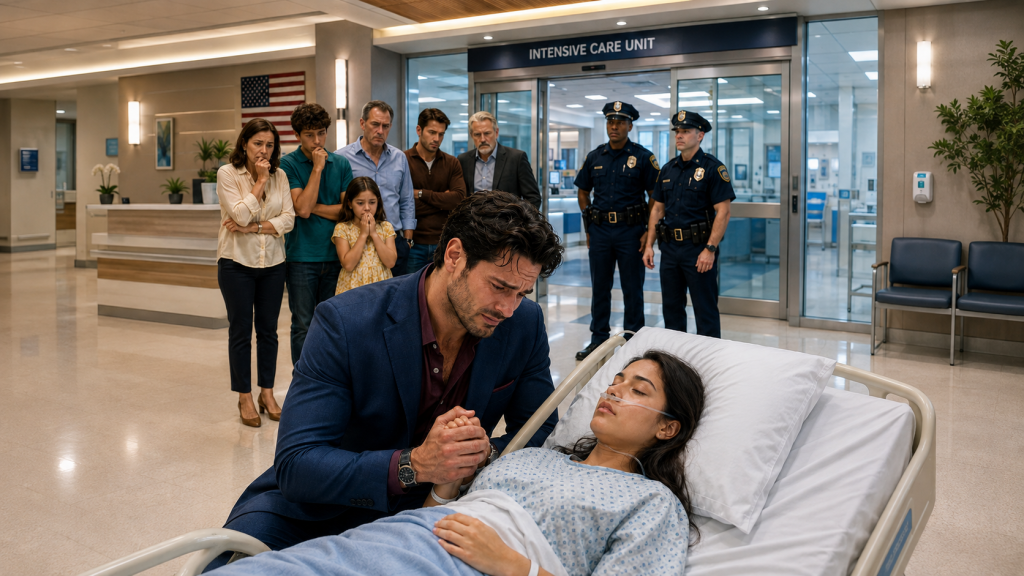
Clara lay beneath harsh white lights, surrounded by machines. One side of her face was swollen. Dark bruises covered her arms and neck. A breathing tube rested between her lips.
Her hand lay across her stomach.
Across the place where our child had been.
The doctor spoke carefully.
“She has three broken ribs, a fractured collarbone, and internal bleeding.”
Then he stopped.
His eyes dropped to the floor.
“We couldn’t save the baby.”
For several seconds, I heard nothing except the machines beside her bed.
I had ordered powerful men removed from companies with a quiet sentence. I had ended business wars over dinner. I had destroyed political careers without ever appearing on the news.
But those five words nearly brought me to my knees.
We couldn’t save the baby.
I placed one hand against the wall because my legs suddenly felt too weak to hold me.
Our daughter.
We had already chosen her name.
Sophie.
Clara had painted the nursery herself because she said I would choose colors that looked like a corporate office. There was a small white crib beside the window, stuffed animals lined neatly against the wall, and a wooden sign Clara had ordered with Sophie’s name carved into it.
Three nights earlier, Clara had stood barefoot in the nursery, laughing as the baby kicked.
“Come here,” she had told me.
She took my hand and pressed it against her stomach.
I felt the movement.
Strong.
Alive.
I had smiled like an idiot.
Now Sophie was gone.
“How did this happen?” I asked.
The doctor hesitated.
“This wasn’t an accident. She was struck repeatedly by several people.”
“How many?”
“At least nine.”
I already knew.
When I stepped into the hallway, Clara’s father and eight brothers stood near the ICU doors.
None of them looked ashamed.
One brother smiled.
“She fell down some stairs.”
Another laughed.
“Maybe you should’ve taught your wife to respect her family.”
Then her father walked toward me.
Victor Hale.
Sixty-three years old.
Owner of several construction companies, two nightclubs, warehouses along the river, and enough politicians to make ordinary people believe he was untouchable.
He had never liked me.
Not because I treated Clara badly.
Because he couldn’t control me.
The first time Clara introduced us, Victor had looked at my watch, my suit, and the quiet way I spoke and decided I was soft.
He believed wealthy men came in two varieties.
Men like him, who screamed.
And men like me, who paid other people to solve problems.
He never understood there was a third kind.
Men who didn’t need to scream.
“You think your money makes you dangerous?” Victor said. “You’re just a businessman playing with powerful people.”
I stared at him.
For years, I had hidden the truth from Clara’s family.
Clara knew I owned companies.
She knew I invested in shipping, security, technology, commercial property, and logistics.
She knew powerful people returned my phone calls.
But she didn’t know how deep the network went.
She didn’t know judges owed me favors because I had saved their careers.
She didn’t know police commanders trusted information from my security division more than information from their own departments.
She didn’t know senators had asked me privately which donors they should avoid.
And she definitely didn’t know that some of the men who truly ruled the city never said my name aloud.
I had kept that world away from her intentionally.
Clara loved books, old movies, terrible reality television, and Sunday mornings drinking coffee on our balcony.
I wanted her to have that life.
I wanted our child to have it too.
Victor mistook restraint for weakness.
I removed my phone.
One message.
Three words.
Release everything now.
Nine phones began ringing.
Victor looked down.
So did his sons.
Their smiles vanished.
Daniel, the oldest brother, answered first.
“What?”
His face changed immediately.
“What do you mean frozen?”
Another brother stepped away from the wall.
“Federal agents?”
A third stared at his phone.
“No. Don’t sign anything. Listen to me. Do not sign—”
The call ended.
The youngest brother, Trevor, turned white.
“My warehouse is surrounded.”
Victor’s phone rang last.
He answered slowly.
Whatever he heard drained every bit of confidence from his face.
“What are you?” he whispered.
Outside the hospital, black vehicles surrounded every exit.
Men in dark suits entered silently.
Not criminals.
Not assassins.
My private security team, several former federal investigators, two attorneys, and the compliance director of a financial firm Victor had unknowingly used for years.
I stepped close enough for only him to hear me.
“I’m the man who allowed your family to live in peace,” I said. “And tonight, you declared war.”
The hallway went silent.
Victor tried to smile, but his lips trembled.
“You can’t scare me.”
“I’m not trying to.”
One of my attorneys, Benjamin Cross, approached carrying a tablet.
He had worked for me for eleven years and never hurried.
Tonight, he did.
“There’s something else,” he said quietly.
I looked toward Victor.
Benjamin understood.
He lowered his voice.
“Our investigators accessed the documents Clara sent yesterday.”
My chest tightened.
“What documents?”
Benjamin glanced at the ICU doors.
“She contacted our internal legal office forty-eight hours ago. She didn’t tell them she was your wife. She used an anonymous reporting address.”
Victor heard enough.
“Shut your mouth,” he snapped.
Benjamin looked at him as if he were furniture.
I grabbed Benjamin’s arm.
“What did she send?”
“Financial records. Property transfers. Contractor payments. Names of officials. Photographs. Audio recordings.”
My eyes returned to Victor.
For the first time, I saw real fear.
This wasn’t about family respect.
It wasn’t about Clara refusing to visit her parents.
It wasn’t about an argument.
“You attacked her because of evidence.”
Nobody answered.
Daniel looked at the floor.
Victor said, “You don’t understand.”
“I understand nine men beat a pregnant woman nearly to death.”
“She stole from me.”
“She exposed you.”
“She stole family records!”
I took one step toward him.
My security chief immediately moved closer, worried I might lose control.
He didn’t need to.
I wanted to hit Victor.
Every part of me wanted to.
But violence would give him exactly what he wanted.
A way to turn himself into a victim.
I wasn’t going to give him that.
I wanted courts.
Evidence.
Witnesses.
Headlines.
Confiscated companies.
Testimony.
Prison doors.
I wanted every lie his family had built over thirty years pulled into daylight.
A nurse rushed through the ICU doors.
“Mr. Mercer?”
I turned immediately.
“Your wife is waking up.”
Everything else disappeared.
I entered Clara’s room.
Her breathing tube had been removed.
She looked impossibly small beneath the blankets.
Her eyes opened when I approached.
For one terrible second, she seemed confused.
Then she recognized me.
Tears formed immediately.
“Ethan.”
I took her hand carefully.
“I’m here.”
She tried to move.
Pain crossed her face.
“Don’t,” I whispered. “You’re safe.”
Her hand moved toward her stomach.
I saw the moment she remembered.
Her eyes widened.
“No.”
I couldn’t speak.
“No, Ethan.”
I lowered my forehead against her hand.
Her breathing became uneven.
“Our baby?”
I shook my head.
Clara made a sound I will hear for the rest of my life.
It wasn’t a scream.
It was quieter.
Worse.
A broken sound from somewhere deeper than pain.
I held her while she cried.
“I’m sorry,” she whispered.
I lifted my head.
“No.”
“I tried to protect her.”
“You have nothing to apologize for.”
“I tried.”
“I know.”
“They kept asking.”
My eyes narrowed.
“Asking what?”
“The files.”
Benjamin had been right.
Clara swallowed painfully.
“I found things at Dad’s office.”
“Why were you there?”
“He asked me to help sort Mom’s old belongings.”
Clara’s mother had died two years earlier.
Despite Victor’s cruelty, Clara had remained close to her mother until the end.
“There was a cabinet behind the old bookcase,” Clara continued. “I found folders. Payments. Photos. Names.”
“Why didn’t you tell me?”
“I was going to.”
Her fingers tightened around mine.
“I didn’t know what you really did, Ethan. I thought maybe if I gave everything to your company lawyers, they could tell us what to do.”
“You did the right thing.”
“They found out.”
“How?”
“I don’t know.”
She looked toward the door.
Fear returned to her face.
“They weren’t alone.”
I froze.
“What?”
“My father and brothers weren’t the only ones involved.”
“Who else?”
“There was a man in the room before they started.”
“What man?”
“I’d never seen him before.”
She closed her eyes, trying to remember.
“He wore a gray coat. Silver hair. He told Dad the files had to disappear before Monday.”
“Did anyone say his name?”
Clara nodded slowly.
“Judge.”
One word.
But it changed everything.
I knew immediately there were only three judges connected closely enough to Victor to fit that description.
Benjamin came into the room ten minutes later after Clara gave permission.
She described the man.
Silver hair.
Gray coat.
A distinctive gold ring.
Benjamin turned his tablet around.
He showed her photographs.
The third image made Clara stop.
“Him.”
Judge Malcolm Voss.
Superior Court judge.
Thirty-two years on the bench.
Public reputation: spotless.
Private reputation: complicated.
I knew him.
Not well.
But well enough.
He had attended charity dinners at my home.
He had shaken Clara’s hand.
He had congratulated us when our pregnancy was announced.
And apparently, he had been protecting Victor Hale.
Benjamin looked at me.
“I’ll verify before we act.”
“Do that.”
Clara looked between us.
“What do you mean, act?”
That question hurt more than I expected.
For years, I had protected her by letting her believe my world was simpler than it was.
Now the walls were collapsing.
“I need to tell you something,” I said.
Clara studied my face.
“What?”
“I haven’t been completely honest about my business.”
A faint, exhausted smile touched her lips.
“Considering the army standing outside my hospital room, I figured that out.”
Despite everything, I almost laughed.
Almost.
“I don’t run organized crime,” I said. “I don’t order people killed. But I have influence. More than I told you.”
“How much influence?”
“Enough that your father was afraid after I sent one message.”
Clara stared at me.
“Ethan, who are you?”
I sat beside her.
“The same man you married.”
“That isn’t an answer.”
“No. It isn’t.”
So I told her.
Not every confidential detail.
But enough.
Years earlier, I had inherited a struggling freight business from my uncle.
Instead of selling it, I expanded.
Ports.
Warehouses.
Data systems.
Private security.
Financial investigations.
Government contracts.
Soon, my companies saw everything moving through the city.
Goods.
Money.
People.
Information.
When powerful people needed discreet solutions to legal problems, supply failures, fraud, corruption, or security threats, they called me.
I never needed a title.
Influence came because everyone owed someone.
Eventually, enough of those people owed me.
Clara listened without interrupting.
When I finished, she said, “Were you ever going to tell me?”
“Yes.”
“When?”
I had no good answer.
She looked away.
“That means no.”
“Clara.”
“I thought I knew my husband.”
“You do.”
“I knew the part you let me see.”
The words landed harder than any insult Victor had thrown at me.
She was right.
“I thought keeping you away from that world protected you.”
Her eyes filled again.
“It didn’t.”
“No.”
“It made me walk into my father’s office without understanding what I had found.”
“I know.”
“If I knew who you were, I would have called you immediately.”
“I know.”
A tear slipped down her cheek.
“And maybe Sophie would still be alive.”
That sentence broke something inside both of us.
I didn’t defend myself.
Because some part of me had already asked the same question.
Maybe if I had trusted my wife with the truth, she would have called me before confronting Victor.
Maybe security would have been there.
Maybe Sophie would have survived.
“I’m sorry,” I whispered.
Clara closed her eyes.
For several minutes, neither of us spoke.
Then she reached for my hand.
“I’m angry with you.”
“You should be.”
“I might be angry for a long time.”
“I understand.”
“But what they did isn’t your fault.”
I looked at her.
“They chose this,” she said. “My father chose it. My brothers chose it. That judge chose whatever part he played.”
Her voice became stronger.
“And I don’t want you becoming like them because of me.”
“I won’t.”
“Promise me.”
I knew exactly what she meant.
“No bodies.”
I nodded.
“No revenge in an alley.”
“I promise.”
“I want them exposed.”
“They will be.”
“I want everyone to know what they did.”
“They will.”
“And I want them in court.”
I squeezed her hand.
“So do I.”
Outside the room, Victor’s empire was already collapsing.
But not because I had magically destroyed it.
The truth was more satisfying.
For six years, my investigators had quietly documented irregularities connected to Hale Construction.
Bid manipulation.
Shell corporations.
Fake invoices.
Illegal dumping.
Bribery allegations.
Most of it had never been strong enough to prosecute.
Clara’s documents connected the missing pieces.
Bank records tied payments to public contracts.
Audio recordings connected Victor directly to bribes.
Photographs showed meetings with officials who had denied knowing him.
And one spreadsheet listed monthly payments under initials.
M.V.
Malcolm Voss.
Judge Voss wasn’t just protecting Victor.
He was being paid.
By sunrise, federal investigators had copies.
I didn’t control them.
I didn’t need to.
Evidence controlled what happened next.
At 6:40 a.m., Judge Voss attempted to leave his country home.
Agents stopped him before he reached the highway.
At 7:15, Daniel Hale was arrested inside the hospital lobby after detectives reviewed security footage from the warehouse where Clara had been attacked.
At 7:22, another brother tried to run.
He made it two blocks.
By eight, Victor stood alone in the hallway.
Seven of his sons had been removed by police.
The eighth sat handcuffed to a chair while a detective completed paperwork.
Victor looked twenty years older.
He saw me approaching.
“You did this.”
“No,” I said. “Clara did.”
His expression hardened.
“She betrayed her blood.”
“Your daughter found proof you were hurting people.”
“I built that family.”
“You controlled it.”
“I fed them.”
“You owned them.”
His jaw tightened.
“You think she’ll forgive you when she learns what you are?”
I stopped.
“That’s between my wife and me.”
“She’ll fear you.”
“Maybe.”
“She’ll leave you.”
“Maybe.”
Victor smiled weakly, thinking he had found the wound.
I leaned closer.
“But whatever happens between Clara and me, you’ll never control her again.”
Detectives approached.
Victor looked toward the ICU doors.
“I want to see my daughter.”
“No.”
“I’m her father.”
A detective answered before I could.
“Mr. Hale, she has requested that you have no contact with her.”
Victor’s face changed.
Not because he loved Clara.
Because for the first time in his life, the word father had failed to open a door.
They led him away.
The investigation widened over the next three weeks.
Clara remained hospitalized for twelve days.
She had two surgeries.
The first repaired internal injuries.
The second stabilized her collarbone.
Every night, I slept in the chair beside her.
Sometimes she spoke.
Sometimes she didn’t.
We grieved Sophie differently.
Clara wanted to talk about her.
I initially couldn’t.
She asked me whether I remembered the first ultrasound.
I did.
She asked whether we should bury the tiny knitted blanket we had bought in Italy with Sophie.
I said yes.
One night, she woke at three in the morning and asked, “Do you think she knew we loved her?”
My throat closed.
“Yes.”
“How?”
“Because you loved her every second she existed.”
Clara began crying.
“So did you.”
I held her hand.
“So did I.”
We buried Sophie beneath a flowering magnolia tree on a private piece of land outside the city.
Only six people attended.
No press.
No business associates.
No politicians.
Just Clara, me, Clara’s elderly aunt Rebecca, two close friends, and Benjamin, who had somehow become family over the years.
Clara placed the knitted blanket inside the small white coffin.
I placed the wooden nameplate from the nursery beside it.
Sophie Mercer.
Loved before we met you.
Loved after we lost you.
After the service, Clara remained beneath the tree.
Everyone else walked away.
I stayed ten feet behind her.
Eventually she turned.
“I want to go home.”
The nursery was still there.
Neither of us touched it for two months.
Meanwhile, the Hale investigation became the biggest corruption scandal in the state.
Journalists called it the Rivergate Network.
Victor’s construction companies had spent more than a decade bribing officials for public contracts.
Judge Voss had dismissed cases, suppressed evidence, approved questionable warrants, and pressured prosecutors.
Two city council members resigned.
A deputy mayor was indicted.
Three corporate executives agreed to cooperate.
Five police officers were suspended while investigators determined whether they had knowingly protected Victor.
Every week brought another headline.
Victor’s sons began turning on one another almost immediately.
Trevor, the youngest, cooperated first.
He claimed he had never wanted to participate in the attack.
Security footage proved otherwise.
He had blocked the warehouse door while Clara tried to escape.
His cooperation might reduce his sentence.
It would not erase what he did.
Daniel refused every deal.
He insisted Clara had caused everything by stealing family property.
During questioning, he apparently told detectives, “She needed discipline.”
That sentence reached the press.
Public sympathy disappeared overnight.
The evidence of the assault was overwhelming.
Warehouse cameras.
Phone location data.
Blood evidence.
Witness statements.
Clara’s injuries.
Text messages between the brothers.
One message from Victor, sent ninety minutes before the attack, was especially damning.
Bring Clara to Warehouse 7. Everybody comes. She talks tonight.
There was no way to explain that away.
Judge Voss attempted to claim he had been at the warehouse to mediate a family disagreement.
Then investigators recovered audio from Clara’s phone.
She had secretly activated the recorder shortly before the confrontation.
The recording was terrible to hear.
I listened once.
Never again.
Victor demanded the files.
Clara refused.
Judge Voss told her she was “creating consequences she didn’t understand.”
Daniel threatened me.
Then came Clara’s voice.
Calm.
“You can threaten Ethan all you want. I already sent copies.”
Silence.
Then Victor.
“To who?”
“You’ll find out.”
The recording captured shouting after that.
Furniture moving.
Clara telling them not to touch her.
Then Judge Voss saying something that ended his career forever.
“Get the location out of her. I don’t care how.”
He left shortly afterward.
The beating began minutes later.
Prosecutors argued that his words helped authorize what followed.
His attorneys argued otherwise.
A jury would eventually decide.
Clara listened to the recording only once too.
Afterward, she sat quietly beside me in our living room.
“That was the last time Sophie was alive.”
I turned off the television.
Clara looked at her hands.
“I remember feeling her kick when Dad started yelling.”
I sat beside her.
“She moved right here.”
Clara touched her stomach.
“I put my hand over her.”
Her voice cracked.
“I thought I could protect her.”
“You did everything you could.”
“It wasn’t enough.”
“You survived.”
She looked at me angrily.
“Don’t tell me surviving makes it okay.”
“I didn’t mean that.”
“I know.”
She covered her face.
“I’m sorry.”
“You never have to apologize for being angry.”
She lowered her hands.
“I’m angry at everybody.”
“I know.”
“My father.”
“I know.”
“My brothers.”
“I know.”
“Voss.”
I nodded.
“And you.”
“I know.”
“And myself.”
That was the one I couldn’t accept.
“Clara—”
“I know what you’re going to say.”
“Then listen anyway.”
She looked at me.
“You are not responsible for what they chose to do.”
“I walked into that warehouse.”
“Because your father told you your aunt had been injured.”
Clara flinched.
Victor had tricked her into coming.
A message from his phone said Aunt Rebecca had collapsed and needed help at one of the family properties.
Clara went without telling me because she thought there was an emergency.
“They planned it,” I said. “You didn’t.”
“I should have known.”
“You trusted your father not to attack his pregnant daughter.”
She looked down.
“That wasn’t stupidity, Clara. That was a basic expectation of humanity.”
For a long time, she said nothing.
Then she leaned against me.
We sat there until the sun disappeared.
Our marriage did not magically recover because the villains were arrested.
Real grief doesn’t work that way.
Clara had nightmares.
I became obsessively protective.
If she took ten minutes longer than expected at the grocery store, I checked her location.
If an unfamiliar car parked near our house, security investigated.
One afternoon, Clara caught me watching cameras on my phone while she watered flowers.
“Ethan.”
I looked up.
“You’re doing it again.”
“I’m just checking.”
“You’ve checked six times.”
“I want you safe.”
“I know.”
She set down the watering can.
“But I cannot live inside a fortress.”
The words stopped me.
I had spent my life believing security solved fear.
Cameras.
Drivers.
Guards.
Locked gates.
Information.
But Clara needed something different.
Control over her own life.
I put the phone away.
“You’re right.”
She looked surprised.
“That easily?”
“No.”
A tiny smile appeared.
“But you’re still right.”
Therapy helped.
Both of us.
Separately at first.
Then together.
I learned that protecting someone without trusting them could become its own form of control.
Clara learned that grief could exist alongside love without betraying the person we had lost.
Neither lesson came quickly.
Six months after the attack, Victor Hale’s trial began.
The courthouse was surrounded by reporters.
Clara had been offered the option of testifying remotely.
She refused.
“I want him to see me.”
I asked if she was sure.
She looked at me.
“He spent my whole life making me afraid of disappointing him.”
She straightened her jacket.
“I’m done being afraid.”
I sat behind the prosecution table as Clara walked to the witness stand.
Victor watched her.
For the first time since I had known him, he had nothing to say.
The prosecutor asked Clara to describe her childhood.
Victor’s temper.
His obsession with loyalty.
The way her brothers were taught that protecting the family meant obeying their father.
Then she described finding the documents.
“What did you intend to do with them?” the prosecutor asked.
“Give them to people who could investigate.”
“Why?”
“Because some of the records showed money being stolen from public projects. Schools. Roads. Housing.”
“Did you intend to harm your father?”
Clara looked at Victor.
“No. I wanted him stopped.”
Then came the warehouse.
Clara’s hands trembled.
I wanted to stand.
Instead, I stayed seated.
She had asked me not to rescue her from that moment.
She described Victor demanding the files.
Voss threatening consequences.
Her brothers surrounding her.
The first blow.
The second.
Falling.
Trying to protect her stomach.
Begging them to stop.
When the prosecutor asked why she kept refusing to reveal where the copies had gone, Clara’s voice shook.
“Because by then I understood that if I told them, they would destroy the evidence and continue hurting people.”
The courtroom was silent.
“What were you thinking about while you were being attacked?”
Clara looked toward me.
“My daughter.”
I lowered my eyes.
“I kept thinking that if I stayed curled around my stomach, maybe she would be safe.”
Several jurors were crying.
Victor was not.
His attorney attempted to portray Clara as a disgruntled daughter.
He questioned whether she had stolen documents.
Whether she disliked her father.
Whether family arguments had happened before.
Then he asked the wrong question.
“Mrs. Mercer, isn’t it true that your husband used his influence to destroy your family after this incident?”
Clara looked at him.
“No.”
The attorney smiled.
“Your father’s companies collapsed within hours.”
“Yes.”
“His accounts were frozen.”
“Yes.”
“His political allies abandoned him.”
“Yes.”
“And you expect this jury to believe your husband had nothing to do with that?”
Clara paused.
“My husband made sure evidence reached the authorities.”
“So he destroyed your family.”
Clara’s eyes hardened.
“No.”
She pointed toward Victor.
“My father destroyed our family when he decided keeping his secrets mattered more than the life of his daughter and granddaughter.”
The attorney stopped smiling.
Clara continued before he could interrupt.
“Ethan didn’t make my brothers beat me. Ethan didn’t make Judge Voss threaten me. Ethan didn’t send me to that warehouse. They made those choices themselves.”
The judge instructed her to answer only the questions asked.
But the jury had heard enough.
Victor was convicted on charges connected to the assault, conspiracy, corruption, fraud, and obstruction.
Daniel and three other brothers were convicted separately.
Four accepted plea agreements in exchange for testimony.
Judge Voss was convicted months later on corruption and obstruction charges, with additional findings connected to his role in the conspiracy.
The sentences were long.
Not eternal.
Nothing could balance Sophie’s death.
There was no number of prison years that could make the equation fair.
I realized that outside the courthouse when a reporter shouted, “Mr. Mercer, do you feel justice was served?”
I stopped.
Clara stood beside me.
Dozens of cameras turned.
For years, I had avoided cameras.
That day, I answered.
“Justice doesn’t mean we get our daughter back.”
The reporters became quiet.
“It means the people responsible can’t pretend it never happened.”
Then Clara took my hand.
We walked away.
Victor requested to speak with Clara twice after sentencing.
She refused.
A year later, he sent a letter.
It arrived at our house in a plain envelope stamped from the prison.
Clara held it for several minutes.
“Do you want me to open it?” I asked.
“No.”
She walked outside.
There was a small fire pit near the garden.
She placed the unopened letter inside.
Then she lit it.
We watched the paper curl.
“You don’t want to know what he said?”
Clara shook her head.
“He had my entire childhood to say what mattered.”
The envelope collapsed into ash.
“I’m not giving him another minute.”
She walked back toward the house.
I followed.
The nursery remained closed for nearly fourteen months.
Then one Saturday morning, Clara stood outside the door holding a cardboard box.
“I think I’m ready.”
We entered together.
Dust had collected along the shelves.
The crib remained untouched.
Sophie’s books were stacked beside the rocking chair.
Clara ran her fingers across the wood.
“We can keep some things.”
“Anything you want.”
“Not everything.”
I nodded.
We spent the day sorting.
Some clothes were donated.
Some toys went to a women’s shelter.
We kept the ultrasound photographs.
The small yellow sweater Clara had bought the week we learned she was pregnant.
A stuffed rabbit.
And the little ceramic moon that had sat beside the crib.
When the room was nearly empty, Clara opened the curtains.
Sunlight filled the space.
“I thought this would feel like losing her again,” she said.
“Does it?”
“No.”
She looked around.
“It feels like admitting we’re still alive.”
Two years passed.
Our lives became quieter.
I changed too.
I sold interests in several companies that required constant political contact.
I reorganized my security division.
I stopped attending meetings where favors were traded like currency.
People in the city still returned my calls.
But I no longer wanted to be the invisible man behind every door.
Power had once made me feel safe.
After Sophie, I understood how little power mattered when the person you loved was lying beneath hospital lights.
Clara started a foundation.
She named it The Sophie Project.
Its purpose was simple: help women escaping violent families obtain emergency housing, attorneys, medical assistance, and financial support.
She refused to put our surname on the building.
“This isn’t about us,” she said.
The foundation’s first office occupied a renovated brick house near the university.
On opening day, dozens of people attended.
Clara spoke for eleven minutes.
She never mentioned Victor by name.
She talked about fear.
About family pressure.
About how difficult it can be to recognize abuse when the people hurting you insist they love you.
Then she said something I never forgot.
“Silence protects the person causing the harm far more often than it protects the person surviving it.”
Afterward, a young woman approached Clara.
She couldn’t have been older than twenty.
She whispered something.
Clara hugged her.
The woman cried.
Later, I asked what she had said.
Clara looked toward the foundation building.
“She said she came today because she saw my testimony online.”
“And?”
“She left her father’s house this morning.”
That was when I finally understood what victory looked like.
Not Victor behind bars.
Not Voss losing his robes.
Not bank accounts frozen.
Not companies dismantled.
This.
One woman walking away before it became too late.
Three years after Sophie died, Clara became pregnant again.
We weren’t trying.
We weren’t avoiding it either.
She stood in our bathroom staring at the test.
I found her sitting on the floor.
“Clara?”
She looked up.
She was crying.
For half a second, I couldn’t tell whether they were happy tears.
Then she showed me.
Two lines.
My heart stopped.
Neither of us celebrated immediately.
Fear arrived first.
“What if it happens again?” she whispered.
I sat beside her.
“It won’t happen the same way.”
“You can’t promise that.”
“No.”
That was something else I had learned.
Promises should not pretend to control the uncontrollable.
“But I can promise you won’t go through any part of it alone.”
She leaned against me.
We stayed on the bathroom floor for nearly an hour.
The pregnancy was medically uneventful.
Emotionally, it was anything but.
Every appointment frightened us.
The first heartbeat made Clara sob.
At twenty weeks, when the doctor said everything looked normal, I had to leave the room for a minute because I couldn’t breathe.
We chose not to learn the sex.
The nursery became a nursery again.
Not Sophie’s room.
Not a replacement.
Something new.
We kept the ceramic moon on one shelf.
Beside it, we placed Sophie’s ultrasound photograph.
Our second child arrived on a rainy Thursday morning.
A boy.
Clara held him first.
I stood beside the bed completely unable to speak.
She looked at me.
“You can touch him, Ethan.”
I laughed through tears.
“I know.”
“You look terrified.”
“I am.”
She placed him in my arms.
He opened his eyes.
Tiny.
Warm.
Alive.
I had faced men who controlled ports and judges who controlled courtrooms.
I had watched entire corporate empires collapse in days.
Nothing had ever frightened me like holding my son.
“What should we call him?” Clara asked.
We had discussed names for months without choosing one.
I looked at her.
“Samuel?”
She smiled.
“Samuel.”
His middle name was Victor.
Not because of Clara’s father.
Never because of him.
Victor had also been the name of Clara’s grandfather, the gentle man who raised her during long periods when her father was away.
For months Clara had worried that using the name meant allowing her father into our son’s life symbolically.
Eventually she realized a cruel person did not own a name.
Samuel Victor Mercer.
He came home four days later.
For the first week, I barely slept.
Every sound from the crib woke me.
One night Clara found me standing over Samuel at two in the morning.
“What are you doing?”
“Checking if he’s breathing.”
“You checked ten minutes ago.”
“He could have changed his mind.”
Clara laughed.
A real laugh.
The kind I hadn’t heard often enough since Sophie died.
She wrapped her arms around me from behind.
“He’s okay.”
I looked at our son.
“I know.”
“You’re still checking again in ten minutes, aren’t you?”
“Probably.”
She kissed my shoulder.
“At least you’re predictable.”
Five years later, Samuel asked us who the girl in the photograph beside his ceramic moon was.
Clara and I looked at each other.
We had always known the question would come.
“That’s your sister,” Clara said.
Samuel stared at the ultrasound image.
“I have a sister?”
“Yes.”
“Where is she?”
Clara’s eyes watered.
“She died before you were born.”
Samuel thought about this with the solemn seriousness only a five-year-old can manage.
“What was her name?”
“Sophie.”
He touched the edge of the frame.
“Would she be bigger than me?”
“Yes.”
“Would she boss me around?”
I laughed.
Clara smiled through tears.
“Definitely.”
Samuel nodded.
“Okay.”
Then he ran outside because he had discovered a ladybug.
Children understand grief differently.
Sometimes more wisely than adults.
That evening, Clara and I walked to the magnolia tree.
It had grown tall.
Every spring it filled with white flowers.
We brought Samuel there sometimes, but that night we went alone.
Clara sat beneath the branches.
“Do you ever think about that night?”
“Yes.”
“So do I.”
I waited.
“Not every day anymore.”
“Me neither.”
She looked toward the horizon.
“For a long time, I thought healing meant I would stop thinking about her.”
I took her hand.
“But that isn’t what happened.”
“No.”
She smiled faintly.
“I think healing meant remembering her stopped destroying me.”
I understood.
The hospital hallway still existed in my memory.
Victor’s laughter.
Daniel’s smile.
The phone in my hand.
The message.
Release everything now.
For years, people told the story incorrectly.
They said I destroyed the Hale family with one message.
That I snapped my fingers and powerful men disappeared.
That I burned an empire to the ground overnight.
It made a dramatic rumor.
But it wasn’t true.
Victor destroyed his own family slowly, choice by choice, lie by lie, threat by threat.
My message simply opened the doors he had spent decades trying to keep closed.
Clara exposed him because she chose truth over fear.
The investigators acted because evidence existed.
The jury convicted him because facts mattered.
And the world he built collapsed because it had always been standing on rot.
There was one final thing I did.
Ten years after the attack, the old Hale mansion went up for sale.
The government had seized it years earlier, and after passing through several owners, it returned to the market.
Clara showed me the listing.
“Do you want to buy it?” I asked.
She stared at me as though I had suggested purchasing a volcano.
“Why would I want that house?”
“I don’t know.”
She looked at the photos.
Her childhood bedroom.
The dining room where Victor demanded obedience.
The staircase where he once made all nine children stand while he lectured them about loyalty.
Clara closed the laptop.
“No.”
A week later, she changed her mind.
Not about living there.
About owning it.
The Sophie Project purchased the property.
The mansion was renovated over the next year.
Locked offices became counseling rooms.
Victor’s formal dining room became a communal kitchen.
The library became a legal aid center.
Six bedrooms became temporary housing for women and children escaping dangerous homes.
The iron gates were removed entirely.
On the day the new shelter opened, Clara stood beside me outside.
A new sign rested where the Hale family crest once hung.
SOPHIE HOUSE.
SAFE STARTS HERE.
Clara stared at it for a long time.
“You okay?” I asked.
She nodded.
“I used to lie awake in that house wishing someone would open the gate and tell me I could leave.”
She looked toward the entrance.
“Now women come through that gate because they already decided to.”
Samuel, now seven, ran past us carrying a box of donated toys.
“Mom! Where do these go?”
“Playroom!”
He disappeared inside.
Clara smiled.
I wrapped an arm around her.
“You turned his house into everything he hated.”
She raised an eyebrow.
“What?”
“A place where people don’t have to obey out of fear.”
Her smile widened.
“That is satisfying.”
We stood there as the doors opened.
Women entered with suitcases.
Children entered holding stuffed animals.
Counselors greeted them.
Attorneys waited upstairs.
Nobody knew Victor Hale had once believed those walls represented his power.
His portrait had hung above the fireplace.
Now the same spot displayed a simple framed sentence.
YOU ARE ALLOWED TO LEAVE.
Years earlier, standing outside Clara’s ICU room, I had believed revenge meant destruction.
I wanted Victor terrified.
I wanted his sons begging.
I wanted everyone who laughed while my wife nearly died to understand that they had chosen the wrong family to attack.
Part of me will never apologize for that anger.
But anger was only the beginning.
If I had answered violence with more violence, maybe I would have frightened them.
Maybe I would have satisfied something dark inside myself for a few minutes.
But Clara would still have lost Sophie.
And I might have lost Clara too.
Instead, Victor watched everything he valued disappear through the same legal system he had spent years corrupting.
His money.
His companies.
His political allies.
His reputation.
His authority over his children.
And, most importantly, his authority over Clara.
She survived him.
She testified against him.
She built a life beyond him.
She turned the house where she learned fear into a place where others learned freedom.
That was the part Victor never understood.
Power is not making people afraid to challenge you.
Power is surviving someone who tried to break you and refusing to become them.
One evening, after everyone left Sophie House, Clara and I stood alone in the old entrance hall.
The building was quiet.
Sunset poured through the windows.
She looked toward the staircase.
“Do you remember what Dad said to you at the hospital?”
“Yes.”
“He called you a harmless businessman.”
I smiled.
“I remember.”
“For years, I thought the funniest part was that he had no idea how powerful you were.”
“And now?”
Clara took my hand.
“Now I think the funniest part is that he never understood what actually defeated him.”
“What was that?”
“Evidence.”
I laughed.
She leaned against me.
“And a daughter who finally stopped being afraid.”
Outside, Samuel called for us.
Clara squeezed my hand.
We walked toward the door together.
Before leaving, I glanced once at the sign above the fireplace.
YOU ARE ALLOWED TO LEAVE.
Then I thought of the hospital hallway.
Nine men had stood there laughing because they believed strength meant fear.
They believed family meant obedience.
They believed money could bury evidence.
They believed a judge could protect them forever.
They believed Clara would remain silent.
And they believed I would respond exactly as men like them responded—with rage, threats, and blood.
They were wrong about all of it.
I did send one message that night.
One message opened every door.
But Clara was the one who had placed the truth behind those doors.
And once that truth stepped into the light, Victor Hale discovered something no amount of money could change.
Empires built on fear do not collapse because someone stronger arrives.
They collapse when the frightened people inside them stop being frightened.
Victor once controlled nine children.
Then eight sons followed him into prison, disgrace, or lives permanently marked by the choices they made that night.
The one daughter he tried hardest to silence became the person whose courage destroyed everything he had built.
As for me, I eventually stopped caring whether people considered me dangerous.
I had spent too many years believing power was measured by who answered my calls.
Now I measured my life differently.
By Clara laughing in the kitchen.
By Samuel running through the garden.
By flowers blooming above Sophie every spring.
By women walking out of Sophie House carrying apartment keys instead of bruises.
By the fact that my wife could sleep through the night again.
Those things mattered.
The rest was noise.
Sometimes people still whispered my name.
Let them.
Sometimes reporters still repeated the old story about the businessman who destroyed an entire dynasty with one text message.
Let them repeat it.
Clara and I know the truth.
The most important message sent that week wasn’t mine.
It was the anonymous email Clara sent before the attack.
Attached to it were the documents Victor had spent decades hiding.
Her message contained only one sentence.
Please make sure this reaches someone who cannot be bought.
It did.
And in the end, that sentence proved more powerful than every threat Victor Hale had ever made.
 THE END! THANK YOU FOR READING!