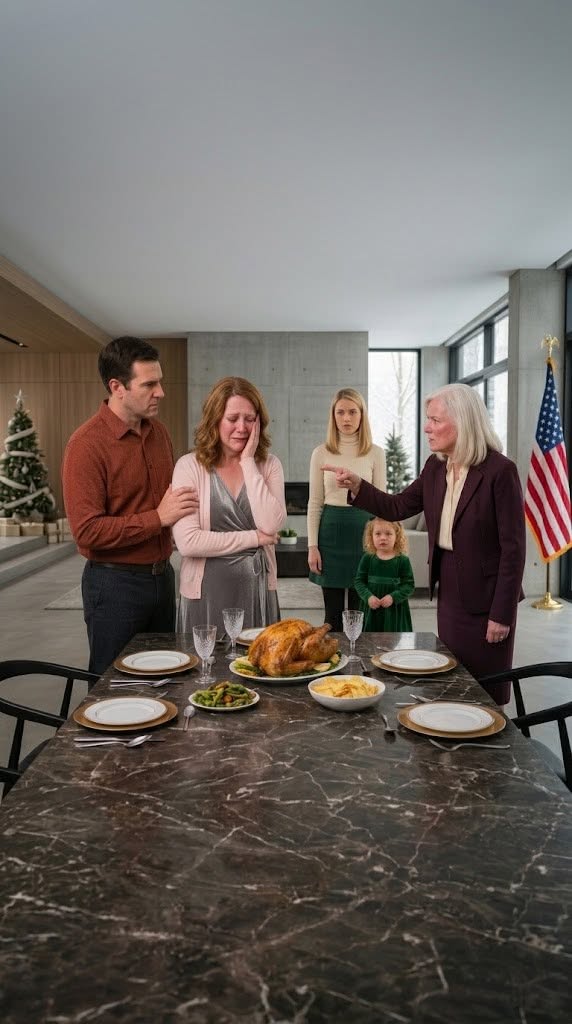
At Christmas dinner, my mother-in-law slapped me, called me “trash,” and pointed at my three-year-old daughter.
“Take her and get out of my house!”
My husband didn’t yell.
He didn’t argue.
Ethan simply picked up our little girl, took my hand, and said, “We’re done here.”
Two hours later, his father called.
And with one sentence, he destroyed the Christmas my mother-in-law thought she still controlled.
Christmas dinner at my in-laws’ house outside Columbus had barely reached dessert when my sister-in-law started attacking my three-year-old daughter.
My name is Claire, and my daughter Mia had accidentally spilled a little milk earlier that evening.
It was harmless.
A few drops on the white tablecloth.
I had immediately apologized, grabbed a napkin, and cleaned it up while Mia looked at me with huge guilty eyes.
“Sorry, Mommy.”
“It’s okay, sweetheart. Accidents happen.”
That should have been the end of it.
But Natalie, my husband’s older sister, apparently decided a three-year-old spilling milk was evidence that I had failed as a mother.
She spent the next twenty minutes making comments.
Some were quiet.
Some were aimed directly at me.
And some were designed so everyone at the table could hear.
“Children behave according to what they’re taught.”
A few minutes later, she added, “When we were little, Mom never allowed us to act like that at Christmas dinner.”
Mia had stopped eating by then.
She sat beside me with her tiny hands folded in her lap.
Ethan noticed.
I could tell because the muscles in his jaw tightened.
Then Natalie leaned back in her chair and smiled.
“Maybe some people shouldn’t give parenting advice when they can’t even control their own child.”
I set my fork down.
“She’s three, Natalie.”
Natalie lifted one shoulder.
“So?”
“So you’ve been making comments about her all night.”
“I’m making observations.”
“No. You’re picking on a toddler.”
My father-in-law, Robert, stared down at his plate.
He had always been the quiet one in that family.
Not cruel.
Not particularly warm either.
Just tired.
For years I had wondered whether he stayed silent because he agreed with Diane or because he had learned that arguing with her was pointless.
Natalie gave me a smug look and turned toward Ethan.
“I’m just saying you could have done better.”
There it was.
The sentence she had been building toward all evening.
Ethan slowly pushed his chair back.
“That’s enough.”
But before he could stand, Diane rose from her chair.
My mother-in-law had disliked me from the first week Ethan introduced us.
I had never been wealthy enough.
Never polished enough.
Never impressed enough by her.
When Ethan and I got engaged, she told him I had “trapped” him because I worked as a public-school speech therapist instead of coming from a family with money.
When we bought our first house, she criticized the neighborhood.
When Mia was born, she questioned everything I did.
Breastfeeding.
Sleep schedules.
Day care.
Pediatricians.
Car seats.
Food.
Clothing.
She once criticized me for dressing Mia in yellow because she thought “girls should look like girls.”
I had tolerated it because Ethan loved his family.
Or maybe because I kept hoping that one day, if I was patient enough, Diane would stop treating me like an outsider.
She never did.
That Christmas night, she walked around the table until she stood beside me.
“You have no respect for this family.”
I looked up at her.
“I’m defending my daughter.”
“You’re always defensive.”
“Natalie has been criticizing a three-year-old for twenty minutes.”
“She’s telling the truth.”
Then Diane struck me.
The first slap happened so fast I didn’t process it.
My head snapped sideways.
The second hit landed across the same cheek.
Someone gasped.
The third one made my chair scrape backward across the floor.
The dining room went completely silent.
Mia stared at me.
Her mouth fell open.
Then she began crying.
“Mommy!”
Ethan shot out of his chair so violently it toppled behind him.
“Mom!”
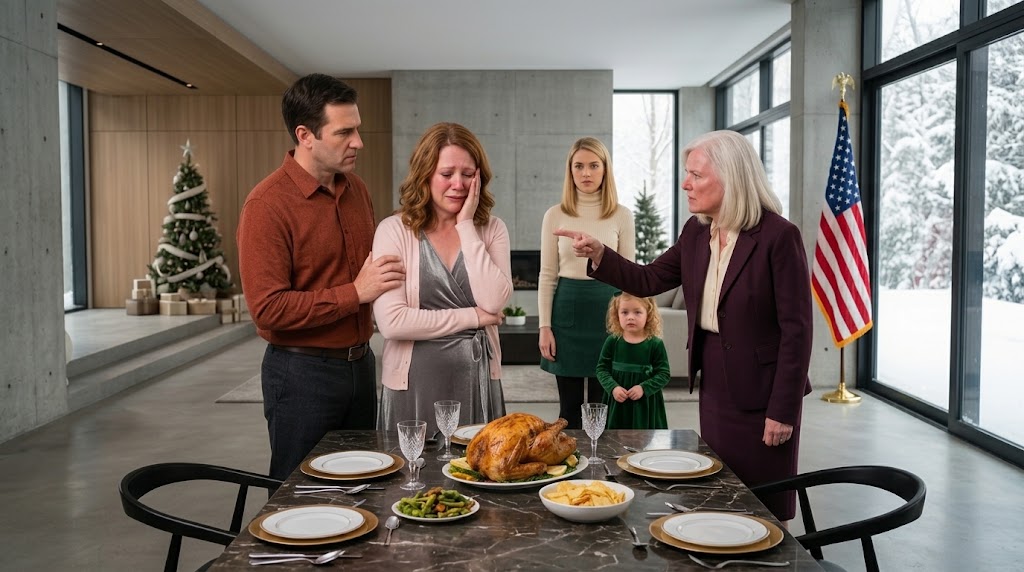
Diane pointed at me.
“You’re trash.”
Ethan stepped between us.
But Diane wasn’t finished.
“My son deserves better than you.”
Then she pointed at Mia.
“At both of you.”
Her face twisted with anger.
“Take her and get out of my house.”
I wish I could tell you I immediately said something clever.
I didn’t.
I sat frozen.
My cheek burned.
My ears rang.
And I could only look at my little girl.
She was crying so hard she could barely breathe.
Ethan knelt beside her first.
“Come here, bug.”
He lifted her into his arms.
Then he came to me.
His voice was low.
Controlled.
“Claire.”
I looked at him.
He held out his hand.
“Let’s go.”
Natalie stood.
“Oh, come on. Mom lost her temper. Nobody needs to make this dramatic.”
Ethan turned toward his sister.
His expression changed in a way I had never seen before.
“I just watched my mother hit my wife while my daughter stood there.”
Natalie opened her mouth.
“There’s nothing left to discuss.”
He picked up our coats.
Diane followed us toward the hallway.
“You walk out that door, Ethan, don’t expect me to chase you.”
He didn’t even turn around.
“Good.”
That one word made her stop.
He helped me into my coat.
Wrapped Mia in hers.
Then opened the front door.
Snow was beginning to fall.
The Christmas lights along the porch roof blinked red and white above us.
Behind us, Diane shouted something about disrespect.
Ethan closed the door before she finished.
During the forty-minute drive home, Mia kept asking the same question.
“Why did Grandma hit Mommy?”
Every time she asked, Ethan’s hands tightened around the steering wheel.
Finally, I reached back and touched her knee.
“Grandma made a bad choice, sweetheart.”
“Was Mommy bad?”
My heart broke.
“No.”
“Was Mia bad?”
“No, baby. Absolutely not.”
She sniffled.
“I spilled milk.”
“That doesn’t make you bad.”
Ethan’s voice cracked.
“You didn’t do anything wrong, Mia.”
The rest of the ride was quiet.
When we got home, Ethan carried her inside.
We changed her into Christmas pajamas.
I sat beside her bed while she hugged her stuffed rabbit.
She normally begged for three stories.
That night she wanted none.
“Can Daddy stay?”
“He can stay.”
Ethan sat on the edge of her mattress.
Mia reached one tiny hand out.
He took it.
Within twenty minutes, she fell asleep.
We left her door cracked open.
In the kitchen, Ethan wrapped ice in a dish towel and pressed it gently against my cheek.
“I should have stopped this years ago.”
I looked at him.
“Stopped what?”
He stared at the floor.
“Supporting them.”
I frowned.
“What are you talking about?”
He looked almost ashamed.
“For six years, I’ve been helping Mom and Dad financially.”
I knew he occasionally paid for things.
His father’s medical bills.
Repairs.
Maybe property taxes.
But his expression told me it was more.
“How much?”
“About twenty-five hundred a month.”
I lowered the ice pack.
“What?”
“Sometimes more.”
“Every month?”
He nodded.
“For six years?”
“Yes.”
I stared at him.
That was nearly two hundred thousand dollars.
Maybe more.
Ethan rubbed both hands over his face.
“Dad’s retirement took a hit. Mom never adjusted her spending. Natalie kept having emergencies. Car repairs. Credit cards. Rent. Legal fees after that business she tried failed.”
“You paid for Natalie too?”
“Through Mom.”
I couldn’t believe what I was hearing.
Ethan and I were comfortable.
He worked in commercial real estate.
I had gone part-time after Mia was born.
We had savings.
But we weren’t living some billionaire fantasy.
We budgeted.
We postponed vacations.
We refinanced once.
I bought clothes on sale.
And all that time, Ethan had been quietly transferring thousands of dollars every month to the same people who treated me like I was beneath them.
“Why didn’t you tell me?”
“Because it started before we were married.”
“That doesn’t explain six years.”
“I know.”
He swallowed.
“And because every time I tried to reduce it, Mom made it sound like Dad would lose everything.”
I looked toward the hallway.
“So what happens now?”
Ethan picked up his phone.
“I stopped the transfers.”
“You already did?”
“In the car.”
He gave a humorless laugh.
“I canceled every automatic payment at a red light.”
For the first time that night, I almost smiled.
Then his phone rang.
His father’s name appeared on the screen.
Robert.
Ethan looked at me.
I nodded.
He answered.
“Dad.”
Robert’s voice was low.
“Your mother just found out.”
Ethan leaned against the counter.
“Found out what?”
“That you canceled everything.”
“I did.”
A pause.
Then Robert said something that changed the entire situation.
“Then I guess she’ll finally have to face the fact that the house isn’t hers.”
Ethan straightened.
“What?”
“The house.”
Robert sounded exhausted.
“It belongs to you.”
Neither of us spoke.
Ethan finally said, “Dad, what are you talking about?”
“I transferred it to you four years ago.”
“Why?”
“Because of my surgery.”
Robert had undergone emergency heart surgery four years earlier.
Ethan had handled some paperwork then, but apparently not all of it.
Robert continued.
“My attorney recommended restructuring several assets. Your mother signed the documents. You signed too.”
“I signed a trust packet.”
“Yes.”
Ethan’s face changed.
“The house was in that?”
“Yes.”
I stared at him.
Diane had thrown us out of a house Ethan legally owned.
Robert sighed.
“Your mother has known since the day it happened.”
“Then why does she keep calling it her house?”
“You know your mother.”
Ethan’s voice hardened.
“No, Dad. I don’t think I do.”
We heard shouting in the background.
Diane.
Even through the phone, I recognized her voice.
Then Robert said quietly, “There’s more.”
“What?”
“She borrowed money.”
Ethan closed his eyes.
“How much?”
“I don’t know exactly.”
“What do you mean you don’t know?”
“She handled it.”
“Against the house?”
“No. She couldn’t. Not without you.”
“Then what?”
“Personal loans. Credit cards. Natalie’s business debts.”
The shouting grew louder.
Robert lowered his voice.
“She assumed you would keep paying.”
Ethan stared at the kitchen wall.
“Paying what?”
“Everything.”
Then the phone changed hands.
Diane’s voice exploded through the speaker.
“Ethan!”
He didn’t answer immediately.
“You cannot do this to your own mother!”
“I can.”
“You are being manipulated.”
I nearly laughed.
Of course.
Somehow this was already my fault.
Diane continued.
“That woman has poisoned you against your family.”
Ethan’s eyes met mine.
Then he looked toward Mia’s room.
“No.”
His voice was calm.
“You slapped my wife three times.”
“She provoked me.”
“She defended our daughter.”
“That child has no discipline.”
Ethan’s face went cold.
“Do not talk about my daughter like that.”
“You always take their side.”
“They are my family.”
Silence.
Not long.
Maybe two seconds.
But it was enough.
Diane understood exactly what he meant.
Then she changed tactics.
“What about your father?”
“What about him?”
“He has medical needs.”
“I’ll pay Dad’s legitimate medical bills directly.”
“And the house?”
“What about it?”
“You can’t stop paying the expenses.”
“I can.”
“You wouldn’t.”
“You told the legal owner to get out tonight.”
I watched the words hit her.
Even over the phone, the silence felt enormous.
Then Diane spoke more quietly.
“This is still my home.”
“No, Mom.”
“You wouldn’t throw your parents out at Christmas.”
Ethan shook his head even though she couldn’t see him.
“I’m not throwing anyone out tonight.”
Her breath relaxed slightly.
Then he continued.
“But from now on, you’re responsible for your own utilities, groceries, personal debts, credit cards, and spending.”
“What?”
“I’ll cover property taxes while Dad lives there. Necessary maintenance too. Nothing else.”
“You can’t expect us to suddenly—”
“I’ve been sending you thirty thousand dollars a year.”
“That money helped the whole family.”
“It helped Natalie buy a forty-thousand-dollar SUV.”
I looked at him.
Apparently that detail was new to me too.
Diane sputtered.
“She needed reliable transportation.”
“She doesn’t have a job.”
“She’s between opportunities.”
“She’s thirty-seven.”
“That has nothing to do with you.”
“It had everything to do with me when I was paying the loan.”
Diane started crying.
Not quiet tears.
The dramatic kind.
The kind that demanded an audience.
After years around her, I recognized it instantly.
“How can you do this to me?”
Ethan’s voice stayed flat.
“You hit Claire.”
“I said I was angry.”
“You hit her.”
“I lost control.”
“And now you’re losing access to my money.”
That ended the call.
Diane hung up.
I stared at Ethan.
He put his phone down.
Neither of us spoke for nearly a minute.
Finally, I said, “Are you sure?”
“About what?”
“All of it.”
“Yes.”
“I don’t want you making permanent decisions because you’re angry.”
He looked at me.
“Claire, I’m not doing this because I’m angry.”
He glanced down the hallway.
“I’m doing it because Mia asked if she was bad.”
That sentence stayed with me.
The next morning was Christmas Day.
Mia woke before seven and ran into our bedroom yelling that Santa had come.
For a few hours, we pretended the world was normal.
We opened presents.
Ate cinnamon rolls.
Watched Mia shriek over a toy kitchen she had asked for since October.
Ethan built half of it backward.
I teased him.
He blamed the instructions.
Mia wore the cardboard box as a hat.
It should have been peaceful.
Then the messages started.
Natalie first.
You happy now?
Then another.
Dad is stressed because of YOU.
Then:
Mom hasn’t slept.
Then:
You’re tearing this family apart over one argument.
I didn’t respond.
Ten minutes later, she messaged Ethan.
He showed me.
Tell your wife to stop pretending she’s innocent.
He typed something.
I touched his arm.
“What are you saying?”
“Nothing.”
He deleted it.
Then blocked her.
At ten thirty, Robert called again.
This time, he asked if he could come over.
Alone.
Ethan hesitated.
Then agreed.
Robert arrived after lunch carrying a brown leather folder.
He looked twenty years older than he had the night before.
Mia ran toward him.
“Grandpa!”
He hugged her tightly.
“Hey, sweetheart.”
Then she pulled away.
“Grandma hit Mommy.”
Robert closed his eyes.
“Yes.”
“Why?”
“I don’t know.”
“She was bad.”
Robert looked at me.
“Yes.”
His voice broke.
“She was.”
Mia seemed satisfied with that answer.
She ran back to her new toys.
Robert sat with us at the kitchen table.
He placed the leather folder in front of Ethan.
Inside were property records.
Trust documents.
Bank statements.
Loan notices.
And a stack of letters.
Ethan read quietly for several minutes.
Then he looked up.
“Dad.”
Robert rubbed his forehead.
“I know.”
“There’s seventy-eight thousand dollars in unsecured debt.”
“I know.”
“In Mom’s name.”
“Yes.”
“And Natalie’s.”
“Yes.”
“What is this?”
Ethan pulled out a document.
Robert sighed.
“Renovation estimate.”
“For ninety-four thousand dollars?”
“Your mother wanted to redo the kitchen and add a downstairs suite.”
“With what money?”
Robert didn’t answer.
Ethan stared at him.
“With what money, Dad?”
“She thought you would finance it.”
I couldn’t believe it.
“She planned a hundred-thousand-dollar renovation without asking Ethan?”
Robert nodded.
“And Natalie was going to move in.”
I leaned back.
“What?”
“She and her boyfriend broke up.”
Ethan laughed once.
Not because it was funny.
Because sometimes disbelief has nowhere else to go.
“So Mom wanted me to pay for Natalie to move into my house.”
Robert looked embarrassed.
“That was the plan.”
“Whose plan?”
“Your mother’s.”
Ethan pushed the papers away.
“Did you agree?”
Robert looked toward the living room where Mia was playing.
“No.”
“Did you stop her?”
Another silence.
“No.”
And there it was.
The truth about Robert.
He had spent years telling himself he wasn’t part of the problem because he wasn’t the one saying cruel things.
But silence had protected Diane.
Again and again.
Robert folded his hands.
“I should have.”
Ethan looked at him.
“Yes.”
“I kept thinking if I stayed quiet, things would settle.”
“They never did.”
“I know.”
“You watched Mom disrespect Claire for years.”
“I know.”
“You watched Natalie do it too.”
“I know.”
“And last night?”
Robert’s eyes dropped.
“I froze.”
“You watched Mom hit my wife.”
Robert’s voice was barely audible.
“Yes.”
I had expected excuses.
Instead, he looked at me.
“Claire, I’m sorry.”
I said nothing.
“I should have stood up.”
“Yes,” I said.
He nodded.
“I know.”
That mattered more than some elaborate apology.
Not enough to erase anything.
But enough for me to believe he understood.
Then Robert reached into the folder.
“There’s one more thing.”
He handed Ethan a printed email.
It was from Diane to an attorney.
Dated three weeks earlier.
The subject line read:
Transfer of Property Control.
Ethan read it twice.
“What is this?”
Robert took a slow breath.
“Your mother wanted to know if there was any way to reverse the transfer of the house without your approval.”
My stomach tightened.
Ethan kept reading.
The email was blunt.
Diane described Ethan as “emotionally influenced by his spouse” and suggested that he might not be “capable of protecting family assets.”
She wanted to know whether Robert could claim he had been mentally impaired when the house was transferred.
Ethan’s face went pale.
“She wanted Dad to claim incompetence?”
Robert nodded.
“To take the house back?”
“Yes.”
“Why?”
“Because she was worried.”
“About what?”
Robert looked at me.
Then back at his son.
“That Claire would convince you to sell it.”
I almost laughed.
I had never once suggested selling their home.
I didn’t even know Ethan owned it.
Robert continued.
“Your mother has convinced herself for years that Claire is waiting to take something from this family.”
“But there was nothing to take,” Ethan said.
Robert gave a sad smile.
“Exactly.”
The irony was almost painful.
Diane had spent six years calling me a gold digger while secretly depending on my husband for her lifestyle.
She accused me of wanting family money while consuming tens of thousands of dollars of ours every year.
She called me trash inside a house her son owned.
And she had apparently been consulting lawyers to take that house away from him.
Ethan stood.
“I need some air.”
He walked into the backyard.
Snow covered the grass.
I joined him a minute later.
He stood near the fence without a coat.
“You’re going to freeze.”
“I don’t care.”
I slipped his coat over his shoulders anyway.
He looked at me.
“I’m sorry.”
“Stop apologizing.”
“I brought you into this.”
“You married me. You didn’t cause her behavior.”
“I kept thinking she’d change.”
“So did I.”
“I thought if I helped them financially, maybe she’d stop feeling insecure.”
“Insecure?”
“Money was always her fear.”
He looked back through the kitchen window.
“Growing up, everything was about appearances. Perfect house. Perfect Christmas. Perfect family.”
“And underneath?”
He laughed bitterly.
“Debt.”
That explained more than I expected.
“Dad made decent money. But Mom spent more. Cars. Clothes. Furniture. Trips. She wanted everyone to think we were wealthy.”
“And you kept rescuing them.”
“Yeah.”
“Why?”
He was quiet for a moment.
“Because when I was sixteen, Dad almost lost the house.”
I looked at him.
“I didn’t know that.”
“No one does.”
He shoved his hands into his coat pockets.
“Mom made me promise I’d never let that happen again.”
“You were sixteen.”
“I know.”
“You were a child.”
“I know.”
But I could see that some promises follow people long after they stop making sense.
That afternoon, Ethan made two phone calls.
The first was to the attorney whose name appeared on the property documents.
The second was to our accountant.
By evening, he had confirmed everything.
The house belonged legally to him through a trust structure created after Robert’s surgery.
Diane had no authority to sell it, borrow against it, or transfer it.
Robert had a lifetime right to live there.
Diane’s right to remain depended on Robert continuing to use the property as his primary residence.
Which meant Ethan couldn’t simply throw his mother out.
Not that he wanted to.
But he could stop financing her lifestyle.
So he did.
He canceled the credit card he had added Diane to years earlier.
Changed access permissions on one family account.
Removed himself as guarantor from Natalie’s car insurance at the next renewal.
Set up direct payment for Robert’s prescriptions and necessary medical costs.
Then he sent one email.
It contained no insults.
No threats.
No drama.
Mom,
After what happened on Christmas Eve, Claire and Mia will not be around you for the foreseeable future.
I will not debate this.
I am ending all financial support unrelated to Dad’s health and the basic maintenance of the property.
I will continue paying property taxes and necessary repairs because I own the house and because Dad has the right to remain there.
All other expenses are your responsibility.
Do not contact Claire.
Do not contact Mia.
If you need to communicate about Dad or the property, email me.
Ethan.
He pressed send.
Then we waited.
The first response arrived eleven minutes later.
You ungrateful son.
The second:
After EVERYTHING I did for you.
The third:
She finally got what she wanted.
The fourth:
You will regret choosing that woman over your mother.
Ethan never answered.
For three days, nothing happened.
Then Natalie showed up at our house.
I saw her through the front window.
She was pounding on the door.
Ethan came downstairs.
“Don’t open it.”
“I’m not going to.”
She rang the bell again.
Then shouted.
“I know you’re home!”
Mia was upstairs napping.
Ethan opened the security app on his phone and spoke through the doorbell camera.
“Leave.”
Natalie stared into the lens.
“You need to fix this.”
“There’s nothing to fix.”
“Mom’s freaking out.”
“That’s not my problem.”
“The electric bill is due.”
“She can pay it.”
“With what?”
“Her money.”
Natalie laughed angrily.
“She doesn’t have that kind of money.”
“Then she needs a budget.”
“You make three times what she gets from Dad’s retirement.”
“And?”
“She’s your mother.”
“She assaulted my wife.”
“Claire isn’t dying.”
I felt my stomach turn.
Ethan’s face changed.
“Leave my property.”
Natalie rolled her eyes.
“Oh my God. Listen to yourself.”
“I’m serious.”
“She barely touched her.”
Three slaps had become barely touched.
“Leave.”
“You’re doing this because Claire hates us.”
“No.”
Ethan’s voice sharpened.
“I’m doing this because you apparently believe hitting my wife is acceptable.”
Natalie looked directly into the camera.
“Claire, I know you’re listening. Congratulations. You won.”
I walked toward the door.
Ethan looked at me.
I shook my head.
Then I pressed the microphone button.
“Natalie.”
She froze.
“This was never a competition.”
She opened her mouth.
I continued.
“I never wanted your mother’s house, money, approval, or family position. I wanted basic respect.”
She scoffed.
“You always thought you were better than us.”
“No.”
I looked at Ethan.
“But I do think my daughter deserves better than what happened on Christmas.”
Natalie’s face hardened.
“You’re keeping Mom from Mia.”
“Your mother terrified her.”
“She made a mistake.”
“And mistakes have consequences.”
Natalie stared at the camera another second.
Then she walked away.
The next week brought a new problem.
Diane called the police.
Not on us.
On Ethan.
She reported that her son was “financially abusing elderly parents.”
Two officers came to our house.
Ethan let them in.
I sat at the kitchen table while he showed them everything.
Property documents.
Bank records.
Monthly transfers.
Medical payments.
The email sent after Christmas.
One officer looked genuinely confused.
“So you’ve been giving them around twenty-five hundred dollars a month voluntarily?”
“Yes.”
“And now you stopped?”
“Yes.”
“But you’re still paying your father’s medical bills?”
“Yes.”
“And property taxes?”
“Yes.”
“And they live in a house you own?”
“Yes.”
The officer looked at his partner.
Then back at Ethan.
“This doesn’t appear to be financial abuse.”
“That’s what I assumed.”
The officer closed his notebook.
“Your mother seems upset that the financial support changed.”
“She is.”
“Then this is a family dispute.”
“Yes.”
They left twenty minutes later.
Diane’s next move was more embarrassing.
She posted on Facebook.
She wrote a long message about ungrateful children abandoning elderly parents at Christmas.
She never mentioned the slapping.
Never mentioned the house belonged to Ethan.
Never mentioned the six years of financial support.
Instead, she wrote that “outside influences can destroy even the strongest mother-son bond.”
Everyone knew who the outside influence was.
Me.
I found out because my cousin sent me a screenshot.
“Do you want me to respond?” she asked.
“No.”
And I meant it.
For years, I had wasted energy explaining myself to people committed to misunderstanding me.
I was done.
Ethan didn’t respond either.
Robert did.
That surprised everyone.
Under Diane’s post, he wrote one comment.
Diane hit Claire three times in front of Mia. Ethan has supported this household financially for years. Please stop lying about what happened.
Then he turned off his phone.
Within an hour, Diane deleted the post.
Robert called Ethan that evening.
“Your mother is furious with me.”
“I can imagine.”
“She says I embarrassed her.”
“You told the truth.”
“I should have done it years ago.”
Ethan sat quietly.
Then he said, “Yes.”
Robert didn’t argue.
January arrived.
Reality arrived with it.
Diane canceled the kitchen renovation.
Natalie returned the SUV she couldn’t afford.
The weekly restaurant dinners stopped.
The expensive club membership disappeared.
Two streaming services apparently became casualties too, according to Natalie, who somehow blamed us for that.
But the biggest change wasn’t financial.
It was Robert.
He began making decisions.
Small ones at first.
He opened his own bank account.
Moved his retirement deposits.
Started paying household expenses directly.
Asked Ethan to help create a budget.
For the first time in decades, Diane could no longer spend money and expect someone else to rescue her.
She hated it.
One afternoon in February, Robert came to our house alone.
He brought Mia a puzzle.
She hugged him.
Then asked, “Is Grandma still mad?”
Robert looked at me before answering.
“Grandma has a lot to think about.”
Mia nodded as if that made perfect sense.
Children understand more than adults think.
After she went upstairs, Robert sat at the kitchen table.
“I’m considering separation.”
Ethan nearly dropped his coffee.
“What?”
Robert stared at his hands.
“I don’t know if I’ll do it.”
“Dad…”
“I’ve spent forty-one years avoiding conflict.”
His voice trembled.
“I called that loyalty.”
He looked at me.
“But maybe it was cowardice.”
I didn’t know what to say.
Robert continued.
“Christmas scared me.”
“Because Mom hit Claire?” Ethan asked.
“Because I watched it happen and my first instinct was to hope everyone would calm down.”
He shook his head.
“That’s what I’ve done my whole marriage.”
He took a breath.
“Your mother yells. I wait.”
“She spends. I fix it.”
“She insults someone. I apologize privately.”
“She hurts people. I explain that she’s stressed.”
He looked toward the stairs.
“And now my granddaughter saw me do nothing.”
The room was silent.
“I don’t want Mia growing up thinking men protect peace by ignoring cruelty.”
That sentence landed hard.
Ethan reached across the table.
Robert took his hand.
A week later, Diane called me.
Not Ethan.
Me.
I almost didn’t answer.
Then curiosity won.
“Hello?”
Her voice was stiff.
“Claire.”
“Diane.”
“We need to talk.”
“No, we don’t.”
She paused.
“I want to see Mia.”
“No.”
“She’s my granddaughter.”
“Yes.”
“You can’t keep her from me forever.”
“I can keep her away from people who scare her.”
“I made one mistake.”
“You slapped me three times.”
“I apologized.”
“No, you didn’t.”
Another silence.
Then she sighed impatiently.
“Fine.”
Her tone changed.
“I’m sorry.”
It was the least sincere apology I had ever heard.
I said nothing.
“Are you happy?”
“About what?”
“You got everything.”
I almost laughed.
“What exactly did I get?”
“My son.”
“He’s my husband.”
“My husband is talking about leaving.”
“That has nothing to do with me.”
“My daughter can’t afford her apartment.”
“That has nothing to do with me.”
“My whole family has fallen apart.”
I gripped the phone tighter.
“No, Diane.”
My voice stayed calm.
“Your family stopped protecting you from consequences.”
She inhaled sharply.
“You think you’re so perfect.”
“I don’t.”
“You’ve always judged me.”
“I spent years trying to make you like me.”
“You turned Ethan against us.”
“No.”
I heard my own voice becoming stronger.
“You did that when you slapped his wife in front of his child.”
She started speaking.
I cut her off.
“And if you ever want a relationship with Mia again, you need to understand something.”
“What?”
“You will never insult me in front of her.”
Silence.
“You will never criticize her.”
More silence.
“You will never tell her that what happened was my fault.”
Diane whispered, “So there are conditions.”
“Yes.”
“I’m her grandmother.”
“Then act like one.”
She hung up.
I assumed that would be the end of it.
It wasn’t.
Three weeks later, an envelope arrived.
Handwritten.
No return address.
Inside was a letter from Diane.
I almost threw it away.
Instead, I read it.
Claire,
I have spent most of my life believing respect meant being obeyed.
When Ethan was little, I told myself that controlling everything made me a good mother.
When he grew up, I treated his independence as rejection.
When he married you, I blamed you because it was easier than accepting that my son had built a life that did not revolve around me.
That does not excuse what I did.
I hit you.
I frightened Mia.
I humiliated Ethan.
I am ashamed.
Robert has moved into the guest bedroom.
Natalie barely speaks to me.
For weeks, I told myself everyone was punishing me.
My counselor asked me a question I hated.
She asked, “What if they are simply refusing to protect you from the results of your own behavior?”
I thought of what you said.
You said almost the same thing.
I am not asking you to forgive me.
I am asking permission to keep working until maybe someday you can believe I mean this apology.
I am sorry.
Diane.
I read it twice.
Then gave it to Ethan.
He read it slowly.
“What do you think?”
“I don’t know.”
Neither did I.
Apologies are easy when consequences become uncomfortable.
Change is harder.
So we did nothing.
Not cruelly.
Not dramatically.
We simply waited.
Diane began therapy.
Robert confirmed it.
She sold jewelry she rarely wore and paid down part of her debt.
She took a part-time administrative job at a local medical office.
Natalie moved into a small apartment she could afford.
For the first time in years, both women were living within their own means.
Spring came.
Then summer.
We did not see Diane.
She sent Mia a birthday card in June.
No guilt.
No request to visit.
Just:
Happy fourth birthday, Mia. I hope you have a beautiful day. Love, Grandma Diane.
I put it on the kitchen counter.
Mia saw it.
“Grandma sent me this?”
“Yes.”
“Is she nice now?”
Children always ask the hardest questions in the simplest way.
“I think she’s trying to make better choices.”
Mia thought about that.
“Like when I say sorry?”
“Yes.”
“But saying sorry doesn’t fix everything.”
I stared at her.
Apparently preschool was doing excellent work.
“No.”
I smiled.
“It doesn’t.”
“You have to do better too.”
“Exactly.”
She carried the card to her room.
In September, Robert moved into an apartment.
Not because Ethan asked him to leave.
Because he wanted to.
He and Diane had decided on a legal separation.
They didn’t divorce.
At least not immediately.
Robert told Ethan he needed space to understand who he was without spending every day managing someone else’s emotions.
Diane remained in the house temporarily under an agreement with Ethan.
She paid utilities.
She paid insurance.
She paid a modest amount toward maintenance.
For the first time, she treated the property like someone else’s asset instead of her kingdom.
Then October came.
Almost ten months after Christmas, Ethan asked me a question.
“Would you ever consider seeing her?”
I knew who he meant.
“Do you want to?”
“I don’t know.”
He sat beside me on the couch.
“She hasn’t pressured me once since March.”
“I know.”
“Dad says therapy is helping.”
“I know.”
“Natalie says Mom apologized to her too.”
That surprised me.
“For what?”
“Basically using money to control her.”
I thought about that.
Diane had enabled Natalie for years.
But enabling someone is another form of control.
If Natalie always needed rescue, Diane always remained necessary.
“Do you want Mia to see her?”
“I want Mia to have grandparents.”
“That’s not the same thing.”
“I know.”
I studied his face.
He wasn’t asking me to forgive his mother.
He wasn’t defending her.
He was asking whether change deserved a door cracked open.
Maybe it did.
So we set rules.
Public place.
One hour.
No physical affection unless Mia initiated it.
No discussion of Christmas.
No guilt.
No comments about parenting.
No pretending nothing happened.
Diane agreed to everything.
We met at a park.
I recognized her immediately, but she looked different.
Not physically.
Something in her posture had changed.
She wasn’t dressed like she was hosting a charity luncheon.
No designer handbag.
No perfect coat.
Just jeans, boots, and a navy sweater.
She stood near a bench holding a small paper bag.
Mia stayed close to Ethan.
Diane didn’t rush toward her.
That mattered.
“Hi, Mia.”
Mia looked up at her father.
Then at me.
Then at Diane.
“Hi.”
Diane swallowed.
“I brought some sidewalk chalk. Your dad said you like drawing outside.”
Mia looked interested.
“Purple?”
“Yes.”
“Pink?”
“Yes.”
“Blue?”
“Two blues.”
That won her over slightly.
For the next forty minutes, they drew flowers, houses, and an enormous purple cat on the sidewalk.
Diane never touched Mia without permission.
Never mentioned Christmas.
Never criticized.
Never tried to corner Ethan.
At the end, Mia walked back toward us.
“Grandma draws bad cats.”
Ethan laughed.
Diane did too.
Then Mia turned around.
“Bye, Grandma.”
Diane’s eyes filled with tears.
“Bye, sweetheart.”
She didn’t ask for a hug.
Mia ran back anyway.
She wrapped her arms around Diane’s waist for two seconds.
Then returned to us.
Diane looked at me.
I could see how much she wanted to say something.
She didn’t.
She simply nodded.
I nodded back.
It wasn’t forgiveness.
But it was something.
Thanksgiving passed quietly.
We had dinner at our house with Robert.
Diane had dinner with Natalie.
No one complained.
No one demanded a united family photo.
No one weaponized the holiday.
Then Christmas approached.
The anniversary hung over all of us.
One year since the slaps.
One year since the drive home.
One year since Mia asked if she was bad.
Two weeks before Christmas, Diane emailed Ethan.
The message was short.
I understand if the answer is no.
Would you, Claire, and Mia be willing to have Christmas lunch with me at a restaurant?
No house.
No expectations.
One hour.
If not, I understand.
Ethan handed me his phone.
“What do you think?”
I stared at the message.
A year earlier, Diane would have written paragraphs about family obligation.
Now she asked once.
Without pressure.
So I surprised myself.
“Okay.”
Christmas morning, we opened presents at home.
Just the three of us.
Then around noon, we drove to a small restaurant near downtown Columbus.
Diane was already there.
So was Robert.
They arrived separately.
Natalie came too.
That made me nervous.
But Natalie walked straight toward me.
“Can I say something?”
I glanced at Ethan.
Then nodded.
She looked embarrassed.
“I was awful last Christmas.”
“Yes.”
“I kept criticizing Mia because I was jealous.”
I blinked.
“Jealous of a three-year-old?”
“Not of her.”
Natalie stared at the floor.
“Of Ethan.”
“What?”
“He had a family.”
She swallowed.
“I was thirty-seven, unemployed, living off Mom, pretending I was happy.”
She looked at me.
“And you were easy to attack because Mom already blamed you for everything.”
I didn’t know what to say.
Natalie continued.
“I’m sorry.”
This time, I believed her.
Not because the apology was perfect.
Because she didn’t ask for anything afterward.
She went to her seat.
Lunch began.
No one mentioned last Christmas.
Not directly.
We talked about Mia’s preschool.
Robert’s new apartment.
Natalie’s new job at an insurance company.
Diane’s work at the medical office.
Halfway through dessert, Mia knocked over her water.
The glass tipped.
Water spread across the white tablecloth.
Every adult froze.
For one strange second, time folded in on itself.
Mia looked terrified.
She looked at Diane.
Then at me.
Diane reached for a napkin.
She placed it over the water.
Then smiled gently.
“Accidents happen.”
I stopped breathing.
Mia stared at her.
Then smiled.
“Mommy says that too.”
“I know.”
Diane handed her another napkin.
“Want to help me clean it?”
“Okay.”
Together, they wiped the table.
No criticism.
No lecture.
No shame.
When it was finished, Mia returned to her ice cream as if nothing important had happened.
But Ethan reached under the table and squeezed my hand.
I looked at him.
His eyes were wet.
Mine were too.
After lunch, we stood outside beneath gray winter skies.
Diane approached me.
“Claire.”
“Yes?”
“I know today doesn’t erase anything.”
“No.”
“I know.”
She looked toward Mia, who was showing Robert something she had found on the sidewalk.
“A year ago, I thought losing control meant losing my family.”
She paused.
“I didn’t understand that controlling them was how I was losing them.”
I said nothing.
She continued.
“Thank you for allowing today.”
“You earned today.”
Her eyes filled again.
That mattered too.
Not because I wanted her gratitude.
But because for once, she understood the difference.
Forgiveness was not something she could demand.
Access was not something she was owed.
Trust was something she had to rebuild.
Slowly.
After that Christmas, things never returned to normal.
And I’m glad.
Because our old normal had been terrible.
The new version was smaller.
More careful.
More honest.
Robert and Diane remained separated for another year.
Eventually, they started having dinner together twice a month.
Whether they would fully reconcile became their decision.
Natalie kept her job.
Paid off debt.
Started dating someone who had never met the version of her that depended on Ethan’s money.
She became surprisingly good with Mia.
Diane stayed in therapy.
She never again commented on my clothes.
Never criticized my parenting.
Never called without asking first.
And she never, ever referred to Ethan’s house as hers.
Two years after the Christmas dinner that changed everything, Ethan decided to sell the property.
Robert no longer lived there.
Diane had found a smaller townhouse near her job.
When Ethan told her, I expected some old piece of her to return.
The rage.
The entitlement.
The accusation.
Instead, she went quiet.
Then she said, “It’s your house.”
Three words.
That was all.
The sale closed in September.
Ethan used part of the money to fund Mia’s college account.
Part went into our retirement savings.
And part paid for something he had wanted to do for years.
He bought a small cabin near Hocking Hills.
Nothing enormous.
Nothing luxurious.
Two bedrooms.
A stone fireplace.
A porch overlooking trees.
The first Christmas we spent there, snow fell before breakfast.
Mia was six.
She ran outside in snow boots and pajamas while Ethan chased her with a coat.
I stood in the doorway holding coffee.
No shouting.
No insults.
No expectations.
Later that afternoon, Robert came.
Then Natalie.
And finally Diane.
She entered carrying a pie.
She looked around the cabin.
“This is beautiful.”
Ethan smiled.
“Thanks.”
She turned toward me.
“Where should I put this?”
“Kitchen counter.”
She carried it away.
That simple question almost made me laugh.
Years ago, Diane would have walked into any home and started rearranging things.
Now she asked.
At dinner, Mia told a ridiculous story about a boy at school who glued a paper snowman to his own sweater.
Everyone laughed.
Natalie spilled gravy.
Robert teased her.
Diane passed napkins.
No one called anyone careless.
After dessert, Mia came running from the living room.
“Grandma!”
Diane turned.
“Yes?”
“Come see my fort.”
Diane stood immediately.
“I’d love to.”
They disappeared around the corner.
I watched them go.
Ethan leaned beside me.
“You okay?”
“Yeah.”
He looked toward the doorway.
“Ever think we’d get here?”
“No.”
“Me neither.”
I rested my head against his shoulder.
For years, I thought keeping a family together meant swallowing insults.
Avoiding arguments.
Forgiving everything quickly.
Pretending hurt didn’t matter because holidays were supposed to be happy.
I was wrong.
Sometimes a family only has a chance to heal after someone finally refuses to pretend.
That Christmas Eve, when Diane slapped me and ordered us out, she believed she was showing me who had the power.
Instead, she accidentally forced Ethan to decide what kind of husband and father he wanted to be.
He chose us.
Not with screaming.
Not with revenge.
Not by destroying anyone.
He simply stopped financing disrespect.
Stopped excusing cruelty.
Stopped confusing guilt with obligation.
And the moment he did, everything changed.
Diane lost the control she had mistaken for love.
Natalie lost the safety net that had kept her dependent.
Robert lost the excuse that silence was the same as peace.
And I lost something too.
My need to earn acceptance from people who had already decided I wasn’t good enough.
What came after was better.
Not perfect.
Real.
A year after we bought the cabin, I found an old photograph tucked inside one of our Christmas storage boxes.
It had been taken the night everything happened.
Before dinner.
Before the milk spilled.
Before the slaps.
All of us stood in front of Diane’s enormous Christmas tree.
Robert beside her.
Natalie in red.
Ethan holding Mia.
Me beside him.
Everyone smiling.
The picture looked perfect.
That was the strangest part.
If someone had seen only that photograph, they would have thought we were a happy family.
I stared at it for a long time.
Then Mia came into the room.
“What’s that?”
“An old Christmas picture.”
She climbed beside me.
“I was little.”
“You were three.”
She pointed at herself.
“I had sparkly shoes.”
“You loved those shoes.”
Then she pointed at Diane.
“Grandma looks different.”
I looked closely.
She did.
Not physically.
Her smile was tight.
Possessive almost.
Like everyone in the picture belonged exactly where she had placed them.
Mia looked up at me.
“Was that the Christmas Grandma made a really bad choice?”
My throat tightened.
“Yes.”
She thought about that for a moment.
Then said, “She makes better choices now.”
I smiled.
“Most of the time.”
“Everybody makes bad choices sometimes.”
“That’s true.”
“But you have to fix them.”
I pulled her close.
“You’re pretty smart.”
“I know.”
She grabbed the photograph.
“Can I keep this?”
I was surprised.
“Why?”
“Because Grandpa looks funny.”
I laughed.
“Sure.”
She ran off with it.
And just like that, the photograph lost its power.
It wasn’t evidence of some perfect family we had failed to preserve.
It was simply an old picture.
A moment before everything changed.
That evening, Ethan and I sat on the cabin porch while snow drifted between the trees.
Mia was inside helping Diane decorate sugar cookies.
Robert and Natalie argued cheerfully over a card game.
Through the window, I could see Diane laughing when Mia covered an entire cookie in blue frosting.
I rubbed my hands together.
“Cold?”
Ethan asked.
“A little.”
He wrapped a blanket around my shoulders.
For a while, we just watched the snow.
Then he said, “I still think about that drive home.”
“So do I.”
“I remember thinking I’d failed you.”
“You didn’t.”
“I let it go too long.”
“Yes.”
He looked at me.
I smiled slightly.
“But you stopped it when it mattered.”
He nodded.
“I almost turned around.”
“What?”
“That night.”
I stared at him.
“You never told me that.”
“About halfway home.”
“Why?”
“Mom kept calling.”
I remembered his phone lighting up over and over.
“I thought maybe I should go back and make her apologize.”
“What stopped you?”
He looked through the window toward Mia.
“She asked if she was bad.”
My chest tightened.
“That was when I realized going back would teach her the wrong thing.”
“What thing?”
“That someone can hurt your mother, scare you, and still demand access to you because they’re family.”
He shook his head.
“I couldn’t teach her that.”
I took his hand.
“You didn’t.”
Inside, we heard Mia yelling.
“Daddy! Grandma made the ugliest cookie!”
Diane shouted back.
“It is artistic!”
Ethan laughed.
“Sounds serious.”
“Very.”
We went inside.
Diane was standing at the kitchen island holding a cookie that looked vaguely like a snowman suffering from some kind of frosting emergency.
Natalie was laughing so hard she had tears in her eyes.
Robert pointed at the cookie.
“That thing needs professional help.”
Diane looked offended.
“It has personality.”
Mia grabbed my hand.
“Mommy, make one!”
So I did.
Mine was worse.
And when a cup of sprinkles tipped over and scattered across the floor, everyone froze for half a second.
Then Mia burst out laughing.
I laughed too.
Natalie grabbed the broom.
Robert fetched the dustpan.
Diane crouched beside Mia.
“Well,” she said, “I suppose accidents happen.”
Mia grinned.
“Exactly.”
And somehow, that tiny mess felt like the final chapter of everything we had survived.
Not because the past disappeared.
It didn’t.
I still remembered the sting in my cheek.
Ethan still carried guilt for not drawing boundaries earlier.
Robert still struggled with confrontation.
Natalie still had moments when she slipped into old habits.
And Diane would probably spend the rest of her life learning how to love without controlling.
But none of us pretended anymore.
That was the difference.
We had stopped protecting appearances.
Stopped performing family.
Stopped smiling for photographs while resentment sat beneath the table.
And once the performance ended, we finally had space to build something genuine.
Later that night, after everyone went to bed, I stood alone near the Christmas tree.
The cabin was quiet.
A fire crackled softly.
Pine lights reflected against the dark windows.
On the coffee table sat one framed photograph.
Not the old one.
A new one.
Taken that afternoon.
Robert was laughing.
Natalie had one arm around Mia.
Diane stood beside me.
Ethan stood behind us.
Nobody was perfectly positioned.
Mia was looking away from the camera.
Robert’s eyes were half closed.
I was mid-laugh.
And Diane wasn’t standing in the center.
It was not a perfect photograph.
That was why I loved it.
Ethan came up behind me.
“What are you looking at?”
“The picture.”
He rested his chin on my shoulder.
“Better than the old family Christmas photos.”
“Much.”
He kissed my temple.
“You know what Dad told me last week?”
“What?”
“He said Mom thanked him.”
“For what?”
“For finally standing up to her.”
I turned.
“You’re kidding.”
“No.”
“What did he say?”
“That he should’ve done it forty years earlier.”
I smiled.
“And what did she say?”
“That he probably should have.”
We both laughed.
Then I looked back at the photograph.
There are people who believe boundaries destroy families.
I understand why.
Boundaries can feel like rejection to someone who benefits from having none.
They can feel cruel to someone accustomed to unlimited forgiveness.
They can look selfish to people who believe love means endless access.
But boundaries didn’t destroy our family.
They revealed it.
They showed us who was willing to change.
Who was willing to apologize.
Who was willing to accept consequences.
And who could love us without controlling us.
Diane nearly lost her son because she thought being his mother meant she could disrespect his wife.
Robert nearly lost his family because he thought silence kept the peace.
Natalie nearly wasted her adulthood because someone was always willing to rescue her.
And Ethan nearly spent his entire life paying for everyone else’s comfort at the expense of his own home.
Christmas Eve forced all of us to see it.
The slap wasn’t the beginning.
It was the moment everything hidden became impossible to ignore.
The money.
The resentment.
The entitlement.
The silence.
The fear.
The years of pretending.
Sometimes the worst night of your life doesn’t destroy you.
Sometimes it destroys the lie you were living inside.
The lie that disrespect should be tolerated because someone is family.
The lie that money can buy peace.
The lie that silence is kindness.
The lie that forgiving someone means giving them endless chances to hurt you again.
That Christmas, Ethan didn’t scream.
He didn’t threaten.
He didn’t create some dramatic revenge plan.
He simply picked up our daughter.
Took my hand.
And walked out.
Three words.
“We’re done here.”
At the time, I thought he meant we were done with Christmas dinner.
Later, I realized he meant something much bigger.
We were done accepting cruelty to preserve tradition.
Done funding entitlement to avoid guilt.
Done letting other people decide what our marriage should tolerate.
Done teaching our daughter that love required silence.
And that changed everything.
The following morning, when Robert called and revealed that Diane had thrown us out of a house Ethan legally owned, it felt like some strange twist of fate.
But the house was never the real victory.
The money wasn’t either.
We didn’t win because Diane lost access to thousands of dollars a month.
We won because Ethan finally understood that supporting a family does not mean financing behavior that harms your own.
I won because I stopped begging for approval.
Mia won because she grew up watching her parents choose safety over appearances.
And eventually, even Diane won something.
A chance to become a better person after losing the control she had mistaken for love.
It would have been easy to make her the permanent villain of our story.
For a long time, I did.
But people are complicated.
Some refuse to change.
Some double down forever.
Some apologize only because consequences hurt.
And a few, when everyone finally stops rescuing them, look at the wreckage and decide to do the work.
Diane did the work.
Slowly.
Imperfectly.
Without guarantees.
That was why, years later, she was allowed to sit at our Christmas table again.
Not because family automatically deserved another chance.
Because she earned one.
The night before Mia turned eight, she climbed into our bed.
“Mom?”
“Hmm?”
“Can Grandma come early tomorrow?”
“Why?”
“She said she’ll help me make pancakes.”
Ethan opened one eye.
“That seems dangerous.”
Mia giggled.
“She burns them.”
“Exactly.”
I smiled.
“Yes. She can come early.”
Mia hugged me.
Then she whispered, “Grandma told me something.”
“What?”
“She said she used to be mean to you.”
Ethan opened both eyes.
“What did you say?”
Mia shrugged.
“I told her that was a bad choice.”
I tried not to laugh.
“And what did Grandma say?”
“She said I was right.”
Mia curled between us.
“Then she said you were brave.”
My throat tightened.
“Did she?”
“Yeah.”
Mia yawned.
“She said Daddy was brave too.”
Ethan stared at the ceiling.
A few seconds later, I felt his hand find mine beneath the blanket.
Mia fell asleep between us.
I thought about the three-year-old girl who once sat in the back seat asking whether she had caused Grandma’s anger.
That child was gone.
In her place was a confident little girl who knew adults could be wrong.
Who knew apologies required changed behavior.
Who knew she did not have to accept cruelty to be loved.
That mattered more than any inheritance.
More than any house.
More than any family reputation.
And if I could go back to that Christmas Eve, to the moment Diane raised her hand, I would not tell myself to endure it.
I would not tell myself to keep the peace.
I would tell myself something I understand now.
Watch your husband.
Because the moment that matters is coming.
Not the slap.
Not the insult.
Not the door closing behind you.
The moment that matters is when Ethan looks at your daughter, takes your hand, and decides the cycle ends with him.
That is the moment your family truly begins.
Years later, Diane once asked me whether I hated her that night.
I thought carefully before answering.
“No.”
She looked surprised.
“I hated what you did.”
“What’s the difference?”
“If I had decided you were nothing but the worst thing you’d ever done, I never could have believed you changed.”
Her eyes filled.
“I’m grateful you eventually did.”
She nodded.
“So am I.”
We never became the kind of mother-in-law and daughter-in-law who talked on the phone every day.
We didn’t need to.
Our relationship became something quieter.
Respectful.
Careful.
Real.
Sometimes, that is better than forced closeness.
Every Christmas, Diane still brings pie.
Robert still criticizes her crust.
Natalie still arrives late.
Ethan still pretends he understands assembly instructions.
And Mia still spills something.
Almost every year.
Juice.
Gravy.
Milk once.
Nobody yells.
Someone grabs a towel.
Someone laughs.
And life continues.
One Christmas, when Mia was nine, she spilled an entire glass of chocolate milk across Diane’s table.
We all froze dramatically.
Diane looked at Mia.
Mia looked at Diane.
Then Diane slowly pointed toward the door.
For half a second, my heart stopped.
Then Diane grinned.
“Take the milk and get out of my house.”
Mia burst into laughter.
So did everyone else.
Diane immediately hugged her.
“I’m kidding, sweetheart.”
“I know.”
Mia looked at me.
“Mom’s face looked scared.”
Everyone laughed harder.
Even me.
Later, Diane apologized privately.
“I shouldn’t have joked about that.”
“It’s okay.”
“Are you sure?”
“Yes.”
Because that was another difference.
The old Diane would have told me I was too sensitive.
The new Diane cared whether she had crossed a line.
Growth rarely looks dramatic.
Sometimes it is simply someone asking, “Are you okay?” when they once would have demanded, “Why are you upset?”
That night, as we drove home, Ethan glanced at me.
“You really okay?”
“Yes.”
He smiled.
“Good.”
Mia was asleep in the back seat.
Christmas music played softly.
Snow covered the fields beside the highway.
I looked out the window and remembered another Christmas drive years earlier.
Mia crying.
My face burning.
Ethan gripping the steering wheel.
None of us knowing what came next.
If someone had told me then that Diane would one day laugh at the same memory without owning power over us, I wouldn’t have believed them.
If someone had told Ethan that his father would finally stand up for himself, he wouldn’t have believed it.
If someone had told Natalie she would become financially independent, she probably would have laughed.
And if someone had told Diane that losing control would be the thing that saved her relationships, she would have called them insane.
But that is what happened.
The Christmas she thought she controlled became the Christmas that broke her control forever.
And in the end, that was the best gift any of us received.
Not revenge.
Not humiliation.
Not money.
Freedom.
Freedom for Ethan to be a husband without being trapped by guilt.
Freedom for Robert to speak.
Freedom for Natalie to grow up.
Freedom for me to stop proving my worth.
Freedom for Mia to understand that love and respect belong together.
And even freedom for Diane to become someone other than the woman who had spent decades demanding obedience.
The house she thought was hers was eventually sold.
The money she thought would always arrive stopped.
The family she thought she could command learned to say no.
And somehow, after all of that, something healthier rose in its place.
A family where apologies mattered.
Where consequences were real.
Where respect was required.
Where nobody had to be afraid of spilling milk.
That was the family I had wanted all along.
I just didn’t realize we would have to walk out of one Christmas dinner to finally find it.
And whenever I think back to the night Diane shouted, “Take her and get out of my house,” I no longer remember the humiliation first.
I remember Ethan reaching for my hand.
I remember Mia wrapped in his coat.
I remember the front door opening to cold December air.
And I remember my husband saying the three words that changed all of us forever.
“We’re done here.”
He was right.
We were done with the old family.
What came next was better.