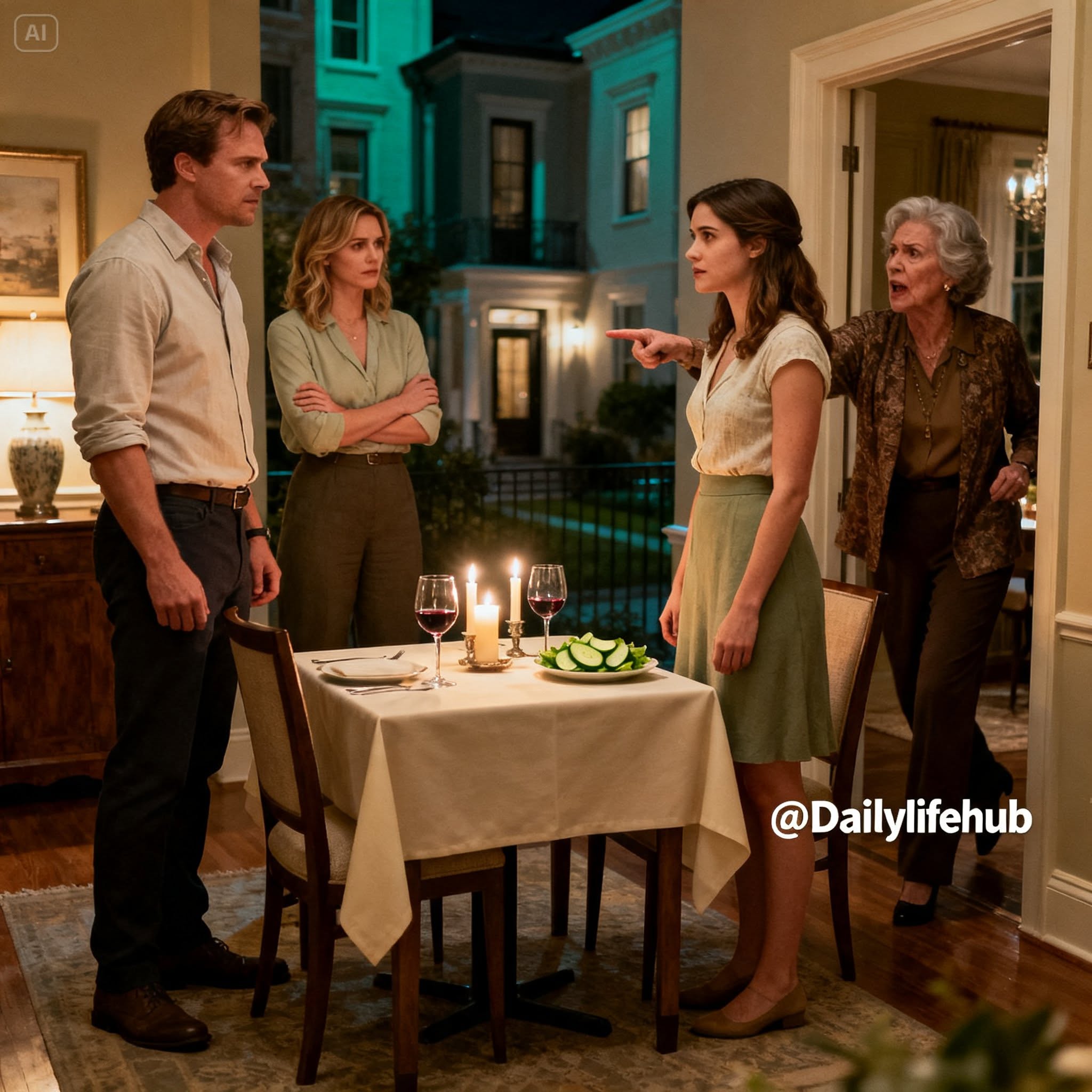
I spent three hours making our anniversary dinner.
My husband needed eleven seconds to turn it into a family buffet.
The lobster tails had just come out of the oven when my phone lit up.
Deacon’s message read:
My sister and the kids are coming by.
Can you make a little extra?
I stared at the six butter-basted Maine lobster tails arranged across our best serving platter.
Then I looked at the candles.
The wine.
The small chocolate cake with HAPPY 3 YEARS written across it.
This was supposed to be our anniversary.
Not another free dinner for Deacon’s family.
And somehow, they always appeared when I cooked something expensive.
Last month, I bought dry-aged ribeyes for the two of us.
His sister arrived with her husband and two children before the steaks had rested.
Three weeks before that, I made crab cakes using fresh lump crabmeat.
Same miracle.
The doorbell rang just as I put them on the table.
Every time, Deacon called it coincidence.
I finally stopped believing in coincidences.
I opened seven food containers.
Every lobster tail went inside.
I wrapped them, carried them to the garage freezer, and buried them behind frozen vegetables.
Then I returned to the kitchen.
I found one cucumber.
Ten minutes later, our anniversary dinner consisted of a bowl of cucumber salad with garlic, vinegar, and sesame oil.
I set out two plates.
Exactly two.
Twenty minutes later, the door opened.
“Anybody home?”
Brynna Rourke never waited to be invited inside.
She swept into our Portland townhouse with her husband, Colby, and their two boys behind her.
She stopped in the entryway and sniffed.
“Oh my God.”
Her eyes widened.
“What did you make?”
“Cucumber salad.”
She laughed.
“No, seriously.”
“I am serious.”
Her smile faded.
“I could smell butter all the way from the hallway.”
“Maybe one of the neighbors is cooking.”
Brynna walked straight toward my kitchen.
Not the dining room.
Not the couch.
The kitchen.
She lifted the lid from the roasting pan.
Empty.
Then she opened the trash.
I leaned against the doorway.
“Looking for something?”
She jumped.
“No.”
“Lobster shells?”
Her face twitched.
“I was checking whether the trash needed to go out.”
“How thoughtful.”
She opened my refrigerator.
Eggs.
Milk.
Vegetables.
No lobster.
Then her hand moved toward the freezer.
I stepped forward and pushed the door shut before she could open it.
The sound cracked through the kitchen.
Brynna stared at me.
“Hollis, what is your problem?”
“My problem is that you’re searching my refrigerator.”
“I wanted something to drink.”
“Water is on the counter.”
Her face hardened.
“You’ve gotten really weird lately.”
Before I could answer, my phone rang.
Mavis Rourke.
My mother-in-law.
I put her on speaker.
“Hollis, Brynna said you haven’t made dinner.”
I looked directly at Brynna.
“She’s standing in my kitchen.”
“Well, then feed them.”
Mavis sounded genuinely offended.
“She drove all that way with two children.”
“They live twelve minutes away.”
“That isn’t the point.”
“What is the point?”
“The point is that you married into this family.”
Her voice rose.
“Brynna is Deacon’s sister, which makes her your sister too.”
I almost laughed.
“So I’m required to cater whenever she arrives?”
“Don’t be selfish.”
There it was.
The word I had been trained to fear throughout my marriage.
Selfish.
Selfish if I did not pay for dinner.
Selfish if I said no to weekend visits.
Selfish if I wanted a holiday alone with my husband.
Selfish if Brynna’s children could not take leftovers home.
I looked at the woman standing in my kitchen.
She was smiling.
Not warmly.
Triumphantly.
And suddenly I understood.
This was not coincidence.
Brynna already knew what I had cooked.
Someone had told her.
I ended the call.
Brynna crossed her arms.
“So are we eating or not?”
“You’re welcome to the cucumber.”
Her face twisted.
“You invited us here and you’re serving cucumber?”
“I didn’t invite you.”
“Deacon did.”
“Then Deacon can cook for you.”
She immediately called him.
Her voice changed before he even answered.
“Deacon, you need to come home.”
A sniff.
“She’s being awful to us.”
I almost admired the performance.
“She won’t feed the kids.”
Colby stood silently behind her pretending to study the floor.
Twenty minutes later, Deacon came through the door looking furious.
He walked straight past me.
“Brynna, you okay?”
“I’m fine.”
She wiped imaginary tears.
“I just didn’t expect your wife to treat us like beggars.”
Deacon finally turned toward me.
“Hollis, what is going on?”
“Ask your sister.”
“I’m asking you.”
His tone made something inside me go still.
For three years, this man had told me we were a team.
Yet the moment his sister complained, I became the defendant.
He looked toward the dining table.
“Where’s the lobster?”
I smiled.
That question confirmed everything.
I had never told Brynna about the lobster.
But I had told Deacon that morning.
“I ate it.”
“What?”
“All of it.”
Brynna stared at me.
Deacon’s face turned red.
“You ate six lobster tails?”
“I was hungry.”
“Hollis, you knew they were coming.”
“No.”
I pointed at the small anniversary cake.
“I knew today was our third wedding anniversary.”
Silence.
Deacon glanced at the candles.
For one second, guilt crossed his face.
Then Brynna scoffed.
“You’re seriously doing all this over an anniversary dinner?”
I looked at her.
“Yes.”
She blinked.
Deacon lowered his voice.
“Can we not make a scene?”
“You already invited five extra people to our anniversary.”
“They’re family.”
“That sentence is starting to sound like a threat.”
The front door opened again.
Mavis entered without knocking.
Apparently she had decided the emergency required reinforcements.
“Hollis, what kind of woman lets children go hungry because she’s angry at their mother?”
“There’s a grocery store four blocks away.”
Mavis pointed at me.
“You have become impossible since marrying my son.”
Brynna nodded.
Deacon said nothing.
That silence hurt more than either woman’s insults.
Three people stood in my living room telling me I had failed them because I refused to surrender a meal I had bought, prepared, and planned for my own anniversary.
I looked at Deacon.
“Are you going to say anything?”
His jaw tightened.
“Hollis, just apologize so everybody can calm down.”
And there it was.
The moment my marriage changed.
Not when his mother screamed.
Not when Brynna searched my refrigerator.
When my husband asked me to apologize for finally saying no.
That night I locked the bedroom door.
I did not cry.
I stared at the ceiling until after midnight.
Then I heard Deacon leave the room where he had decided to sleep.
A few minutes later, the glow of his phone appeared in the living room.
I quietly opened my door.
He was sitting on the couch.
I could see his screen reflected in the dark window behind him.
A group chat.
ROURKES ONLY.
Members:
Deacon.
Brynna.
Mavis.
His father, Orson.
Not me.
Deacon typed:
She got suspicious tonight.
Next time I’ll tell you earlier so you can come before she puts everything away.
Brynna replied almost instantly:
I knew she hid the lobster.
She acts like everything belongs to her.
Mavis:
Because she still thinks she’s an outsider with her own money.
She needs to understand marriage means sharing with the family.
Then Deacon wrote:
Let it go tonight.
I’ll smooth things over tomorrow.
My hands went numb.
Every steak.
Every crab dinner.
Every expensive bottle of wine that mysteriously disappeared when Brynna visited.
My husband had been reporting it all.
I lifted my phone and recorded the entire conversation from behind the doorway.
The next morning, I made coffee like nothing had happened.
Deacon looked exhausted.
“Hollis.”
“Yes?”
“I’m sorry about last night.”
I buttered my toast.
“I have a coworker whose husband has a private family group chat without her.”
His hand froze around his coffee mug.
I continued casually.
“She says it makes her feel like an outsider.”
A bead of sweat appeared near his temple.
“That’s strange.”
“You think so?”
“Maybe they just forgot to add her.”
I looked directly into his eyes.
“Maybe.”
He lasted less than three seconds before looking away.
“I’m late.”
He grabbed his jacket and left.
I waited until his car disappeared.
Then I drove to the garage freezer.
I brought every container of lobster back inside.
I warmed the butter.
Added fresh herbs.
Set one place at the table.
Mine.
Then I photographed the feast and posted it to my private story.
Belated anniversary dinner.
Turns out one person is enough to celebrate.
I hid the post from Deacon and every member of his family.
But I left it visible to mutual friends.
Thirty-seven minutes later, my phone started exploding.
One message caught my attention.
Hollis, what did Brynna just post about you?
I opened her page.
There was a photograph of my cucumber salad.
Under it, she had written:
Some women marry into a family and still never learn what family means.
My mother-in-law had commented beneath it.
Selfish people eventually end up alone.
I took a slow bite of lobster.
Then I opened the video I had recorded the night before.
For the first time in three years, I was not angry.
I was prepared.

PART 2
I did not answer Brynna’s post. I did not defend myself in the comments, and I did not call Mavis. I sent one thing to Deacon instead: the video from the family group chat. Under it, I wrote, Handle your family. If you don’t, I will. His call came less than ten minutes later. “Hollis, why were you recording me?” “Interesting first question.” “You invaded my privacy.” “You were discussing me in a group called ROURKES ONLY while sitting in my living room.” Silence. Then he tried a softer voice. “Can we talk tonight?” “We can talk now.” He exhaled. “Fine. Yes, I told Brynna when you cooked certain things. She likes your food. It wasn’t malicious.” “You told them when to come.” “Sometimes.” “You told them what I bought.” Another pause. “Sometimes.” “And you knew they saw me as an outsider.” “Mom says things when she’s angry.” I laughed once. “Your mother wasn’t angry. She was explaining the family policy.” Deacon’s voice cracked. “Hollis, please don’t post that video.” That was the first honest thing he said. He was not afraid of losing me. He was afraid of being exposed.
That evening, he came home carrying my favorite cheesecake and wearing the expression of a man arriving for negotiations. “Mom and Brynna will delete everything,” he said. “And apologize?” “Eventually.” “Eventually isn’t an apology.” He placed the cake on the counter. “Why are you making this so extreme?” I stared at him. “Extreme was your sister searching my freezer because she thought she was entitled to food I bought for our anniversary.” “She shouldn’t have done that.” “Extreme was your mother calling me selfish in my own house.” “You know how she is.” “And extreme was my husband helping them do it.” Deacon’s shoulders dropped. “What do you want?” I went to the bedroom and returned with a thick notebook. For three years, I had tracked our household spending because Deacon hated budgeting. I opened to the first page. “Your mother’s fiftieth birthday dinner. I paid for it. Brynna’s baby shower. I paid for the catering. Christmas gifts for your parents. Me. The beach rental last summer. Half was supposed to come from Brynna. She never sent it.” I kept turning pages. Groceries. Restaurant bills. School fundraiser tickets for Brynna’s sons. Furniture Mavis “borrowed” and never returned. Deacon stared at the numbers. “I didn’t realize it was that much.” “That is the problem. You never had to realize because I was always expected to absorb it.”
I gave him two choices. “Your mother and sister come here, apologize to my face, delete what they posted, and repay the personal expenses they pressured me into covering. Or we end this marriage.” Deacon looked at me as if I had threatened to burn the house down. “You’d divorce me over food?” “No. I’d divorce you over the fact that you still think this is about food.” He paced the kitchen. “My mom is never going to apologize like that.” “Then she has made your decision easy.” “And Brynna doesn’t have the money.” “She had money for a new phone last month.” His face tightened. “Hollis, family doesn’t keep score.” “People who benefit from the score always say that.” He sat down hard. For a moment, I saw the man I had married—tired, scared, caught between wanting everyone happy and refusing to disappoint the people who raised him. Then he said, “Can’t you just be the bigger person?” Whatever sympathy I had left disappeared. “I have been the bigger person for three years. Apparently that just made me easier to climb on.” I walked into the bedroom and locked the door.
The next morning, Deacon was gone. On the dining table sat a signed separation agreement he had printed from a template overnight and a handwritten note: I love you, but I can’t choose between you and my family. I read that sentence three times. Then I laughed so hard I nearly cried. He still did not understand. I had never asked him to abandon them. I had asked him to stop sacrificing me to keep them comfortable. I called an attorney that morning and learned quickly that a downloaded form was not a completed divorce. The townhouse had been purchased largely with money my parents gave me before the wedding, and the title was in my name, but we still needed a proper review of marital contributions and shared accounts. I moved my direct deposit into an individual account, copied every financial statement, changed passwords, and documented the family messages. By afternoon, Brynna had posted again, this time claiming I had “thrown Deacon out with nothing.” Mavis added that I had used money to control him. I saved screenshots and said nothing. For the first time, silence belonged to me instead of being used against me.
Two days later, Mavis and Brynna showed up at my office. They did not ask to see me quietly. They staged a performance in the lobby. Mavis sat in a chair crying loudly about the “heartless daughter-in-law” who had destroyed her son. Brynna told anyone who would listen that I had stolen Deacon’s home and drained his accounts. By the time reception called me downstairs, half my department had heard their version. I walked into the lobby holding my phone. “Finished?” Mavis pointed at me. “Tell these people what you did to my son.” “Gladly.” I connected my phone to the lobby presentation screen and played the recording. Deacon’s message appeared first: Next time I’ll tell you earlier so you can come before she puts everything away. Then Brynna’s: She acts like everything belongs to her. Then Mavis’s: She needs to understand marriage means sharing with the family. The lobby went silent. Brynna’s face drained of color. Mavis stood so quickly her chair tipped backward. I stopped the video. “Would you like me to play the part where Deacon admits he gave you advance notice every time I bought expensive food?” No one answered. I looked toward security. “Please escort them out.” As the doors closed behind them, my phone buzzed with a message from Deacon. What did you just do? I typed back one sentence. I stopped protecting people who never protected me.
PART 3
The office confrontation ended up helping me more than hurting me. My manager called me into her office afterward, closed the door, and said, “Take three days. Not because you did anything wrong, but because you’ve clearly been carrying this for a long time.” I expected embarrassment. Instead, I felt relief. During those three days, I slept late, joined a yoga class, reorganized the townhouse, and cooked meals I actually wanted to eat. No one called asking what I had made. No one opened my refrigerator. No one told me generosity was an obligation. My attorney handled the divorce properly, and because Deacon and I had no children, the process remained painful but relatively clean. The townhouse stayed with me after the financial review, while our joint savings were divided according to the final agreement. Deacon apologized once outside the courthouse. “I should have defended you.” I looked at him. “No. You should have stopped using me as the price of keeping everyone else happy.” He lowered his eyes. I walked away before he could ask for forgiveness.
I blocked Mavis and Brynna everywhere. Deacon could contact me only through the attorney until the divorce was final. Life became strangely quiet. Then it became good. At work, I threw myself into a difficult client project and earned a promotion before the end of the year. I replaced the furniture Deacon had chosen, painted the bedroom a warm earthy green, and turned the spare room into a reading space. I started inviting friends over for dinner, and the first time someone asked, “Can I bring anything?” I nearly laughed at how unfamiliar basic consideration felt. I cooked scallops, roasted vegetables, and a ridiculous chocolate tart. Everyone helped clean afterward. No one asked for containers of leftovers. No one inspected my freezer. That night, standing alone in the kitchen after my friends left, I realized I had spent three years confusing exhaustion with love. Peace did not feel lonely anymore. It felt expensive, precious, and entirely worth protecting.
Six months later, an unfamiliar number called while I was leaving work. The woman introduced herself as one of Brynna’s former coworkers. “I know this is uncomfortable,” she said, “but Brynna is in serious trouble.” She had allegedly used money from her employer to cover personal debts and a failed online business. The company had discovered it during an audit and was preparing legal action. Colby had already filed for separation, and Mavis had drained most of her savings trying to help. “Brynna asked if you might loan her the remaining twenty-five thousand dollars,” the woman said. I actually stopped walking. “She asked me?” “She said you used to be family.” I almost hung up. Then the woman told me Brynna was in the hospital after a mental-health crisis and that Mavis was with her. I did not suddenly forgive them. I did not believe suffering erased what they had done. But I decided to visit once—not to rescue Brynna, but to close the door properly.
Mavis looked ten years older when I entered the hospital room. The arrogance was gone. She stood, took one step toward me, then stopped. “Hollis, please.” Brynna lay against the pillows, pale and exhausted. “I know I treated you horribly,” she whispered. “I was jealous of you. Your job, your house, your marriage. I thought if Deacon always chose us over you, it meant I mattered more.” I let the silence sit between us. Finally, I said, “I will lend you the money under three conditions. First, a written promissory note reviewed by my attorney, with a real repayment schedule. Second, you and Mavis publish a clear correction of every false claim you made about me. Third, after today, neither of you contacts me again unless it concerns repayment.” Mavis stared at me. “You’d really make us sign paperwork?” “You taught me what happens when people use the word family instead.” Brynna closed her eyes. “I agree.” My attorney prepared the documents. I transferred the money only after everything was signed. It was not forgiveness. It was the last transaction I ever intended to have with them.
A year after the lobster dinner that ended my marriage, I moved into a smaller condo near downtown Portland after selling the townhouse. I wanted a place chosen entirely for myself, not one filled with memories of negotiations disguised as family dinners. On move-in night, I stood on the balcony watching headlights move below when my phone rang. It was Eamon Vale, an attorney I had been dating for several months. “What do you want for dinner?” he asked. “I’m stopping at the market.” I smiled. “Lobster.” “How much?” I looked through the glass doors at my quiet new kitchen. “Enough for two.” He laughed. “Done.” An hour later, he arrived carrying dinner and a bottle of wine. He did not invite anyone else. He did not call his family to tell them what we were eating. And when we finished, he picked up the plates and asked where I kept the dishwasher soap. I stood there watching him and thought about how complicated I once believed love had to be. It wasn’t. Respect was not dramatic. Boundaries were not cruelty. And a home was not a place where everyone was entitled to take from you simply because they knew the address. That night, there were two lobster tails left. I put them in the refrigerator. The next morning, they were still there.