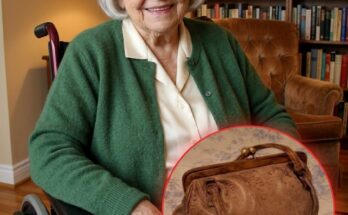
My mother always believed you could discover something about a person by the way they cared for their yard.
Not through expensive landscaping or perfectly trimmed hedges meant to impress the neighbors.
She meant the simple, everyday kind of care.
Watering what needed water.
Pulling weeds before they spread.
Pruning whatever had grown too wild.
Showing up season after season, even when nobody was watching.
Her yard had always been that way.
She had lived in the same house on Birchwood Lane for forty years, including every year after my father died when I was twelve.
There were roses lining the fence, vegetables that produced more tomatoes than she could ever eat, and flowers that came back every spring without being asked.
But the most important thing in that yard was the red maple.
She planted it twenty-seven years ago.
The same year I married Joe.
For most of my life, I never believed those two events were connected.
Not until I found myself beneath that tree at ten o’clock at night, holding a shovel in my hands.
My name is Sarah Beaumont.
I have been married to Joe for twenty-seven years.
By most ordinary standards, he has been a good husband.
He worked steadily as a finishing carpenter.
He came home when he said he would.
We raised two daughters together.
Nora is twenty-four now and lives in Portland.
Caitlin is twenty-one and finishing college a few hours away.
We own a comfortable house.
We have an aging dog named Copper who still insists on sleeping at the foot of our bed.
From the outside, ours looked like the kind of marriage people describe as solid.
There was only one problem that had been there almost from the beginning.
My mother hated Joe.
And Joe hated my mother.
For twenty-seven years, I told myself their dislike came down to personality.
My mother, Margaret, was controlled, disciplined, and fiercely independent.
Joe was louder, more relaxed, and more comfortable taking up space.
I thought they were simply two people who would never understand one another.
I was wrong.
My mother had been widowed at thirty-nine.
My father died of a heart attack, leaving her with a twelve-year-old daughter, a house, and a small financial consulting business she had only recently started.
She built the business on her own.
She never remarried.
She became the kind of woman who trusted preparation more than promises and self-sufficiency more than dependence.
I admired her enormously.
But I also absorbed some lessons from her that were not entirely healthy.
I learned to handle problems quietly.
I learned not to need too much from other people.
Most importantly, I learned how easy it was to avoid asking questions when I was afraid of the answers.
I met Joe when I was twenty-three.
By twenty-five, we had been together eight months, and I finally brought him to my mother’s house for dinner.
At first, everything seemed pleasant.
Mom cooked.
Joe was charming.
Everyone smiled.
But as the evening continued, something changed.
My mother grew quieter.
Joe became louder.
There was no argument.
No obvious insult.
Yet by dessert, they were acting like two people who had recognized something in each other and silently decided not to discuss it in front of me.
At the time, I told myself they simply needed time.
They never warmed to each other.
Instead, they developed a strange, controlled hostility that lasted for nearly three decades.
They remained civil because they both loved me.
But the tension was always there.
Once, about seven years into my marriage, I overheard my mother say something to Joe from the next room.
“You know exactly what you did.”
Joe went silent.
I could have walked into the room.
I could have asked what she meant.
I didn’t.
Even then, some part of me knew that whatever existed between them was more serious than a clash of personalities.
But I had built my adult life around believing otherwise.
So I stayed where I was.
I never asked.
That unanswered question eventually became part of the furniture in our family—something all of us knew was there and carefully walked around.
Then my mother died.
She had been diagnosed with pancreatic cancer in November.
By March, she was gone.
She spent those final months doing what she had always done best: putting everything in order.
She updated her will.
Organized financial documents.
Made arrangements for her house.
Said goodbye carefully to Nora and Caitlin.
And near the end, she tried to tell me something.
She was holding my hand when she whispered, “You have been the best thing in my life.”
I told her she had been the same for me.
Then she looked at me with an expression I still cannot forget.
“I want you to know the truth.”
“What truth?”
Her eyes closed for a moment.
“I was going to tell you. I wanted to tell you.”
Then she drifted away again.
She never finished the sentence.
Those were the last completely coherent words she ever said to me.
I want you to know the truth.
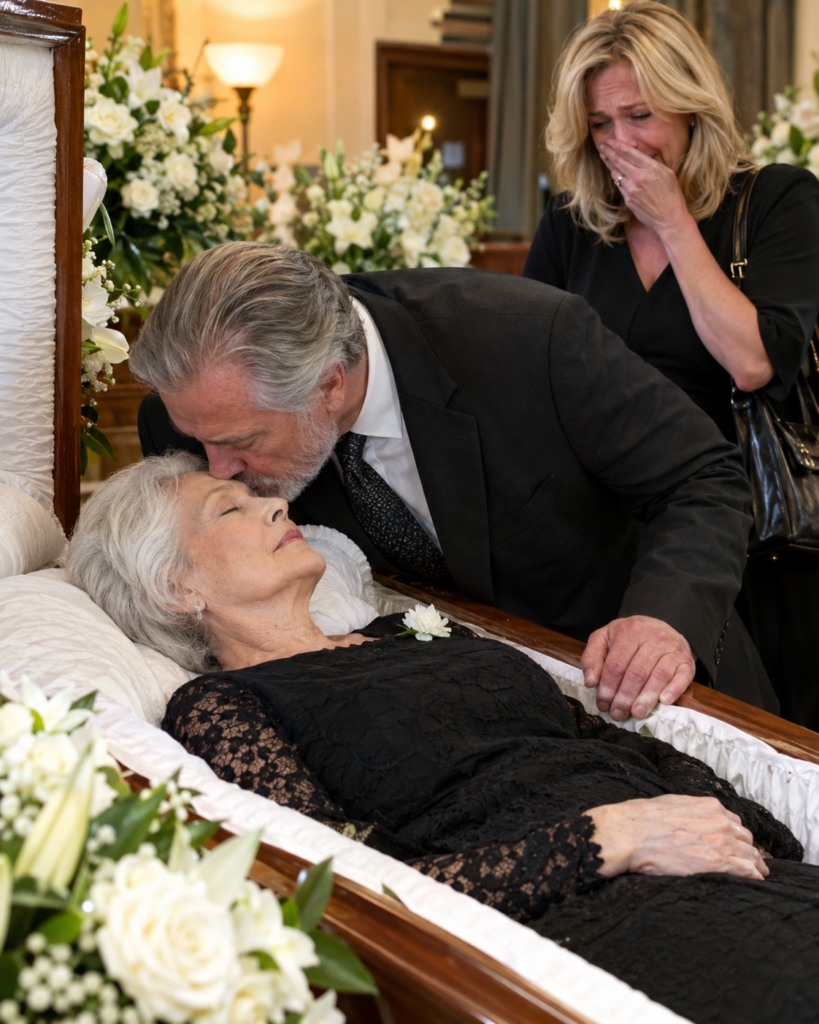
Her funeral was held on a Saturday near the end of March.
Joe behaved exactly as a supportive husband should.
He sat beside me.
Held my hand.
Spoke kindly to relatives.
Helped whenever something needed to be done.
I remember being grateful for him.
Then, during the reception, I realized he was gone.
I went looking for him.
Near the viewing room, I heard his voice through a partially open door.
He was alone with my mother’s coffin.
I stopped before he could see me.
“I kept our secret, Margaret,” he said quietly.
My body went rigid.
“No one ever found out.”
There was a pause.
Then he said something that changed everything.
“It’ll stay buried under the red maple in your yard forever.”
I stepped backward before he came out.
My heart was hammering.
I returned to the reception and pretended nothing had happened.
I spoke to relatives.
Held a cup of tea I never drank.
Smiled when necessary.
But all I could think about was the red maple.
My mother had always been unusually protective of that tree.
She never allowed landscapers to work near its roots.
When the roots cracked part of the walkway, she paid to repair the walkway rather than removing the tree.
Once, Joe suggested cutting it down.
My mother stared at him for several seconds before saying:
“That tree stays exactly where it is.”
He never mentioned it again.
That night, I drove to Birchwood Lane.
The house felt emptier than it ever had before.
Not temporarily empty.
Final.
I went into the garage and found a shovel.
Then I walked into the backyard.
The maple was enormous now.
Twenty-seven years had transformed it from a young tree into something solid and established.
For several minutes, I simply stood there.
Then I began digging.
The ground was difficult.
Roots twisted through the soil.
More than once, I nearly stopped.
Maybe I had misunderstood Joe.
Maybe “buried” was metaphorical.
Maybe grief had made me hear what I wanted to hear.
Then my shovel struck metal.
The sound was unmistakable.
I dropped to my knees and cleared away the dirt with my hands.
Beneath the roots was a sealed metal container wrapped in old layers of plastic.
My hands began to shake.
I carried it to the porch.
Inside was a folder.
The first document was a police report.
Date: August 14, 1996.
The name listed on the report was Joseph Beaumont.
My husband.
The offense was assault.
I read the document once.
Then again.
The victim was a woman named Clare Ashby.
According to the report, Joe had been involved in an argument with her at a bar.
The confrontation escalated.
Joe struck her.
Her nose was broken.
Clare reported the incident to police.
But the case never went to prosecution.
The next document explained more.
It was a letter from my mother to Clare.
Mom had somehow learned about what happened before Joe and I were married.
She introduced herself as the mother of the woman Joe was dating and asked Clare if she would be willing to speak with her.
There was also Clare’s reply.
She described Joe as charming until he felt embarrassed or challenged.
She said alcohol made his temper worse.
She admitted she had been frightened of him.
She also explained why she had decided not to pursue the case. She believed nothing meaningful would come from it, and she did not want to endure the emotional strain.
At the end of her letter, she wrote four words:
Please tell your daughter.
I had to stop reading.
But there were more documents.
The most painful one had been written by my mother to herself.
It said:
Sarah loves him.
If I tell her now, she will not believe me.
She will think I simply dislike him.
She will defend him.
She may choose him over me.
If I wait, she may someday hate me for not telling her sooner.
There is no good choice.
Only the choice I believe will hurt her least.
My mother had chosen silence.
But she had kept the proof.
Then the letter described something I had never known.
Joe had gone to her house after discovering that she knew about Clare.
He sat across from her at the kitchen table.
According to my mother, he looked at her and said:
“You’re going to be a problem, aren’t you, Margaret?”
Mom told him she had documentation.
She told him that if anything ever happened to me, everything she knew would immediately be turned over to the police.
Joe responded:
“Nothing is going to happen to Sarah.”

My mother wrote that she had answered:
“That’s correct. Because I’m going to make sure of it.”
They made an agreement.
Neither of them would tell me.
Joe stayed silent because my mother had leverage.
My mother stayed silent because she believed that if she told me while I was young and deeply in love, I would defend Joe and push her out of my life.
As the years passed, she became increasingly ashamed of that decision.
Every year she waited made telling me more difficult.
Why didn’t you tell me sooner?
She knew that would eventually be my question.
And she knew she would never have a good answer.
The final lines were devastating.
I wanted to protect her.
I hope that is what I did.
I hope he became a better person.
I don’t know if he did.
I sat on my mother’s porch for what felt like hours.
The red maple towered above the hole I had dug.
Suddenly, twenty-seven years of family dinners, restrained conversations, uncomfortable holidays, and cold looks made sense.
My mother had not simply disliked my husband.
She had been watching him.
And Joe knew it.
I called my friend Patricia.
She was a family-law attorney I had known for years.
She listened without interrupting.
When I finished, her first question was:
“Do you have the documents with you?”
“Yes.”
“Are you safe?”
“I’m at my mother’s house. Joe doesn’t know I’m here.”
She explained that the old assault itself was far beyond the point where it could realistically be prosecuted.
But the documents could still matter, especially depending on what I decided to do about my marriage and whether I had any concerns about my current safety.
Then she asked, “What are you trying to do?”
I looked across the yard at that tree.
“I don’t know.”
“That’s okay,” Patricia said. “You don’t have to know tonight.”
I asked her something else.
“Do you think my mother did the right thing?”
There was a long pause.
Finally, Patricia said:
“I think she was wrong about the strategy.”
Then she added:
“But I think she was right about the love.”
I went home.
Joe was asleep in the bed we had shared for twenty-seven years.
I stood in the doorway and watched him.
This was the man who had helped raise my daughters.
The man who made coffee every morning.
The man who fixed loose cabinet doors without being asked.
The man who had never struck me, threatened me, or made me physically afraid.
But now there was another man standing beside that version of him.
A twenty-eight-year-old man in a bar.
Drunk.
Angry.
A woman with a broken nose.
And my mother sitting across from him afterward, making sure he understood that she was watching.
I did not know whether Joe had truly changed.
Or whether knowing my mother possessed proof had kept him controlled.
Perhaps those two things were not mutually exclusive.
I slept on the couch.
Actually, I barely slept at all.
The next morning, Joe found me there.
“You slept downstairs?”
“I couldn’t sleep.”
He looked concerned.
“Where did you go last night?”
I stared at him.
Then I said his name.
“Joe.”
Something in my voice changed his expression.
“Yes?”
“I heard you at the funeral home.”
He stopped moving.
“I heard what you said to my mother.”
Silence.
“You said you kept a secret.”
His face changed.
“You said it was buried under the red maple.” He slowly lowered himself into the chair.
“I dug it up.”
Joe’s eyes shifted toward the table.
“She kept them.”
“Yes.”
“I thought she might destroy them eventually.”
Then he confessed something else.
Three years earlier, when my mother had briefly been hospitalized, he had gone into her backyard to make sure the container was still buried there.
It was.
“Why didn’t you take it?” I asked.
“Because she would have known.”
“And then your deal would have been over.”
He said nothing.
“The deal where she stayed silent and you promised not to hurt me.”
“That isn’t how I would describe it.”
“How would you describe it?”
Again, he had no answer.
Finally, he met my eyes.
“Your mother was protecting you.”
He said it without hesitation.
“Yes. She was.”
Then Joe told me his side of the story.
He said he had been a terrible person in 1996.
He drank too much.
He had a temper.
What happened with Clare was not an accident.
He dealt with anger through violence, then ran because he was ashamed and terrified of the consequences.
Afterward, he quit drinking.
He went to therapy for two years.
I had never known any of it.
“I didn’t want you asking why,” he said.
“You were afraid I’d learn about Clare.”
“Yes.”
He stared at me for a long moment.
“I have been afraid for twenty-seven years that you would find out.”
“Because you thought I’d believe you might hurt me?”
“Yes.”
Then he said something I never expected.
“And you would be right to wonder.”
He didn’t try to excuse what he had done.
He didn’t claim Clare had exaggerated.
He didn’t blame alcohol.
He simply said:
“I did something terrible.”
Then he added:
“I haven’t done anything like it since.”
I asked whether that was because he had truly changed or because my mother had kept the truth hanging over him.
Joe shook his head.
“I honestly don’t know.”
He said perhaps therapy had helped.
Maybe sobriety had helped.
Maybe becoming a husband and father had changed him.
Maybe my mother’s warning had changed him too.
Probably all of it.
“That’s a terrible thing not to know about yourself,” I said.
“Yes,” he replied.
“It is.”
I told him I needed to know everything.
So he told me.
He said he had struck Clare.
She fell.
Her nose broke.
He left.
He never went back to apologize.
He never called to see whether she was okay.
Over the years, he had thought many times about finding her, but he had always been too afraid.
“Afraid she wasn’t okay?” I asked.
“Yes.”
“Or afraid she was okay and would still expect you to take responsibility?”
He lowered his eyes.
“Yes.”
I told him I needed time.
Joe didn’t argue.
He packed a bag and went to stay with his brother.
Before he left, he stopped in the kitchen.
“Sarah.”
“Yes?”
“Your mother was right about something.”
I almost laughed bitterly.
“She was right about many things.”
“Yes. But I mean one thing in particular.”
He hesitated.
“If she had told you when you were twenty-six, I think you would have chosen me.”
I said nothing.
“I think you would have believed I made one mistake and that she was interfering in our relationship.”
The painful truth was that I knew he was probably right.
At twenty-six, I loved Joe fiercely.
My mother and I were close, but I also desperately wanted to prove that I could make my own choices.
I might have defended him.
I might have accused her of trying to control me.
I might even have pulled away from her.
Joe continued.
“I’m not saying she was right to keep it from you.”
Then he looked toward the window.
“But I always understood why she did.”
After he left, I remained alone at the kitchen table.
The question was no longer whether Joe had done something terrible.
He had.
The question was what twenty-seven years of seemingly decent behavior meant when placed beside one terrible act he had hidden from me.
Did change erase anything?
No.
Did someone who had once committed violence remain forever identical to the person they had been?
I didn’t know.
Did twenty-seven years of secrecy matter?
Absolutely.
And somewhere in all of it was my mother, carrying the weight of what she knew until the end of her life.
I called Nora.
I told her that her father and I would be spending some time apart.
She immediately asked:
“Are you safe?”
“Yes.”
Then I told her everything.
She stayed quiet through most of the story.
When I finished, she said:
“Grandma kept those papers under the tree for twenty-seven years?”
“Yes.”
“Because she was trying to protect you?”
“Yes.”
“And Dad knew?”
“Yes.”
“And he never told you?”
“No.”
Nora fell silent.
Then she asked the question everyone seemed to ask me.
“What are you going to do?”
“I don’t know.”
Her answer surprised me.
“That’s okay.”
“Is it?”
“Yes. Taking time isn’t the same as making a decision. It’s just giving yourself time.”
After we hung up, my thoughts returned to my mother.
To the maple.
To something she had said when she planted it.
“I want something that will grow.”
For twenty-seven years, I had assumed she was talking about the tree.
Now I understood.
The tree marked the place where she had buried something she could not bring herself to say.
Its roots grew deeper every year.
Its trunk widened.
Its branches spread across the yard.
The tree even cracked the pavement.
She refused to remove it.
Once, when Caitlin was very young and began digging around its base with a toy shovel, my mother reacted with unusual panic.
At the time, I thought she was simply too sentimental.
She wasn’t protecting the tree.
She was protecting what was beneath it.
A few days later, I returned to Birchwood Lane.
I brought my mother’s gardening gloves.
I walked into the backyard and stood beneath the maple.
It was still beautiful.
That had not changed.
I knelt beside the hole I had made and slowly covered it again.
I pressed the soil down with my hands.
Then I stood.
For a moment, I simply looked up through the branches.
“Thank you,” I said.
I don’t know whether I was speaking to my mother, the tree, or simply the space she had occupied in my life.

Maybe all three.
My mother had been wrong to keep the truth from me for so long.
I believe that now.
But she had not acted out of cruelty.
She had acted from fear, uncertainty, and a fierce love that convinced her she could somehow stand between me and danger without telling me that danger existed.
For twenty-seven years, the truth remained buried beneath that maple.
Protected.
Preserved.
Waiting.
My mother had said at the end of her life:
“I want you to know the truth.”
She ran out of time to tell me herself.
So she left me a way to discover it.
The container had never been locked.
It had been protected from rain and soil, but not from the person who was eventually meant to open it.
Maybe she had always believed that someday I would.
Not at twenty-six.
Not when I was young enough to confuse love with certainty.
But later.
When I had lived enough life to understand that people could be more than one thing at once.
That someone could love you and still make the wrong decision.
That someone could do something terrible and spend decades trying not to become that person again.
That a good marriage could contain a secret large enough to change how you understood every year that came before it.
I was fifty-three now.
I had raised two daughters who could handle complicated truths.
And now I had to learn to do the same.
The red maple stood above me, tall and deeply rooted.
Some things are planted because we want them to grow.
Others are planted because we need something to guard what we cannot yet face.
And sometimes, years later, we finally become strong enough to dig beneath the roots and discover what was waiting there all along.