My mother-in-law stayed behind on vacation with a man she had known for less than a week. Five nights later, at 12:47 in the morning, my phone rang.
When I answered, all I heard at first was breathing. Then Valerie whispered four words that made me sit straight up in bed. “Natalie, please help me
I looked at my husband sleeping beside me.
Before I could ask another question, she added:
“And don’t tell Owen.”
That was the moment I knew whatever had happened at that beach cottage was more complicated than a bad vacation romance.
And by sunrise, I was on a plane.
But to understand why Valerie called me instead of her own son, you have to understand what she had been through.
And what Owen had slowly become after losing his father.
My name is Natalie.
I had been married to Owen for eight years, which meant Valerie had been part of my life long enough for me to recognize the rhythm of her moods.
Valerie was not the stereotypical mother-in-law who showed up uninvited, rearranged your kitchen, criticized your cooking, or competed for her son’s attention.
She had opinions.
Plenty of them.
But most of the time, she understood boundaries.
Mostly.
She called Owen almost every day.
Sometimes twice.
Those calls were rarely dramatic.
She asked whether he had eaten.
She complained about her neighbor parking too close to the mailbox.
She sent pictures of broken cabinet hinges and asked whether Owen thought she needed a handyman.
She wanted advice about taxes.
The lawn.
Her television remote.
A dripping faucet.
She once called at eight in the morning because a squirrel had apparently been “looking aggressive” from her porch railing.
Owen found most of it amusing.
Before his father died, Valerie’s calls were background noise.
After his father died, they became something else.
A lifeline.
Owen’s father, Thomas, died suddenly two years earlier.
Thirty-five years of marriage ended in one afternoon.
No long illness.
No time for proper goodbyes.
No gentle transition into grief.
Thomas left the house on a Tuesday morning to pick up supplies for a leaking outdoor faucet.
By Tuesday evening, Valerie was sitting in a hospital room holding his wedding ring.
A massive heart attack.
That was all the explanation anyone could give her.
One morning she was married.
That night she was a widow.
There are certain losses that don’t simply break your heart.
They rearrange your identity.
Valerie had been Thomas’s wife for more than half her life.
Then suddenly everyone expected her to understand how to be Valerie again.
For the first few months, she barely functioned.
She wore Thomas’s old flannel shirts around the house because they still smelled faintly like his laundry detergent.
She slept on his side of the bed because lying on her own side meant staring at the empty space where he should have been.
She left his reading glasses beside his chair.
His shoes stayed by the back door.
His jacket stayed on the hallway hook.
One Christmas, Owen suggested she move the jacket because she kept crying whenever she saw it.
Valerie looked at him and said:
“If I move everything that makes me cry, there won’t be anything left.”
He never suggested it again.
By the second year, she was functioning.
Technically.
She went grocery shopping.
She kept doctor appointments.
She paid bills.
She attended church sometimes.
She had lunch with two old friends every few weeks.
But she had stopped living anywhere beyond the boundaries of her routine.
Every invitation was met with the same excuse.
Too tired.
Maybe next time.
Not feeling up to it.
Travel?
Absolutely not.
Dating?
She practically looked offended if anyone mentioned it.
“I already had the love of my life,” she would say.
There was never bitterness in her voice.
Just finality.
Like Thomas’s death had closed a door she had no intention of opening again.
So when Owen and I planned a week at the beach that summer, inviting Valerie felt obvious.
At first she resisted.
“I’ll just slow you two down.”
“You won’t.”
“You don’t want your mother-in-law tagging along.”
“I do,” I told her.
She narrowed her eyes.
“You say that now.”
“I’m serious.”
Owen added:
“Mom, you haven’t gone anywhere in two years.”
“That is an exaggeration.”
“You drove to Aunt Beth’s house.”
“That is forty miles.”
“You also went to Costco.”
Valerie gave him a look.
“Costco is an expedition.”
I laughed.
Eventually she agreed.
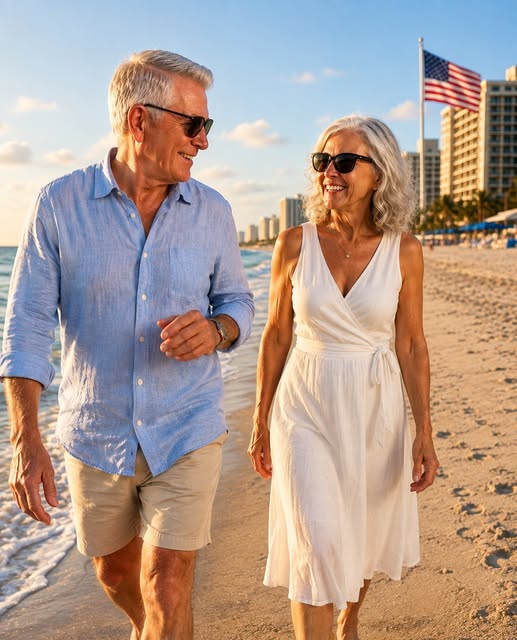
The hotel was one of those quiet beachfront places designed to convince you the rest of the world had temporarily stopped existing.
White balconies.
Palm trees.
A courtyard with string lights.
A pool shaped like a lazy river.
The ocean beyond a row of dunes.
Our rooms were across the hall from each other.
The first two days, Valerie behaved exactly the way I expected.
She sat under an umbrella by the pool with a paperback.
She drank iced tea.
She complained that sunscreen made her hands greasy.
She refused to go paddleboarding.
She took photographs of the sunset and sent them to three different family group chats.
She was relaxed.
But still the same Valerie.
Then she met Russell.
It happened on our second evening.
Owen and I had gone downstairs for drinks before dinner.
Valerie joined us because she claimed she wanted sparkling water.
She ended up sitting two seats away from a man with silver hair, an open-collar linen shirt, and the kind of easy confidence that belongs to someone who has learned not to fill every silence.
I noticed them talking while Owen was paying our tab.
I didn’t think anything of it.
Then Valerie laughed.
Not her polite little social laugh.
Not the laugh she used when someone told a predictable joke at Thanksgiving.
This was different.
Her head tipped back.
Her eyes closed.
Her hand touched her chest.
It was the kind of laugh that seemed to surprise even her.
I stopped walking.
Owen nearly bumped into me.
“What?”
I nodded toward the bar.
He followed my gaze.
Valerie was still smiling.
Russell leaned toward her and said something else.
She laughed again.
Owen stared.
“Who is that?”
“I don’t know.”
“Why is she talking to him?”
I looked at my husband.
“Because people sometimes talk to other people.”
“You know what I mean.”
“No. I genuinely don’t.”
He frowned.
We walked over.
Valerie introduced him.
“This is Russell.”
Russell stood and shook Owen’s hand.
“Nice to meet you.”
He was sixty-five.
Divorced.
Two adult children.
A retired high school principal from North Carolina.
He had been traveling alone because, according to him, his daughter insisted he stop “sitting around pretending retirement was a prison sentence.”
Valerie laughed when he told us that.
Again.
I remember looking at her face.
Really looking.
For two years, grief had lived there.
Not dramatically.
Not constantly.
But in the corners.
Around the eyes.
In the way she smiled but never seemed fully present.
That night, something had lifted.
Even temporarily.
And it made her look ten years younger.
Owen and I went upstairs around ten.
Valerie stayed at the bar.
The moment we entered the elevator, Owen said:
“That guy is flirting with her.”
I pressed the button for our floor.
“Yes.”
He looked horrified.
“Why are you saying it like that?”
“Like what?”
“Like it’s normal.”
“Owen, your mother is sixty-three, not dead.”
His mouth opened.
Closed.
Opened again.
“I didn’t say she was dead.”
“You look like somebody just proposed a reality dating show starring your mother.”
“I just wasn’t expecting it.”
“Neither was she.”
He leaned against the elevator wall.
“What do we know about him?”
I stared.
“Nothing.”
“Exactly.”
“They met forty minutes ago.”
“That’s my point.”
I laughed.
“Your point is that two strangers should know each other before they know each other?”
He gave me an irritated look.
I kissed his cheek.
“Relax.”
He didn’t.
The next morning, Valerie appeared at breakfast wearing lipstick.
Bright coral lipstick.
Owen stopped chewing.
He actually stopped mid-bite.
“Mom.”
Valerie poured coffee.
“What?”
“You’re wearing lipstick.”
She looked down at herself as if checking whether she had accidentally worn a ball gown.
“Yes.”
“At eight in the morning.”
“I’ve worn lipstick before.”
“Not on vacation.”
“Do you keep records?”
I kicked Owen beneath the table.
He winced.
Valerie pretended not to notice.
Then she smiled.
“Russell asked if I’d have breakfast with him.”
Owen slowly put down his fork.
“Russell.”
“Yes, Owen.”
“Breakfast.”
“That is usually what people eat in the morning.”
I bit the inside of my cheek to keep from laughing.
“Are you going somewhere?” Owen asked.
“There’s a café down the beach.”
“With him.”
Valerie leaned back.
“If you ask me one more question in that tone, I’m grounding you.”
I lost it.
Owen glared at me.
Valerie finished her coffee and walked away smiling.
That became the pattern.
For the next several days, we barely saw her.
She and Russell walked along the beach every morning.
They went for coffee.
They had lunch.
One afternoon, they rented bicycles.
Another day, they drove twenty minutes down the coast to a seafood restaurant Valerie had mentioned wanting to try.
I was delighted.
Not because I believed Russell was about to become the second great love of Valerie’s life.
I wasn’t thinking that far ahead.
Neither, I assumed, was she.
I was simply happy to see her excited about something.
Anything.
She bought a new dress from a little boutique near the hotel.
She wore earrings I hadn’t seen since before Thomas died.
She stopped checking her phone every fifteen minutes.
She talked about books and music instead of home repairs.
Once, I passed through the lobby and saw Russell teaching her how to play some ridiculous card game.
She cheated.
He accused her of cheating.
She laughed so hard she almost spilled her drink.
I stood there watching for a moment before walking away.
It felt private.
Not romantic exactly.
Just human.
Like I was watching someone remember there was still oxygen in the room after believing for two years that she had to breathe carefully.
Owen noticed the change too.
But happiness didn’t stop him from worrying.
In fact, it almost made him worry more.
On the fourth night, Valerie returned after ten.
Owen was sitting in the lobby.
Waiting.
I had told him not to.
He did it anyway.
Valerie stepped through the doors carrying her sandals.
Her hair was windblown.
She looked happy.
Then she saw her son.
Her smile faded.
“Owen?”
He stood.
“Where were you?”
Her eyebrows rose.
“Excuse me?”
“I texted.”
“My phone was in my purse.”
“It’s after ten.”
Valerie glanced at the lobby clock.
“And?”
Owen crossed his arms.
“Mom, you barely know this man.”
There was a long pause.
I knew immediately he had chosen the wrong approach.
Valerie put her sandals down.
“I’m sixty-three years old.”
“I know.”
“Do you?”
“Of course I do.”
“Because you’re currently standing in a hotel lobby waiting for me like I missed curfew.”
“That’s not what I’m doing.”
“It certainly feels like it.”
“Mom, I’m worried.”
“About what?”
“This man.”
“His name is Russell.”
“That doesn’t make him safer.”
“Owen.”
“You met him three days ago.”
“Yes.”
“You don’t know anything about him.”
“I know several things.”
“Things he told you.”
Valerie’s face tightened.
“What exactly are you suggesting?”
“I’m saying you should be careful.”
“I am careful.”
“You’re spending every day with a stranger.”
“I met your father on a Friday and went to dinner with him Saturday.”
“That was different.”
Her eyes narrowed.
“Why?”
Owen opened his mouth.
Nothing came out.
Valerie shook her head.
“I know you love me.”
“I do.”
“But sometimes you behave as though grief damaged my judgment permanently.”
“I never said that.”
“You don’t have to say everything out loud.”
That sentence stayed with me.
Later that afternoon, before the argument in the lobby, Russell had invited Valerie to extend her trip.
He had rented a cottage farther down the coast for another month.
Apparently, the person who was supposed to join him later had canceled.
He asked Valerie whether she wanted to stay a little longer.
When she first told me, I assumed she was joking.
She wasn’t.
The night before Owen and I were scheduled to fly home, the three of us sat on the balcony overlooking the ocean.
Valerie had a glass of wine.
Owen had a face like someone awaiting a medical diagnosis.
“I changed my flight,” Valerie said.
Owen stared at her.
“You what?”
“I changed my flight.”
“To when?”
“I don’t know yet.”
His expression changed.
“What do you mean, you don’t know yet?”
“I’m going to stay down here with Russell for a little while.”
Silence.
Absolute silence.
Even the ocean seemed quieter.
Owen blinked several times.
“You’ve known him for three days.”
“Four.”
“That is not better.”
I turned toward the water.
Valerie sighed.
“Owen.”
“You’re going to live with him?”
“I am not moving in with him.”
“What would you call staying in his house?”
“It isn’t his house. It’s a rental cottage.”
“With a stranger.”
“Stop calling him that.”
“He is a stranger.”
“He is someone I am getting to know.”
“At his house.”
“At a cottage.”
“Mom.”
“Owen.”
I could hear the strain entering her voice.
He leaned forward.
“This isn’t like you.”
There it was.
The sentence that changed the entire conversation.
Valerie stared at him.
“Maybe you don’t know what I’m like anymore.”
Owen’s face fell.
She looked toward the ocean.
“For two years, I’ve done exactly what everyone expects.”
“No one expects anything.”
“Yes, you do.”
Her voice began to tremble.
“You expect me to be careful.”
“That’s reasonable.”
“You expect me to stay close to home.”
“I never said that.”
“You expect me to answer every call.”
“I worry when you don’t.”
“You expect me to tell you where I’m going.”
“That’s not—”
“You expect me to act like the woman whose husband died.”
Owen went completely still.
Valerie’s eyes filled.
“I loved your father.”
“I know.”
“I still love him.”
“I know.”
“But I am still alive.”
Owen looked down.
She wiped beneath one eye.
“I spent two years going from my house to the grocery store and back again. People asked me to dinner, and I said no. They asked me on trips, and I said no. I turned down invitations before anyone even finished making them.”
Her voice broke.
“And now I meet someone who makes me laugh for the first time in God knows how long, and everybody acts like I’ve lost my mind.”
“Nobody said that.”
“You didn’t have to.”
She stood.
I reached for her hand.
She squeezed mine briefly.
Then she went inside.
Owen and I stayed on the balcony.
For several minutes, neither of us spoke.
Finally, he said:
“This is a mistake.”
I stared at the dark ocean.
“Maybe.”
His head snapped toward me.
“You agree?”
“I think staying with someone she barely knows is risky.”
“Exactly.”
“But I also think she knows that.”
“She’s lonely, Natalie.”
“Yes.”
“That’s the problem.”
“No.”
I turned toward him.
“That doesn’t mean she’s helpless.”
He rubbed both hands over his face.
“What if something happens?”
“What if nothing happens?”
“What if he takes advantage of her?”
“What if she has a wonderful week?”
“What if—”
“Owen.”
He looked at me.
“You cannot protect an adult by making every decision for them.”
“She’s my mother.”
“Yes.”
“And she lost Dad.”
“Yes.”
His expression softened.
That was the real issue.
Not Russell.
Not the cottage.
Not even Valerie staying behind.
Owen had already lost one parent unexpectedly.
Some part of him was terrified that if he stopped watching the other one, he might lose her too.
I understood that.
But understanding fear does not mean fear should be allowed to run everyone else’s life.
“I think she’s allowed to make a decision we wouldn’t make,” I said.
Owen looked toward her room.
“And if she regrets it?”
“Then she regrets it.”
“That’s it?”
“That’s adulthood.”
He hated that answer.
But the next morning, we flew home without her.
Valerie hugged me tightly at the airport.
Then she hugged Owen.
He held on longer.
“Call me.”
“I always do.”
“Every day.”
She pulled back.
“Owen.”
“Fine.”
She smiled faintly.
“I’ll call.”
“And text.”
“Goodbye.”
“Mom.”
“Owen.”
She laughed.
For the first few days, everything seemed fine.
Better than fine.
Valerie called Owen every morning.
She sent photographs.
Restaurants.
Sunsets.
Seafood.
Ridiculous cocktails with tiny umbrellas.
A picture of Russell asleep in a beach chair with a paperback over his face.
Another of Valerie standing ankle-deep in the ocean.
She looked happy.
Genuinely happy.
Russell appeared in several photographs.
He looked ordinary.
That reassured me more than it probably should have.
No sinister expression.
No unsettling background details.
No strange captions.
Just two older people enjoying a vacation.
Owen studied every picture as if he were conducting a criminal investigation.
“This cottage looks isolated.”
“It’s near the beach.”
“There aren’t many houses around.”
“There are houses behind them.”
“How do you know?”
“They’re literally visible in the picture.”
He zoomed in.
I stared at him.
“You need a hobby.”
“My mother is my hobby.”
“That sentence should concern you.”
He almost smiled.
On the fourth day, the pictures stopped.
Owen noticed before I did.
We were eating dinner.
He checked his phone.
Then checked it again.
“Mom hasn’t sent anything today.”
“She called you this morning.”
“For six minutes.”
I slowly lowered my fork.
“Do you time her calls?”
“No.”
His face told me he absolutely did.
“What did she say?”
“Nothing.”
“Then why are you worried?”
“She sounded distracted.”
“People sound distracted.”
“She usually talks longer.”
“Maybe Russell was waiting.”
“That’s what I’m worried about.”
I reached across the table.
“Owen.”
He exhaled.
“I know.”
“Leave it alone.”
He nodded reluctantly.
And he did.
For the rest of the evening.
That night, we went to bed around eleven.
At 12:47 a.m., my phone rang.
The sound sliced through the darkness.
I reached for it quickly so Owen wouldn’t wake.
Valerie’s name glowed on the screen.
My stomach tightened instantly.
She never called me that late.
I slipped out from beneath the blanket and answered in a whisper.
“Valerie?”
Silence.
Then breathing.
“Valerie?”
A faint sound.
Then:
“Natalie?”
Her voice was barely audible.
I sat up.
“Yes. I’m here.”
I looked toward Owen.
Still asleep.
“Are you alone?” she asked.
My heart began pounding.
“Yes. Owen’s sleeping.”
A long pause.
“What’s wrong?”
More breathing.
Then she said:
“Natalie, I need you to save me.”
I was out of bed before she finished the sentence.
I stepped into the hallway and closed the bedroom door.
“Where is Russell?”
“Sleeping.”
“Did he hurt you?”
“No.”
“Did he threaten you?”
“No.”
“Did he touch you?”
“No.”
“Are you locked in somewhere?”
“No.”
That stopped me.
“Valerie, tell me what’s happening.”
“I can’t explain this properly.”
Her voice cracked.
“I just don’t want to be here when he wakes up.”
“Why?”
“Because he’ll start talking.”
“Talking about what?”
“About why I shouldn’t leave.”
A chill went through me.
“Has he stopped you from leaving?”
“No.”
“Has he hidden your keys?”
“No.”
“Taken your phone?”
“No.”
“Your wallet?”
“No.”
“Your passport?”
“No.”
“Your money?”
“No.”
I pressed my fingers against my forehead.
“Then tell me what happened.”
There was silence.
When she finally spoke, she sounded smaller.
“I think I made a mistake.”
Every ounce of urgency in me shifted.
Not disappeared.
Shifted.
“Okay.”
“I want to come home.”
“Then come home.”
“I don’t know how.”
“Yes, you do.”
Her breathing trembled.
“I mean I don’t know how to explain it.”
“You don’t owe anyone a courtroom argument.”
“Natalie…”
“Yes?”
“Please don’t tell Owen.”
I closed my eyes.
“What?”
“Please.”
“If you’re in danger—”
“I don’t think I’m in danger.”
“You just asked me to save you.”
“I know.”
Her voice cracked again.
“I don’t even know if I have the right to be upset.”
“Valerie.”
“He hasn’t done anything terrible.”
“That doesn’t mean you have to stay.”
“I know.”
But the way she said it told me she didn’t.
Not emotionally.
Not yet.
I heard water running briefly.
“Where are you?”
“In the bathroom.”
“Can you leave the cottage safely?”
“Yes.”
“Do you have your suitcase?”
“Not packed.”
“Then listen to me.”
I lowered my voice.
“Take your phone, wallet, medication, identification, charger, and whatever clothes you can grab quietly. Forget anything replaceable. Go somewhere public.”
“Natalie—”
“Do not stand in that bathroom deciding whether your reasons are good enough.”
She started crying.
“I feel ridiculous.”
“You can feel ridiculous after breakfast.”
A tiny broken laugh came through the phone.
“That sounds like something your mother would say.”
“It probably is.”
“Are you sure?”
“Yes.”
“About what?”
“About leaving.”
“But what if I’m overreacting?”
“Do you want to stay?”
Silence.
“No.”
“Then leave.”
Another silence.
Longer.
Then:
“Okay.”
“Text me when you’re outside.”
“What are you going to do?”
“I’m coming.”
Her breathing stopped.
“No.”
“Yes.”
“Natalie, you don’t have to.”
“I know.”
“That’s a long flight.”
“I know.”
“Owen will wake up.”
“I know.”
“He’ll ask questions.”
“I know.”
“Please don’t tell him yet.”
“I won’t tell him the details until I understand them.”
She exhaled.
“Thank you.”
By two in the morning, Valerie was sitting in an all-night diner six blocks from the cottage.
By three, I had booked the earliest flight.
I packed quietly.
Owen woke while I was pulling on jeans.
He blinked at me from the bed.
“What are you doing?”
I froze.
“Valerie needs me.”
His entire face changed.
“What happened?”
“She’s safe.”
“What happened?”
“I don’t know yet.”
He threw off the blanket.
“I’m coming.”
“No.”
“Natalie.”
“She asked for me.”
His eyes narrowed.
“Why?”
“I don’t know yet.”
“That makes no sense.”
“I agree.”
He stood.
“Is Russell involved?”
“I don’t know.”
“Did he hurt her?”
“She said no.”
“Then what happened?”
“I don’t know.”
I grabbed my bag.
That answer was becoming frustrating because it was also true.
Owen looked furious.
Terrified, really.
“Why didn’t she call me?”
There it was.
The question I couldn’t answer.
I walked over and touched his face.
“Let me get there.”
“Natalie.”
“I will call you.”
“When?”
“When I understand what she wants me to tell you.”
His jaw tightened.
“You’re protecting her from me.”
“I’m respecting her.”
“Same thing.”
“No.”
I kissed his cheek.
“Go back to bed.”
He looked offended.
“I’m not going back to bed.”
“Then make coffee.”
At the airport, I sent him one message.
She is safe.
I’ll call once I understand the rest.
When I landed, the sun was already up.
The beach town looked different in daylight.
Not like the place we had left after a cheerful family vacation.
It felt strangely quiet.
I found Valerie at a breakfast place three streets from the cottage.
She was sitting near the window.
Her suitcase stood beside her chair.
She looked exhausted.
No makeup.
Hair pulled into a loose ponytail.
Same blouse she had worn in one of the photographs two days earlier.
But she did not look frightened.
That mattered enormously.
She looked ashamed.
And somehow, that hurt me more.
The moment she saw me, she stood.
I barely reached the table before she wrapped both arms around me.
“I’m sorry.”
“Why are you apologizing?”
“For making you come.”
“You didn’t make me do anything.”
“I should have handled this myself.”
“You did.”
She pulled back.
“How?”
“You left.”
She stared at me.
Then tears filled her eyes.
We sat.
The waitress brought coffee.
Valerie wrapped both hands around the cup without drinking.
Finally she said:
“I don’t even know if Russell did anything wrong.”
I leaned back.
“Start with why you left.”
She looked out the window.
“The first day was wonderful.”
They had cooked dinner together.
Russell grilled fish outside.
Valerie made a salad.
They drank wine on the porch.
They walked along the beach after dark.
He told her about his marriage.
His divorce.
His children.
The loneliness of retirement.
She told him about Thomas.
For the first time since her husband died, Valerie said she had been able to talk about him without feeling like everyone was waiting for her to cry.
Russell didn’t flinch when she mentioned Thomas.
He didn’t act threatened by a dead man.
He listened.
That mattered.
“When I went to bed,” she said, “I thought maybe this was exactly what I needed.”
“Then what changed?”
“The next morning, he asked where I usually spent Christmas.”
I frowned.
“That’s not terrible.”
“I know.”
She nodded.
“That’s what made it difficult.”
Russell asked whether she normally hosted Christmas or went to Owen’s.
Valerie answered.
Then Russell said maybe they could spend Christmas together.
At first, she assumed he meant casually.
A joke.
Wishful conversation.
Then he began discussing whose house made more sense.
“I laughed,” Valerie said.
“He didn’t.”
I felt my stomach tighten.
“He was serious?”
“Completely.”
Later that afternoon, they drove through a coastal neighborhood.
Russell pointed out houses.
Not in a romantic, hypothetical way.
In a planning way.
He slowed beside a small blue cottage.
“Something like that would be perfect for us next season,” he said.
Valerie had laughed again.
Then realized he wasn’t joking.
“For us?”
“That’s exactly what I asked.”
Russell smiled and told her he liked thinking ahead.
She tried to ignore it.
That evening they went to dinner.
A server asked whether they were visiting.
Russell put an arm across the back of Valerie’s chair and said:
“My girlfriend just needs a little convincing to stay longer.”
Valerie stared down at the table.
“What did you say?” I asked.
“Nothing.”
“Why?”
“Because everybody smiled.”
That answer broke something in me.
Not because Russell’s words were outrageous.
They weren’t.
That was the problem.
Each individual moment was small enough to dismiss.
Friendly enough to excuse.
Romantic enough that objecting made Valerie feel unreasonable.
The next morning, Russell opened rental listings on his laptop.
Two bedrooms.
Three bedrooms.
Ocean view.
Long-term rates.
He asked Valerie which kitchen she preferred.
She laughed nervously.
Russell kept scrolling.
Then he mentioned her house.
“What about it?”
“He asked how much it was worth.”
My eyebrows rose.
Valerie nodded.
“Then he said maintaining two houses eventually wouldn’t make sense.”
“Eventually?”
“That was his word.”
“What did you say?”
“I told him I wasn’t selling my house.”
“And?”
“He laughed.”
My chest tightened.
“What kind of laugh?”
“Like I was being cute.”
That was the moment, she said, when the vacation stopped feeling exciting.
It began feeling crowded.
Not physically.
Emotionally.
Russell started using words like we, ours, together, next year, Christmas, future.
He asked whether she had ever thought about relocating.
Whether she preferred warm weather.
Whether Owen visited often.
Whether she had grandchildren.
Whether she would ever consider spending six months a year somewhere else.
None of those questions, individually, were alarming.
Together, after less than a week, they felt like someone had begun building a house around her before asking whether she wanted to live inside it.
“I kept telling myself he was just enthusiastic,” Valerie said.
“Maybe he was.”
“I think he was.”
She looked at me.
“That’s what makes me feel cruel.”
“Cruel?”
“He wasn’t trying to hurt me.”
“Intent isn’t the only thing that matters.”
“He was lonely.”
“So were you.”
Her eyes lowered.
“That’s what scared me.”
I waited.
She swallowed.
“I liked being wanted.”
There it was.
Not Russell.
Not romance.
Not the cottage.
The truth.
After two years of feeling like the woman people worried about, checked on, pitied, protected, and gently managed, Valerie had met someone who looked at her and saw possibility.
Not widowhood.
Not grief.
Not fragility.
A woman.
Desirable.
Interesting.
Exciting.
She had wanted that feeling so badly that she mistook the feeling for the man who gave it to her.
“There’s nothing wrong with liking that,” I said.
“I know.”
“But?”
“I think I liked being wanted more than I liked him.”
Her voice broke.
“And I didn’t realize it until I was already here.”
I reached across the table.
“Then you realized it.”
She gave a humorless laugh.
“At sixty-three.”
“People learn things at eighty-three.”
She looked down.
“Last night I told him I wanted to spend the rest of the trip at a hotel.”
“What happened?”
“He didn’t yell.”
“Okay.”
“He didn’t threaten me.”
“Okay.”
“He didn’t call me names.”
“Then what?”
“He refused to accept my reason as a reason.”
I went still.
Valerie continued.
Russell asked what had changed.
She said things were moving too quickly.
He told her she was afraid.
She said she needed space.
He told her she was sabotaging something good.
She said she wanted a hotel.
He told her sleeping somewhere else would make everything awkward.
She said that was okay.
He asked whether she was really going to “throw away” their connection because her son had gotten into her head.
“I told him Owen had nothing to do with it.”
“And?”
“He said that was obviously not true.”
Valerie looked at me helplessly.
“He kept telling me what I was feeling.”
That sentence landed hard.
“He said grief had made me afraid to trust happiness.”
She wiped at one eye.
“He said I’d spent too long alone and didn’t recognize something good when it was happening.”
“And what did you say?”
“I told him I wanted to leave.”
“Then?”
“He asked me why.”
“You already told him.”
“I know.”
Her fingers tightened around the coffee cup.
“But every answer became another argument.”
I understood.
Some people believe a boundary is the beginning of a negotiation.
They hear no and interpret it as please convince me.
They hear I’m uncomfortable and respond with a presentation explaining why you shouldn’t be.
They hear I’m leaving and believe their job is to discover the perfect sentence that will make you stay.
Russell didn’t physically trap Valerie.
But emotionally, he had turned her decision into a debate she was required to win.
“He reminded me how lonely I’d said I was,” she whispered.
“What did that feel like?”
“Like evidence.”
I didn’t speak.
“He said I’d complained for two years about feeling invisible. Then somebody finally saw me, and now I was running.”
Tears rolled down her cheeks.
“What if he’s right?”
“Do you want to stay with him?”
She looked at me.
I repeated it.
“Forget whether Russell is right. Forget what Owen thinks. Forget whether you feel embarrassed. Do you want to stay?”
Her answer came quietly.
“No.”
“Then that’s enough.”
She stared at me.
“Natalie—”
“That is enough.”
“But what if I change my mind tomorrow?”
“Then you change it tomorrow.”
“What if I regret leaving?”
“Then you regret leaving.”
“What if I made a mistake coming here?”
“Then you made a mistake.”
Her mouth trembled.
“People survive mistakes, Valerie.”
She looked away.
“I couldn’t call Owen.”
“Because he’d say he knew it.”
She nodded.
“I could hear him before I even called.”
“What would he say?”
“I told you.”
A tear slipped down her cheek.
“And I know he’d be scared, and worried, and relieved. But underneath all of it, there would be that sentence.”
I understood completely.
She didn’t need rescue from a monster.
She needed rescue from humiliation.
She needed one person to tell her:
Changing your mind does not turn the person who warned you into the owner of your future decisions.
She had called me because she knew I wouldn’t turn her leaving into evidence that she never should have gone.
“You weren’t foolish for staying,” I told her.
Her eyes filled again.
“And you aren’t foolish for leaving.”
We sat there for a long time.
Then she said:
“My things are still at the cottage.”
“I know.”
“I don’t want to go alone.”
“You won’t.”
After breakfast, we drove back.
Before I went inside, I texted Owen the address.
I still didn’t explain everything.
I simply wrote:
We’re picking up her belongings. She’s okay.
Then Valerie and I walked to the door.
Russell answered after the second knock.
He looked tired.
When he saw me, surprise crossed his face.
“Natalie?”
“Hi.”
He looked at Valerie.
“What’s going on?”
She stepped inside.
“I’m getting my things.”
His expression tightened.
“Did Owen send you?”
The question irritated me immediately.
“No.”
“Does he know you’re here?”
“He knows now.”
Russell looked back at Valerie.
“Why is everyone treating you like you can’t make your own decisions?”
Valerie stopped.
“They aren’t.”
His eyes shifted toward me.
“Then why is she here?”
“Because I asked her.”
“You called your daughter-in-law in the middle of the night?”
“I called someone who would listen.”
Russell’s face changed.
“But I listened to you.”
“No.”
Her voice became firmer.
“You argued.”
“I was trying to understand.”
“I told you I wanted a hotel.”
“You were panicking.”
Valerie stared at him.
There it was again.
He was explaining her feelings to her.
“You decided I was panicking because you didn’t like my answer.”
Russell exhaled sharply.
“That’s not fair.”
“Maybe not.”
She began folding clothes into her suitcase.
“But I said I wanted space, and you treated it like a problem you could solve.”
“I care about you.”
“We’ve known each other six days.”
“That doesn’t mean I don’t care.”
“I didn’t say you didn’t.”
Russell rubbed his forehead.
“This is crazy.”
Valerie stopped.
His eyes softened.
“I mean… this whole thing.”
He sat down.
And suddenly, for the first time, he didn’t look like the confident stranger from the hotel bar.
He looked old.
Not physically.
Emotionally.
Lonely.
“My house is empty,” he said.
Valerie’s expression changed.
“What?”
He looked toward the window.
“After the divorce, my kids moved away.”
His voice grew quieter.
“My daughter’s in Denver. My son’s in Atlanta. They call. They visit. But I go home and there’s nobody there.”
Valerie sat opposite him.
Russell stared at his hands.
“I eat dinner alone.”
He gave a faint laugh.
“I talk to the television sometimes.”
Nobody interrupted.
“Then I met you.”
His eyes lifted.
“And for a few days I forgot what the house was going to feel like when I got back.”
Valerie’s face softened.
“Russell.”
“I thought this was something.”
“It was.”
“Then why are you leaving?”
“Because something doesn’t have to last forever to be real.”
He looked at her.
She continued.
“You made me laugh.”
A tear appeared in his eyes.
“You made me feel attractive again.”
He smiled faintly.
“You are attractive.”
“I know.”
For the first time that morning, I almost smiled.
Valerie did too.
Then her expression became serious.
“But a few good days don’t mean we belong together.”
Russell looked down.
“I moved too fast.”
“So did I.”
That was the truth neither of them had wanted to admit.
Russell had taken a few joyful days and begun building a lifetime around them.
Valerie had taken those same days and convinced herself they meant she had transformed completely.
Neither was true.
She was not Thomas’s grieving widow forever.
But she was also not suddenly a woman who wanted to sell her house and move to the coast with someone she met in a hotel bar.
She was somewhere in between.
Learning.
Trying.
Changing.
Russell finally nodded.
“I’m sorry.”
Valerie exhaled.
“Thank you.”
“For what?”
“For not arguing this time.”
He gave a sad laugh.
“I suppose I finally ran out of arguments.”
He stood.
Then he picked up one of her bags.
“I’ll carry this.”
Valerie hesitated.
Then allowed him.
We walked toward the car.
I thought the hardest part was over.
Then a rental car turned onto the street.
My stomach dropped.
It parked behind us.
The driver’s door opened.
Owen got out.
Valerie closed her eyes.
“Oh, for goodness sake.”
He must have taken the first available flight after I sent the cottage address.
He walked toward us quickly.
“Mom.”
“I’m fine.”
He wrapped his arms around her anyway.
She stiffened.
Then hugged him back.
He pulled away.
“What happened?”
His eyes moved to me.
Then to Russell.
His face changed instantly.
“What did he do?”
“Nothing,” Valerie said.
Owen looked at her suitcase.
“Then why are you leaving?”
Valerie opened her mouth.
And Owen said the one sentence he should never have said.
“I knew this was a bad idea.”
I closed my eyes.
Valerie went still.
Owen didn’t notice.
“I knew it,” he continued. “I told you.”
“Owen.”
“I said you barely knew him.”
“Owen.”
“I knew something like this would happen.”
“And that,” Valerie said quietly, “is exactly why I didn’t call you.”
Owen stopped.
“What?”
She looked at him.
“You heard me.”
He frowned.
“You called Natalie because you knew I’d be worried?”
“No.”
“Then why?”
“Because I knew you’d make this about being right.”
His face changed.
“I’m not making anything about being right.”
“You just said I told you so without using those exact words.”
“I was scared.”
“I know.”
“I woke up and my wife was flying across the country because my mother needed help.”
“I know.”
“What was I supposed to think?”
“That I changed my mind.”
He stared.
“That’s it?”
“That’s it.”
His frustration returned.
“You asked her to fly here in the middle of the night.”
“Yes.”
“That’s not just changing your mind.”
“No.”
Her voice softened.
“It’s being embarrassed.”
That stopped him.
Valerie looked down.
“I’m not embarrassed because Russell disappointed me.”
Owen glanced toward Russell.
“Aren’t you?”
“No.”
She looked back at her son.
“I’m embarrassed because I knew exactly what you would say.”
“Mom—”
“I stayed longer than I wanted partly because I knew how triumphant your concern would feel.”
Owen looked like she had slapped him.
“Triumphant?”
“You don’t mean to do it.”
Her voice became gentler.
“But every time I make a choice you don’t like, you wait for something to go wrong.”
“That’s not true.”
“Owen.”
He went quiet.
“Since your father died, you question everything I do.”
“I worry about you.”
“I know.”
“You live alone.”
“I know.”
“You forget to eat sometimes.”
“I occasionally eat dinner late.”
“You didn’t answer your phone for four hours last month.”
“I was at a movie.”
“I didn’t know that.”
“Exactly.”
She stepped closer.
“You think loving me means knowing where I am.”
His eyes filled.
“I lost Dad.”
There it was.
Bare and unprotected.
Valerie’s expression softened immediately.
“I know.”
“I went to work that morning and he was fine.”
“I know.”
“By lunch he was gone.”
“I know, sweetheart.”
His voice broke.
“I don’t want that to happen again.”
Valerie reached for his hand.
“I know.”
For several seconds, neither spoke.
Then she said:
“But you cannot keep me alive by keeping me small.”
Owen looked down.
That sentence landed harder than anything else.
Valerie squeezed his hand.
“I know your concern comes from love.”
He nodded.
“But sometimes love can become supervision if you aren’t careful.”
His eyes closed briefly.
“You call if I don’t answer.”
He looked guilty.
“You text my neighbors.”
“Only Mrs. Palmer.”
“She lives across the street.”
“I know.”
“You called my friend Helen because I didn’t return your call during book club.”
“I thought something was wrong.”
“I was discussing a murder mystery, Owen.”
Despite everything, I laughed.
So did Valerie.
Even Russell smiled awkwardly.
Owen rubbed his face.
“I never wanted you to feel incapable.”
“I know.”
Valerie stepped closer.
“But I did.”
His shoulders dropped.
She continued.
“When your father was alive, nobody asked whether I remembered my medication.”
“I know.”
“Nobody checked what time I got home.”
“I know.”
“Nobody made me explain why I wanted to travel.”
He looked at her.
“And after he died, everybody started treating me like surviving him made me fragile.”
Her eyes filled.
“I am not fragile.”
Owen swallowed.
“I know.”
“Do you?”
He nodded slowly.
“I’m trying.”
Valerie looked toward the cottage.
Then back at her son.
“Russell may have moved too quickly.”
Owen glanced at him.
Russell said quietly:
“I did.”
Valerie continued.
“And I may have stayed because I wanted to prove something.”
Owen opened his mouth.
She raised one finger.
“But changing my mind does not mean you were right to make the decision for me in the first place.”
He nodded.
This time, no argument.
No defense.
No correction.
Just:
“Okay.”
Valerie studied his face.
Then Owen asked a question that changed everything.
“What do you want to do now?”
She blinked.
I almost laughed with relief.
Finally.
Not:
What happened?
Why did you do this?
Why didn’t you listen?
Are you sure?
What were you thinking?
Just:
What do you want?
Valerie smiled.
“I want my own hotel.”
Owen instinctively reached for his phone.
Then stopped.
His hand remained halfway toward his pocket.
“Would you like me to help book it?”
Her smile widened.
“I can book a hotel.”
He nodded.
“Right.”
A pause.
“Tell me if you want help.”
“I will.”
She booked the room herself.
A beautiful little hotel overlooking the water.
One king bed.
Balcony.
Ocean view.
No Russell.
No Owen.
No decisions being made for her.
Owen flew home that evening.
Before leaving, he hugged his mother.
“Call me when you get settled.”
She raised an eyebrow.
He corrected himself.
“If you feel like it.”
She smiled.
“I probably will.”
Then he looked at me.
“Take care of her.”
Valerie smacked his arm.
“Owen.”
He winced.
“Right.”
He looked at his mother.
“Take care of yourself.”
“That I can do.”
After he left, Valerie stood outside the hotel watching his rental car disappear.
For a while she said nothing.
Then:
“That was difficult for him.”
“Yes.”
“Do you think I was too harsh?”
“No.”
“He loves me.”
“I know.”
“So do I.”
“I know.”
She looked toward the ocean.
“Sometimes love and fear look exactly alike from inside.”
That night, we had dinner at a restaurant overlooking the beach.
Valerie ordered pasta.
Then stared at the dessert menu for five full minutes.
“Get the cheesecake,” I said.
“I shouldn’t.”
“Why?”
“I’ve eaten terribly all week.”
“Is somebody monitoring your blood sugar?”
“No.”
“Then order the cheesecake.”
She smiled.
“You’re a bad influence.”
“I flew across the country to encourage reckless cheesecake.”
She laughed.
The next morning, we walked along the beach.
Barefoot.
Shoes in our hands.
The water was cold.
Valerie talked about Thomas.
Not Russell.
Thomas.
She told me about their first vacation together.
A cheap motel.
Broken air-conditioning.
One bed that squeaked every time either of them moved.
They had twenty-seven dollars left by the final day.
Thomas bought her an ice cream cone anyway.
“He dropped his,” she said.
“Five seconds after paying.”
I laughed.
“He stood there looking at it like the universe had betrayed him.”
She smiled toward the horizon.
“I laughed until I cried.”
There was no sadness in the memory.
Not exactly.
There was love.
And pain.
But also gratitude.
That was when I realized Valerie wasn’t trying to replace Thomas.
She had never been trying to replace him.
She was trying to discover whether loving him meant she was required to remain the woman she had been with him forever.
And the answer was no.
The people we love shape us.
They do not freeze us in place.
On my last morning, we had coffee on the hotel balcony.
Valerie was quiet.
Then she said:
“I thought Russell meant I was moving forward.”
I looked at her.
“What do you think now?”
She watched a gull swoop toward the water.
“I think I wanted a symbol.”
“A symbol?”
“Yes.”
“A big dramatic thing.”
She gestured toward the beach.
“Stay with a man I just met. Change my flight. Be spontaneous. Prove I’m alive.”
She laughed softly.
“Like grief only counts as defeated if you do something wild.”
I waited.
She took a sip of coffee.
“Now I think moving forward might be smaller.”
“How small?”
She thought about it.
“Going to a movie alone.”
I smiled.
“Very rebellious.”
“Taking myself out to dinner.”
“Scandalous.”
“Traveling somewhere without asking Owen whether the neighborhood is safe.”
“That might kill him.”
She laughed.
Then looked at me.
“Ordering dessert alone might count too.”
“It absolutely counts.”
She nodded.
“Good.”
When I flew home, Owen met me at the airport.
He looked exhausted.
“How is she?”
“Fine.”
“Did she call you?”
“Yes.”
He smiled faintly.
“Me too.”
“How long?”
He gave me an offended look.
“I didn’t time it.”
I waited.
“Twenty-three minutes.”
I burst out laughing.
He shook his head.
“I’m working on it.”
He was.
Slowly.
That night, lying in bed, he asked:
“Do you think I made things worse?”
“Sometimes.”
He stared at the ceiling.
“I thought I was helping.”
“I know.”
“I thought if I paid enough attention, nothing bad could happen.”
“That’s understandable.”
“But impossible.”
“Yes.”
He was quiet.
“My dad dying messed me up.”
“I know.”
“I didn’t realize how much.”
I took his hand.
“You don’t have to stop worrying about your mother.”
He turned toward me.
“You just have to stop making her responsible for calming your worry.”
That took him a moment.
Then he nodded.
Months passed.
Valerie returned home two days after I did.
Russell called once.
She answered.
They talked for almost an hour.
No dramatic reconciliation.
No accusations.
No second chance.
They simply said goodbye properly.
Later, Valerie told me something that surprised me.
“I don’t regret meeting him.”
“Really?”
“No.”
“He reminded me I could still feel something.”
She smiled.
“I just don’t think that means I was meant to keep him.”
Over the following months, Valerie changed.
Not dramatically.
That was the point.
She joined a walking group.
She started having dinner with friends more often.
She attended a concert by herself.
Then another.
She repainted the guest room.
She finally moved Thomas’s jacket from the hallway.
Not because Owen told her.
Because one morning, she was ready.
She folded it carefully.
Placed it inside a cedar box.
Then cried for twenty minutes.
Afterward, she made lunch.
Life continued.
That was the lesson, I think.
Moving on doesn’t mean you stop crying.
It means crying stops being proof that you cannot continue.
One evening, about four months after the beach trip, Valerie called.
Not Owen.
Me.
“I booked something.”
“What?”
“A trip.”
My heart lifted.
“Where?”
“Savannah.”
“With who?”
She paused dramatically.
“Myself.”
I smiled.
“Really?”
“Yes.”
“When?”
“Next month.”
“Does Owen know?”
“Not yet.”
I laughed.
“Do I need to prepare?”
“Probably.”
She told him that evening.
According to Owen, his first response was:
“Alone?”
Valerie simply looked at him.
He corrected himself.
“That sounds great.”
Progress.
The morning of her flight, Owen drove her to the airport.
I went along.
Valerie sat in the passenger seat.
Her suitcase was in the trunk.
At the terminal, Owen lifted it out automatically.
Valerie let him.
Accepting help and needing permission are not the same thing.
He set it beside her.
“Boarding pass?”
She stared.
He raised both hands.
“Sorry.”
“Medication?”
“Owen.”
“Right.”
He smiled.
“Sorry.”
Valerie laughed.
He shifted awkwardly.
“Do you want me to check the hotel reviews one more time?”
She slowly turned toward him.
His face changed immediately.
“Right.”
She waited.
“You’re sixty-three.”
“Correct.”
“And perfectly capable.”
“Excellent.”
He smiled.
“I’m learning.”
She leaned forward and kissed his cheek.
“I know.”
Then she picked up her suitcase.
Owen watched her toward the terminal.
After several steps, Valerie turned.
“And for the record…”
We waited.
She grinned.
“I am very capable of surviving dinner with strangers.”
Owen groaned.
“Please don’t meet another Russell.”
Valerie laughed.
“No promises.”
Then she disappeared through the doors.
Owen stood beside me.
For a long time, he watched the entrance.
“You okay?” I asked.
He nodded.
“Yeah.”
Then, after a pause:
“I really want to text her.”
“I know.”
“Should I?”
“No.”
He sighed.
“Fine.”
We walked back toward the car.
Two hours later, Valerie texted him first.
Made it through security.
Found coffee.
Still alive.
Owen showed me the message.
He was smiling.
He typed:
Have fun, Mom.
Nothing else.
No instructions.
No questions.
No reminders.
Just:
Have fun.
Valerie sent back a heart.
And that was enough.
I think about that beach trip more often than I expected.
Not because Russell was dangerous.
He wasn’t, at least not in the simple way people expect stories like this to work.
He was lonely.
He became attached too quickly.
He mistook intensity for certainty.
He tried to negotiate when he should have listened.
Those things mattered.
But the real story was never about whether Russell was good or bad.
It was about Valerie learning that she could change her mind without apologizing for having had one in the first place.
It was about Owen learning that protecting someone can become controlling even when every intention behind it is loving.
And maybe it was about me learning something too.
I used to think bravery meant sticking with your choices.
Now I’m not so sure.
Sometimes bravery is making the choice.
Sometimes bravery is admitting the choice no longer fits.
Sometimes bravery is leaving.
Sometimes it’s staying.
Sometimes it’s calling your daughter-in-law at 12:47 in the morning and whispering:
“Please help me.”
Not because somebody locked the door.
But because somewhere along the way, you forgot you were allowed to open it yourself.
Valerie eventually went on several more trips.
Some alone.
Some with friends.
One with a man she met through her walking group.
Owen handled that one badly for approximately six minutes.
Then he remembered himself.
The man turned out to be perfectly nice.
They dated for three months.
Valerie ended it.
No crisis.
No midnight phone call.
No rescue flight.
She called Owen afterward.
He asked one question.
“Are you okay?”
“Yes.”
Another pause.
Then:
“Do you want to talk about it?”
She smiled.
“I do.”
And they talked.
Not as a frightened son managing his widowed mother.
As two adults who loved each other.
I think Thomas would have liked that.
One Christmas, we gathered at Valerie’s house.
His photograph still sat on the mantel.
His favorite chair was still in the living room.
Some things remained.
Others changed.
Valerie wore a red dress.
She made too much food.
She burned the rolls.
She laughed when Owen complained.
After dinner, she brought out a cheesecake.
I looked at her.
She looked at me.
Neither of us said anything.
We didn’t need to.
She cut herself the first slice.
A large one.
Owen watched.
“Mom, you said you were cutting back on sugar.”
Valerie slowly turned her head.
He froze.
I waited.
His face changed.
“Actually…”
He reached for another plate.
“That looks fantastic.”
Valerie smiled.
“Would you like some?”
“Yes, please.”
She cut him a slice.
Then she looked at me.
“See?”
“What?”
“Growth.”
I laughed.
Owen rolled his eyes.
But he laughed too.
And for one ordinary moment, everything felt exactly as it should.
Not fixed.
Not perfect.
Not untouched by grief.
Just alive.
Maybe that’s what Valerie had been searching for all along.
Not another husband.
Not a dramatic romance.
Not proof that Thomas no longer mattered.
Permission to remain alive after losing someone she had loved for thirty-five years.
Russell gave her the first glimpse of that.
Leaving Russell gave her the second.
And everything she did afterward belonged entirely to her.
That was the part Owen finally learned to respect.
And it was the part Valerie finally learned to trust.
Because changing your mind is not failure.
Leaving is not always proof that staying was a mistake.
Being wrong about someone does not mean you were wrong to hope.
And needing help does not erase your independence.
Sometimes freedom is dramatic.
A plane ticket.
A packed suitcase.
A midnight phone call.
Sometimes it is almost invisible.
A quiet hotel room.
A dinner table for one.
A boarding pass nobody checked for you.
A piece of cheesecake ordered without asking anyone whether you should.
And sometimes freedom is simply being able to say:
“I thought I wanted this.”
Then taking a breath.
Looking at the life in front of you.
And adding:
“But I don’t anymore.”
That is enough.
It was enough for Valerie.
Eventually, it became enough for Owen too.
And the strange thing is, after everything that happened, the midnight call is no longer the moment I remember most.
I remember the airport.
Months later.
Valerie walking through those doors alone.
Owen beside me, fighting every instinct telling him to follow her.
Her suitcase rolling behind her.
Her shoulders straight.
Her steps unhurried.
No stranger beside her.
No husband guiding her.
No son protecting her.
No daughter-in-law rescuing her.
Just Valerie.
Sixty-three years old.
Widowed.
Loved.
Imperfect.
Still learning.
Still grieving.
Still laughing.
Still capable of making mistakes.
Still capable of changing her mind.
And completely capable of choosing where she wanted to go next.
She never looked back.
And this time, none of us asked her to.