PART 1 — “YOUR FATHER WARNED ME THIS MIGHT HAPPEN”
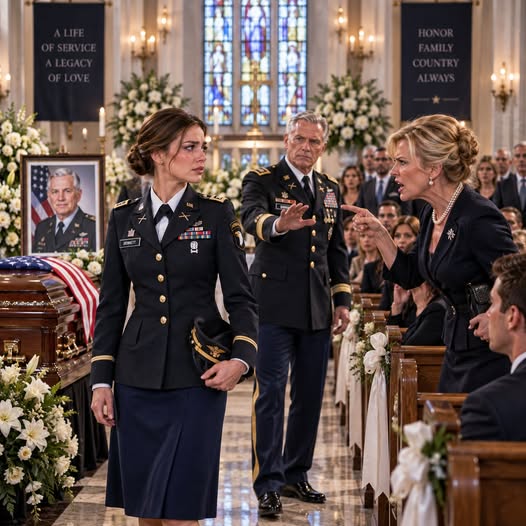
My mother tried to throw me out of my father’s memorial because I wore the military uniform he had personally asked me to wear.
I almost left.
Then a decorated veteran in the front row stood up and said:
“Your father warned me this might happen.”
My name is Laura Bennett.
Three months before my father died, he made me promise one thing.
“Wear your uniform to my memorial.”
I laughed when he first said it.
“Dad, can we not plan your funeral while you’re still arguing with nurses about hospital coffee?”
He smiled.
Cancer had taken weight from him.
It had not taken his stubbornness.
“I’m serious.”
“So am I.”
“Promise me.”
I looked at him through the phone screen.
I was stationed in Virginia at the time, and he was back home in Ohio.
My father, Robert Bennett, had spent most of my adult life feeling like somebody standing on the opposite side of a locked door.
We spoke.
Then we didn’t.
We tried again.
Then something happened.
A missed birthday.
A message that sounded colder than I expected.
A ceremony he didn’t attend.
Another Christmas where my mother told me:
“Your father thinks you made your choice.”
The choice was always the Army.
At least, that was what I believed.
So when Dad suddenly began calling me again during the final year of his life, I never fully understood why.
At first the calls were awkward.
Weather.
Football.
My job.
His garden.
Then one evening he said:
“I’ve missed too much.”
I didn’t know what to do with that.
Neither did he.
We never became one of those movie families where twenty years of hurt disappears because someone gets sick.
But we began speaking twice a week.
Then almost every day.
And three months before his death, he made me promise to wear my dress uniform at his memorial.
“Why?”
“Because I want people to see you as you are.”
That sentence stayed with me.
So when he died on a rainy Monday morning at sixty-eight, I kept my promise.
I arrived at St. Matthew’s Church in my Army Service Uniform.
My medals were aligned.
Shoes polished.
Hair regulation-perfect.
I had spent twenty-six years in uniform.
I had worn it in ceremonies, funerals, promotions, airports, hospital hallways, and once in a desert while trying not to think about the temperature.
But I had never felt more self-conscious wearing it than I did walking into my father’s memorial.
My mother saw me before I reached the family pew.
Elaine Bennett stepped directly into the aisle.
Her expression hardened.
“You are not sitting with the family dressed like that.”
I stopped.
Several people turned.
“Dad asked me to wear it.”
She gave a short laugh, loud enough for the nearby rows to hear.
“Your father regretted what the military did to this family.”
I felt the words like a physical blow.
“Mom—”
“Don’t make his memorial about you.”
I stared at her.
Behind her were relatives I had not seen in years.
My aunt looked down.
My cousin suddenly became fascinated by the memorial program.
Nobody intervened.
And maybe that was why the old doubt returned so quickly.
What if Mom was right?
What if Dad’s request had been one emotional moment from a dying man and everything she had told me for twenty years was still true?
Your father is disappointed.
Your father doesn’t understand why you keep choosing the Army.
Your father said not to invite him.
Your father doesn’t want another argument.
I swallowed.
“Fine.”
I turned toward the back.
I had almost reached the aisle leading to the exit when a chair scraped sharply across the church floor.
An older man stood from the first row.
He was tall even with age bending his shoulders slightly.
Silver hair.
Dark suit.
A row of miniature military decorations on his lapel.
I recognized him from photographs before I recognized his name.
Retired Colonel James Mercer.
Silver Star.
Bronze Star.
Former infantry officer.
Later the director of a regional veterans organization.
He looked directly at my mother.
“That’s enough, Elaine.”
Mom stiffened.
“This is a family matter.”
Mercer shook his head.
“Robert made it my matter.”
Then he looked at me.
His expression softened.
“Colonel Bennett.”
I was a lieutenant colonel, but I didn’t correct him immediately.
“Sir?”
“Your father told me you would come in uniform.”
Mom said:
“James—”
Mercer raised one hand.
“He also told me that if anyone tried to make you leave because of it, I was supposed to stand.”
The church became completely silent.
My mother’s face lost color.
I stared at him.
“How did you know my father?”
“He came to me for help.”
“With what?”
Mercer reached down to the chair beside him and picked up a thick brown folder.
“Fixing what he believed he had broken between you.”
My mother moved toward him.
“Don’t.”
That single word changed the room.
Not because it was loud.
Because it sounded afraid.
Mercer ignored her.
He opened the folder.
Inside were letters.
Printed emails.
Photographs.
Receipts.
And a boarding pass.
He removed the airline reservation first.
I recognized the date before I read the details.
Six years earlier.
Fort McNair.
The weekend I had been promoted to lieutenant colonel.
The ceremony my father had supposedly refused to attend.
My chest tightened.
Mercer held the paper out.
“Your father bought a ticket.”
I took it.
Columbus to Washington.
Friday afternoon.
Return Sunday.
Robert Bennett.
Paid in full.
Canceled the night before departure.
I looked at Mercer.
“Then why didn’t he come?”
Mercer took out a printed text message.
He hesitated before giving it to me.
“This was sent to your father.”
The message appeared to be from me.
Dad, please don’t come. I don’t want another argument at my promotion. Mom is right. Your presence will ruin the day.
I stared at it.
Read it again.
Then a third time.
“I never sent this.”
My mother immediately said:
“This is not the place.”
Mercer looked at her.
“No.”
His voice remained controlled.
“But you made sure there was never another place.”
I turned toward Mom.
“What is he talking about?”
She folded her arms.
“Your father was sick for a long time, Laura. James is turning private confusion into—”
“Mom.”
I held up the page.
“I never sent this.”
She said nothing.
“Who did?”
Nothing.
Mercer opened the folder again.
“There were other messages.”
My stomach dropped.
“What other messages?”
“Letters Robert believed you received.”
He placed another stack on the pew.
“Invitations you were never given.”
Another.
“Apologies he wrote and assumed you rejected.”
I could hear my heartbeat.
Mom said:
“James, stop.”
He looked at her.
“You had twenty years to stop.”
That landed harder than anything else.
Then Mercer removed a sealed white envelope.
My name was written across it in Dad’s shaky handwriting.
Laura
Mom stepped forward immediately.
“Do not open that here.”
I looked at her.
Not Mercer.
Her.
And in that moment I knew something inside the envelope frightened her more than my uniform ever could.
I reached for it.
Mercer stopped me gently.
“Before you read the letter, there is something Robert asked me to give you first.”
He reached deeper into the folder.
A small black flash drive.
I stared at it.
“What’s on there?”
“A video your father recorded six weeks before he died.”
My mother whispered:
“No.”
For the first time that morning, she looked genuinely terrified.
I looked at Mercer.
“What did he say?”
Mercer’s answer was quiet.
“He explained why he let you believe he had rejected you.”
My throat tightened.
“And?”
Mercer looked toward my mother.
Then back at me.
“He also explained why your mother spent years making sure neither of you discovered what the other one was really saying.”
And suddenly my father’s memorial was no longer about the uniform I had worn.
It was about twenty years of conversations that might never have happened the way I remembered them at all.