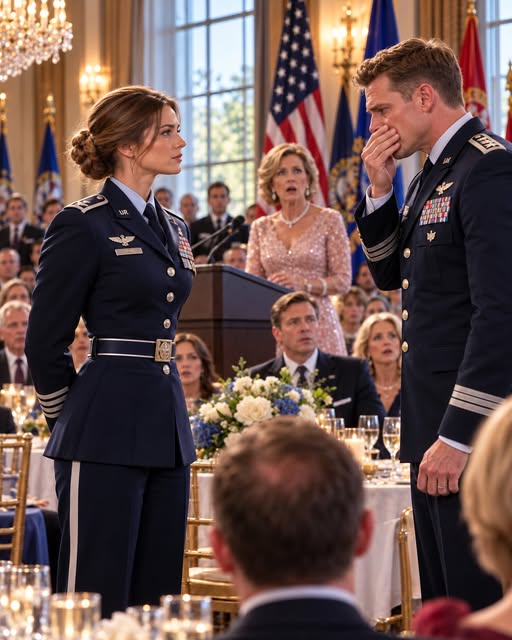
My mother stood before two hundred people and called me the greatest shame of her life, then proudly introduced a decorated Navy SEAL as “the son I always wished I’d had.” She expected him to help humiliate me—but the instant he studied my Marine uniform, his face went pale, his body stiffened, and he whispered, “Ma’am… you’re the One-Eighty-Seven?”
My mother, Judith Bennett, never needed to raise her voice.
She had spent decades learning how to humiliate someone with the calm precision of a surgeon making the first incision.
“Everything that girl has ever done,” she said into the microphone, “has brought me nothing but shame and disappointment.”
Two hundred conversations died at once.
Forks froze halfway to mouths. Ice shifted inside glasses while the old ceiling fans clicked overhead inside the Central Florida Veterans Hall.
I stood in the center aisle wearing my Marine Corps dress uniform, shoulders squared, hands relaxed at my sides. The overhead lights caught the double silver bars on my collar and the ribbons arranged precisely across my chest.
Nobody bothered studying them.
Everyone was watching my face, waiting for me to break.
Mom smiled as though humiliating her daughter publicly was some harmless family joke.
Beside her stood Chief Petty Officer Ethan Rourke, a highly decorated Navy SEAL. His trident rested above his left breast, surrounded by enough ribbons to make the civilians nearby stare with admiration.
Mom proudly placed her hand on his arm.
“Now, this is the son I always wished I’d had,” she announced. “A genuine elite warrior. Not some freeloader collecting a military paycheck for answering phones and scrubbing toilets on a base.”
Someone laughed.
Uncle Dean leaned back with bourbon in one hand and a cigar between his fingers despite the NO SMOKING sign behind him. Aunt Paula held up her phone, recording every second.
My cousin Tyler sat beside them in the seat normally reserved for the guest of honor.
He had been dismissed from a military academy before finishing his first year.
Apparently, in my mother’s private chain of command, even a failed male heir outranked her daughter.
Without changing my expression, I slipped my hand into my pocket and pressed the side button on my phone.
Recording started.
Training had taught me something important: memory became unreliable under pressure.
Evidence didn’t.
“She always wanted attention,” Mom continued. “Even as a child. Always pretending she was tougher than she really was.”
Nobody challenged her.
For years, she had told everyone the same story. I was the selfish daughter who abandoned her sick father. The ungrateful girl who ran away to play soldier. The embarrassment who wore a uniform without earning the right to represent the Bennett family.
She had repeated those lies until people stopped wondering whether they were lies at all.
I inhaled slowly.
Four counts in.
Hold for seven.
Eight counts out.
My pulse remained steady.
Then I noticed Ethan.
He wasn’t smiling anymore.
His eyes moved from the silver bars on my collar to the tactical intelligence insignia above my ribbons.
Something changed in his face.
He stared at me with the stunned recognition of a man seeing someone he had never expected to encounter in person.
Mom kept talking.
She didn’t notice that the very man she had chosen to help humiliate me had stopped listening.
Ethan stepped away from the podium.
The color drained from his face.
His heels suddenly snapped together.
The movement was automatic.
Military.
Respectful.
Then he looked directly at me.
“Ma’am…”
His voice actually trembled.
“You’re the One-Eighty-Seven?”
An elderly veteran near the front dropped his fork.
My mother stopped speaking.
Aunt Paula’s phone remained pointed at us as Ethan took another step toward me, his expression somewhere between disbelief and reverence.
For the first time that night, nobody was laughing.
And my mother was about to discover exactly who the daughter she had spent years calling a disgrace really was.
For several seconds, the only sound in the hall was the slow click of the ceiling fans.
Ethan stood a few feet from me, still at attention.
His eyes remained fixed on the insignia above my ribbons—the small emblem most people would have mistaken for decoration. It represented the intelligence community I had served with, the work I had never discussed outside secure boundaries, and a designation that had earned me an unwanted nickname among the people who knew what it meant.
One-Eighty-Seven.
Not a rank.
Not a title.
A call sign.
A reference to an operation years earlier, when a classified recovery mission had gone wrong and a Marine intelligence officer had kept a team alive long enough for them to come home.
The number had never appeared in any official biography.
It had only traveled quietly through the military, carried by people who had been there or had heard the story from someone who had.
Ethan had apparently heard it.
Mom looked from him to me.
“What are you doing?” she asked.
Her voice was still composed, but a thin uncertainty had entered it.
Ethan seemed to realize that two hundred people were watching him. He lowered his heels and glanced toward the podium.
“Ma’am,” he said carefully, “I’m trying to understand.”
“Understand what?”
He looked back at me.
I gave him the smallest shake of my head.
Not here.
Not yet.
He noticed. His expression tightened, but he respected the request.
That alone told me something about him.
“I may be mistaken,” he said. “It’s been a long time since I heard the story.”
Mom gave a short, nervous laugh.
“I have no idea what story you mean. My daughter has always been very good at collecting impressive-looking symbols.”
The old veteran who had dropped his fork leaned toward the aisle.
“Ethan,” he said, “you know that emblem?”
Ethan nodded.
“I know the designation.”
My mother’s fingers tightened around the microphone.
“What designation?”
The question came out sharper than she intended.
Ethan looked at her for a moment, and I could almost see the decision forming behind his eyes. He could explain. He could expose the truth in front of everyone. He could make the room turn toward me with the same hungry attention it had given my mother.
Instead, he chose restraint.
“That’s something Lieutenant Bennett should answer,” he said.
My mother’s face changed.
Only slightly.
But I knew her well enough to see it.
She had expected Ethan to be an ornament beside her. A decorated stranger whose uniform would lend weight to her insults. She had not expected him to recognize mine.
She turned toward me.
“Lieutenant?”
The word carried a challenge.
I removed my hand from my pocket, keeping the phone recording.
“Chief Rourke is right,” I said. “The designation is mine.”
A murmur moved through the room.
Mom’s smile disappeared.
“What does it mean?”
“It means some people in this room have been talking about a chapter of my life they never bothered to understand.”
Uncle Dean shifted in his chair.
Aunt Paula lowered her phone for the first time.
My mother’s eyes narrowed.
“Don’t make this dramatic.”
“I’m not the one who brought a microphone.”
That drew a few uncomfortable glances.
Mom had always been good at turning silence into agreement. But now the silence had changed. It no longer belonged to her.
It belonged to everyone.
She looked toward Ethan, searching for the ally she had expected him to be.
“Chief Rourke,” she said, “I’m sure you understand that family events sometimes get emotional. My daughter has always had a tendency to exaggerate her importance.”
Ethan did not answer immediately.
He looked at me again.
“Lieutenant Bennett,” he said, “may I ask you something?”
“You may.”
“Were you at Kestrel Ridge?”
The room seemed to contract.
I heard someone whisper, “What’s Kestrel Ridge?”
Mom’s hand fell away from the microphone.
I could feel my father’s absence in the question.
Kestrel Ridge had been the name of the operation that ended my active field work. Not because I had failed, though I had spent years believing I had. Not because I had been wounded in the way people expected. The consequences had been quieter than that.
A team had gone in with incomplete intelligence.
Our task had been to find them, confirm their location, and guide them toward extraction.
The situation had changed.
The route had collapsed.
Communications had failed.
And for six hours, I had been the only person between twelve exhausted Marines and a landscape that seemed determined to swallow them.
I had done what training required.
I had made decisions no one wanted to make.
I had carried voices in my headset that still visited me in dreams.
When it was over, the official report had praised the team’s discipline and credited the recovery to coordinated command.
My name appeared in an appendix.
The people who had been there knew better.
“Yes,” I said.
Ethan’s throat moved.
“I was one of the men you brought out.”
A quiet gasp passed through the hall.
Mom stared at him.
“You knew my daughter?”
“Not personally,” Ethan said. “Not then. We knew her voice.”
Something loosened in my chest, though I had not realized it was tight.
Ethan took one step closer.
“We were told an intelligence officer was coordinating from the forward position. We never saw her face. We only heard instructions. Calm, precise, patient. She kept us moving when the rest of us were ready to stop.”
He looked down at the ribbons on my chest.
“I didn’t know her name until later. By then, she had already been transferred.”
Mom’s gaze moved between us.
“But you served in the Navy,” she said. “How could you—”
“Joint operations,” Ethan replied. “Different branches work together more often than civilians realize.”
He did not say it unkindly.
He did not need to.
The explanation settled over the room like a curtain being drawn back.
The person my mother had called a glorified clerk had once guided a Navy SEAL team through a mission he had never forgotten.
Ethan’s expression softened.
“We called her One-Eighty-Seven because that was the number of the map grid she used to keep us alive. It became shorthand for the officer who never lost track of anyone.”
He looked directly at me.
“I’m sorry, ma’am. I should have recognized you sooner.”
“You had no reason to,” I said.
“I heard your voice over a bad radio. Years ago.”
“Most people don’t recognize voices after a decade.”
“I did.”
The room remained silent.
Then Uncle Dean gave a disbelieving laugh.
“Well, that’s all very interesting,” he said, lifting his bourbon. “But one mission doesn’t make someone a hero.”
Ethan turned toward him.
“No, sir. It doesn’t.”
The answer took the air out of Dean’s confidence.
Ethan continued, “Neither does a row of ribbons. Or a trident. Or a title. People earn those things by what they do when no one is watching.”
His eyes moved briefly toward my mother.
“That’s why I stopped listening when Lieutenant Bennett walked in.”
Mom’s face had gone pale.
She gripped the edge of the podium.
“You were supposed to speak about the veterans’ scholarship,” she said.
“I still will.”
“You were supposed to stand with our family.”
“I am standing with the truth.”
The words were quiet.
That made them harder to dismiss.
My mother looked at me.
For one fleeting moment, I saw something beneath the anger. Fear, perhaps. Or confusion. She had built the evening around a story she had told so many times that she had begun to treat it as fact.
In her story, I had left because I was selfish.
I had stopped calling because I was cold.
I had missed my father’s final days because I cared more about my career than my family.
She had needed those things to be true.
Otherwise, she would have had to ask herself harder questions.
Questions about what she had asked of me.
Questions about what I had been carrying.
Questions about why I had not come home.
She lifted the microphone again.
“Everyone is getting carried away,” she said. “My daughter was not at home when her father needed her. That is the truth that matters.”
The hall seemed to tilt.
There it was.
The real wound.
Not the insults.
Not the comparison to Ethan.
Not the staged introduction.
My father.
My mother knew exactly where to place the blade.
I looked past her to the framed photographs along the wall. Veterans in uniforms. Families standing beside flags. Faces frozen in moments of pride and grief.
My father had been in one of those photographs.
A younger version of him stood near the entrance, wearing a faded Army jacket and holding a paper cup of coffee. He had volunteered at the hall for years. He knew every loose floorboard and every veteran who came through the door.
He had also been the reason I joined the Marines.
Not because he pushed me toward the military.
Because he taught me that service was not about being admired. It was about showing up when someone needed you.
My mother had never understood that distinction.
Or perhaps she had understood it too well.
“I came home,” I said.
Her expression hardened.
“You came home after the funeral.”
“I came home before the funeral.”
Aunt Paula’s phone moved slightly.
My mother shook her head.
“No, you didn’t.”
“I did.”
“You sent flowers.”
“I arrived the night before.”
“You didn’t come inside.”
“I wasn’t allowed inside.”
A murmur moved through the nearest tables.
Mom’s mouth opened, then closed.
I had never said it in public.
For years, I had allowed people to believe I had stayed away because correcting the story would have meant explaining things my father had asked me to keep private.
But I had been home.
I had stood on the porch in my dress uniform, still carrying the dust of the airfield on my boots. I had knocked twice.
My mother had opened the door.
She had looked at me for a long time.
Then she had said, “You don’t get to come back now and perform grief.”
I had not argued.
My father’s hospice nurse, Miriam, had been behind her in the hallway. She had looked at me with tears in her eyes.
“He asked for you,” Miriam had whispered.
Mom had turned sharply.
“He was confused.”
“No,” I had said. “He wasn’t.”
That was when she had closed the door.
I had stood outside until the porch light went off.
The next morning, my father died.
I told no one.
Not because I was ashamed.
Because he had asked me not to make his illness into a battlefield between my mother and me.
He had known her anger.
He had known mine.
He had wanted peace more than he wanted to be defended.
Mom placed both hands around the microphone.
“You’re twisting things.”
“No,” I said. “I’m finally saying them plainly.”
Her eyes shone, but she refused to blink.
Ethan stepped away from us.
“Lieutenant,” he said softly, “do you need a moment?”
“I’m all right.”
He nodded but did not move far.
That was another thing I noticed.
He was not trying to rescue me.
He was making sure I knew I was not alone.
The distinction mattered.
Mom glanced at him.
“Chief Rourke, you don’t know this family.”
“No, ma’am,” he said. “But I know what it sounds like when someone is being blamed for something they didn’t control.”
Her expression faltered.
Before she could reply, a woman near the rear tables stood.
She was small, gray-haired, and wearing a blue cardigan over a veterans’ auxiliary shirt.
“Miriam?” Mom said.
The woman’s hands trembled slightly, but her voice did not.
“I was your husband’s nurse.”
Everyone turned toward her.
I had not known she would be here.
Miriam looked at me first.
“I’m sorry,” she said.
I nodded.
She walked slowly toward the center aisle.
“I told myself for years that it wasn’t my place to correct the story. Your father asked me to keep certain things private, and I believed I was honoring him.”
Mom’s face had lost what little color remained.
“Miriam, this is not appropriate.”
“It may not be comfortable,” Miriam said. “But it is appropriate.”
She stopped beside the first row of tables.
“Your daughter came to the house the night before your husband died. I saw her on the porch. I heard what you said to her.”
Aunt Paula lowered her phone completely.
Uncle Dean set down his bourbon.
Miriam looked at my mother.
“You told her he didn’t want to see her.”
Mom’s lips parted.
“That is not what happened.”
“It is what happened.”
“He was tired. He was confused.”
“He was awake. He asked me three times whether she had arrived.”
My heart gave one hard beat.
I had known he was awake.
I had not known he had asked for me.
Miriam reached into the canvas bag hanging from her shoulder.
She withdrew a small envelope.
The paper was worn at the edges.
“I kept this because I didn’t know where else to put it.”
She held it toward me.
I did not move.
“What is it?”
“Your father gave it to me.”
Mom stepped forward.
“Miriam, don’t.”
The command was not loud, but it carried the old authority I remembered from childhood.
Miriam did not retreat.
“He told me to give it to you if you ever came back to the hall.”
My mouth went dry.
“Why didn’t you give it to me before?”
“Because I didn’t know where you were.”
“You had my address.”
“I had an old address. The letters came back.”
I glanced at my mother.
She looked away.
That small movement told me more than any confession.
Miriam extended the envelope again.
This time, I took it.
My name was written across the front in my father’s handwriting.
Not Lieutenant Bennett.
Not sweetheart.
Just my name.
The name he had used when he wanted me to remember that I was his daughter before I was anything else.
I turned the envelope over.
The seal had been broken and carefully pressed closed again.
Someone had opened it.
Aunt Paula made a small sound.
Mom said, “I was trying to protect you.”
The hall went quiet.
I looked at her.
“From what?”
“From more disappointment.”
The sentence seemed to escape before she could stop it.
Miriam closed her eyes.
Ethan’s posture changed, not with anger but with attention.
I slid one finger beneath the envelope flap.
Inside was a folded sheet of paper and a small brass key.
The key was old-fashioned, marked with a blue plastic tag.
On the tag, in my father’s handwriting, were two words:
“Your room.”
I stared at it.
My childhood bedroom had been emptied years ago.
Or so I had believed.
I unfolded the letter.
The handwriting slanted across the page, uneven in places but unmistakable.
My dear Anna,
If Miriam gives you this, then you have finally come home when no one could tell you not to.
I had to stop reading.
The room blurred.
I had spent years telling myself that my father’s silence at the end had been unavoidable. That maybe he had not recognized me. That maybe the stories my mother told were easier to bear because they required no hope.
But he had written to me.
He had expected me.
I continued.
I know what your mother has said. I know what she believes. Some of it comes from fear, and some of it comes from pride. Neither makes it fair.
You did not abandon me.
You kept the promise you made when you were seventeen. You went where you were needed.
I folded the page slightly, trying to steady my hands.
At seventeen, I had told my father I would never let anyone depend on me and then be left alone.
He had thought I meant him.
I had meant everyone.
The letter continued.
But service has a cost, and I was afraid you were paying more than anyone knew. I asked your mother not to tell you how quickly I was declining because I did not want you to leave your work out of guilt.
I looked at Mom.
She stood frozen.
“You knew,” I said.
Her eyes filled.
“I knew he was sick.”
“You knew he asked you not to call me?”
“He said he didn’t want you distracted.”
“You could have told me.”
“I thought you would come running.”
“I would have.”
“That was the problem.”
The words were quiet.
There was no cruelty in them now. Only exhaustion.
Mom looked down at the floor.
“I couldn’t stand the idea that you would come back for him and then leave again.”
The confession settled between us.
For the first time, I saw the shape of her fear.
She had not wanted to lose my father alone.
She had not wanted to watch me leave after saving everyone else.
She had wanted proof that I belonged to her.
But instead of asking for it, she had tried to make me prove it.
And when I failed the test she had never explained, she turned the failure into a story she could survive.
That did not excuse what she had done.
But it made her human.
I read the final lines.
The key is for the cedar chest in your room. I kept the things you left behind. Not because I expected you to return, but because I hoped you would.
There is something inside you need to know before you decide what to do with this family.
Your mother will tell you I was disappointed in you.
She was wrong.
I was proud of you long before anyone else learned your name.
Love,
Dad
The letter shook in my hands.
I had imagined many versions of my father’s final thoughts.
None had included pride.
I pressed the paper against my chest.
Miriam looked at me with quiet sympathy.
“I’m sorry,” she said again.
I nodded, unable to speak.
Mom took one hesitant step toward me.
“Anna…”
I closed my eyes.
My name sounded different in her mouth now.
Not like an accusation.
Like a question.
I opened my eyes.
“What’s in the chest?”
She looked toward the hallway leading to the small offices and storage rooms.
“Your father’s things.”
“That isn’t what he meant.”
“No.”
“Then what is it?”
She swallowed.
“I don’t know.”
It was the first answer she had given me all evening that sounded entirely honest.
The elderly veteran at the front table cleared his throat.
“Cedar chest is still in the upstairs storage room,” he said. “Your father kept the key to that room in his desk.”
Mom turned to him.
“How do you know that?”
“Because I helped him move it.”
The veteran’s name was Walter Hayes. I remembered him from childhood. He had been my father’s closest friend at the hall, though he and my mother had never liked each other much.
Walter pointed toward the back corridor.
“Your father asked me to leave it alone after he passed. Said Anna would know what to do when she saw the key.”
I looked at the brass key in my palm.
Its edges had left a faint impression in my skin.
“Why did you invite me here tonight?” I asked Mom.
She flinched.
The question had been waiting beneath everything else.
She glanced at Ethan, then at the podium.
“I wanted you to come home.”
“That doesn’t explain the speech.”
“I wanted you to understand what people here think of you.”
“No. You wanted them to think what you think of me.”
Her eyes lowered.
“I was angry.”
“For how long?”
She gave a tired laugh.
“I don’t know.”
“Years?”
“Yes.”
“Since Dad died?”
“Before that.”
That surprised me.
Mom moved toward an empty chair and sat down.
The confident woman who had stood behind the microphone now looked suddenly older than she had when I arrived.
“When you joined the Marines,” she said, “your father was proud. I wasn’t.”
“I know.”
“No, you don’t.”
She rubbed her hands together.
“I was afraid. Every time the phone rang, I thought someone was calling with bad news. Your father told me fear was part of loving someone who served. I hated him for being able to accept that.”
I said nothing.
She continued.
“When you deployed, he learned how to read maps and follow news reports without asking questions. He kept a notebook. Every place you mentioned, he marked it down.”
A small smile passed across her face and vanished.
“I thought he was brave. I thought he was calm. But he wasn’t. He was terrified too.”
I looked down at the letter.
“Then why did you make it sound like he blamed me?”
“Because you didn’t come home when I asked.”
“I couldn’t.”
“I know that now.”
Her voice cracked.
“I didn’t know then.”
“You knew my orders were classified.”
“I knew you always had an excuse.”
The word hurt, though I had heard it many times.
Mom drew a breath.
“When your father got worse, I called the number I had for your unit. They wouldn’t tell me where you were. They said they would pass along a message.”
“They did.”
“When?”
“Three weeks later.”
Her face tightened.
“I didn’t know.”
“I know.”
That was the part I had never been able to understand. The message had reached me while I was preparing for an operation. It had said only that my father’s condition had changed and that I should contact home when possible.
I had tried.
The line had been unavailable.
Then the mission began.
By the time I returned, the message was old.
Mom looked at me.
“I thought you ignored me.”
“I never ignored you.”
“You stopped calling.”
“I called every time I was allowed.”
“Not enough.”
“No,” I said. “It wasn’t enough.”
The admission seemed to disarm her.
I could have defended myself. I could have listed every call made from airports, temporary bases, borrowed phones, and quiet corners where I had whispered into the dark.
But the truth was more complicated.
I had also avoided calling sometimes.
Not because I did not love her.
Because every conversation ended with her asking when I was coming home, and I never knew how to answer without disappointing her.
I had been tired of disappointing her.
So I had chosen silence, believing it would hurt less.
It hadn’t.
Mom looked toward the window.
“I thought if I made you angry enough, you would stay.”
I almost laughed.
“You thought humiliating me would make me stay?”
“I thought anger was stronger than distance.”
“That isn’t love.”
“No,” she said. “It isn’t.”
The simplicity of her answer reached me.
Across the room, Ethan stood beside the old display case, giving us privacy without leaving.
Uncle Dean had stopped looking amused.
Aunt Paula turned off her phone.
The audience no longer felt like an audience. They had become witnesses to something much quieter and more difficult than a public argument.
I folded my father’s letter and placed it carefully inside the envelope.
Mom watched me.
“What will you do?”
“I don’t know.”
“You can hate me.”
“I don’t hate you.”
“You should.”
“No.”
“Why not?”
“Because hate would make this easy.”
Her eyes filled again.
I looked toward the corridor.
“I want to see the chest.”
Mom nodded.
“I’ll take you.”
“No.”
She stopped.
“I’m going alone.”
The words were not punishment.
They were a boundary.
She understood that, at least.
“I’ll wait here,” she said.
I walked toward the hallway.
Behind me, Ethan spoke softly.
“Lieutenant.”
I turned.
He held out a folded napkin.
I looked down and realized I was still holding the edge of my father’s letter so tightly that the paper had begun to crease.
“Thank you,” I said.
He nodded.
Then, after a pause, he added, “For what it’s worth, the story about Kestrel Ridge was never about one person saving everyone.”
“I know.”
“It was about someone refusing to let the rest of us give up on ourselves.”
I looked at him.
“People remember the story differently.”
“Not the people who were there.”
His gaze shifted toward my mother.
“Some people may need time to hear the truth.”
“So may I.”
“That’s allowed.”
I gave him a faint smile.
“Chief Rourke?”
“Yes, ma’am?”
“Don’t call me One-Eighty-Seven.”
His expression softened.
“Understood, Lieutenant Bennett.”
I continued down the corridor.
The veterans’ hall had changed little since I was a child. The floors still creaked near the kitchen. The walls still carried framed certificates and photographs. A faded bulletin board displayed notices for blood drives, scholarship deadlines, and a Saturday breakfast fundraiser.
At the end of the corridor, a narrow staircase led upstairs.
I climbed slowly.
The door at the top was unlocked.
Dust covered the boxes stored along the walls, but the cedar chest sat beneath the only window, exactly as I remembered. Its surface was scratched near the front corner where I had once dragged it across my bedroom floor while trying to move it by myself.
I placed the key in the lock.
It turned easily.
Inside were things I had forgotten.
A blue scarf I had worn in high school.
A stack of letters from my father, most of them written during my first year of training.
A baseball glove.
Photographs.
A small wooden model of a ship.
And beneath everything else, wrapped in a faded blanket, was a black binder.
I lifted it out.
The cover bore no label.
Inside were pages of handwritten notes, printed emails, copies of official documents, and photographs from years I had thought my father had been too ill to notice.
The first page stopped me.
At the top, in my father’s handwriting, were the words:
“What Anna was never told.”
I sat on the floor beside the chest.
The binder contained letters I had written home that never reached him.
Some were addressed to my mother.
Some to my father.
One was dated three days before Kestrel Ridge.
I remembered writing it in a temporary communications room, late at night. I had described the team in general terms, careful not to reveal anything classified. I had written that I was tired, that I missed home, and that I hoped Dad was proud of me.
I had never received a reply.
Now, clipped behind the letter, was a page in my father’s handwriting.
I received this one.
Your mother said there were no letters.
I turned the page.
There were more.
A photograph of me in uniform, sent from a base overseas.
A birthday card I had mailed to my father.
A handwritten note from Miriam saying he had smiled when he read it.
At the back of the binder was a sealed envelope.
This one was not addressed to me.
It was addressed to my mother.
I stared at it for a long time.
Then I noticed the date.
It had been written two weeks before my father died.
I heard footsteps on the stairs.
Mom stopped in the doorway.
She did not ask what I had found.
She knew.
Her face changed when she saw the envelope.
“You weren’t supposed to open that.”
“I haven’t.”
She gripped the doorframe.
“Your father gave it to me.”
“Why is it here?”
“I couldn’t read it.”
“You opened it.”
“I saw the first line.”
“What did it say?”
She looked at the floor.
“That he knew why I had kept your letters.”
The words settled heavily between us.
I lifted the envelope.
“Why did you?”
Mom closed her eyes.
For a moment, I thought she would leave.
Instead, she stepped inside and sat on the floor opposite me.
“I was angry,” she said.
“You said that.”
“I was angry that you had a life where you were needed. Your father had his memories, his friends, his routines. I had a house full of reminders that everything was changing.”
She looked at the binder.
“Your letters made it worse.”
“How?”
“They proved you loved us. And they proved you were still far away.”
I understood then.
The letters had not been weapons.
They had been mirrors.
Every one of them showed her the distance she could not cross.
“So you kept them from Dad.”
“I told myself I was protecting him from disappointment.”
“Did he know?”
“I think he did.”
“Why didn’t he confront you?”
“Because he loved me.”
The answer was almost a whisper.
I looked at the unopened envelope.
“What did he want you to do?”
“I don’t know.”
“You should read it.”
She shook her head.
“I tried once.”
“And?”
“I couldn’t.”
I held it out to her.
She did not take it.
“You read it,” she said.
“It’s addressed to you.”
“I’m asking you.”
“Why?”
“Because I need to know whether he forgave me.”
The question was so fragile that I almost missed it.
My mother, who had spent years insisting she was right, was asking whether my father had forgiven her.
I looked at the envelope.
Then at her.
“Forgiveness isn’t something I can give you on his behalf.”
“I know.”
“And I don’t know if he used that word.”
“Please.”
The plea was quiet.
Not a command.
Not manipulation.
A request.
I broke the seal.
Inside was a single sheet.
Judith,
If you are reading this, then I was not brave enough to say everything while I was still here.
I paused.
Mom’s breathing grew uneven.
I continued.
You were not wrong to be afraid. You were not wrong to want our daughter close. But fear cannot become a home. If you keep asking Anna to prove that she loves us by abandoning what she was called to do, you will lose her—not because she does not love you, but because love cannot survive inside a test that has no answer.
Mom covered her mouth.
I read on.
She will come home differently than she left. You will, too. Do not punish her for the years she spent becoming someone strong enough to carry what others could not. And do not ask her to become small so you can feel safe.
The final paragraph was shorter.
I forgive you for the letters.
I hope one day you forgive yourself.
There was no signature.
There did not need to be.
Mom bowed her head.
For several minutes, neither of us spoke.
Dust moved through the sunlight above us.
Finally, she said, “He knew everything.”
“Yes.”
“And he still loved me.”
“Yes.”
She wiped her cheek.
“Do you?”
The question was not about my father.
I folded the letter and placed it between us.
“I love you.”
Her shoulders lowered.
“But I can’t pretend nothing happened.”
“I don’t want you to.”
“I can’t come back and become the daughter you imagined.”
“I know.”
“I may not come back often.”
“I know.”
“And if we try to repair this, it has to be honest. No speeches written for me. No stories about my service. No using other people to make a point.”
Mom nodded.
“No more comparisons.”
“No.”
“No more telling people I abandoned Dad.”
“No.”
“You may have to correct that story yourself.”
“I will.”
“Even if it makes you look bad.”
She met my eyes.
“It already does.”
That answer surprised me.
It was not enough to heal everything.
But it was a beginning.
Mom reached toward the binder, then stopped.
“May I see the letters?”
I handed it to her.
She read the first one in silence.
Then another.
Her face changed with each page—not dramatically, but steadily, as if she were meeting a version of me she had refused to see.
When she reached the letter written before Kestrel Ridge, she pressed it against her chest.
“You sounded so young,” she said.
“I was young.”
“I thought you were fearless.”
“I was terrified.”
“Why didn’t you tell me?”
“Because every time I admitted fear, you asked me to come home.”
She closed her eyes.
“I would have.”
“I know.”
“I would have driven anywhere.”
“I know.”
“That should have mattered.”
“It did.”
“Then why didn’t you come?”
I looked toward the small window.
“Because other people were waiting for me too.”
Mom nodded slowly.
For once, she did not argue with the answer.
We stayed upstairs until the hall below began to empty.
When we finally returned, Ethan was standing near the entrance with Walter Hayes. The microphone had been removed from the podium. The room looked different without it.
Aunt Paula approached me first.
“I owe you an apology,” she said.
I raised an eyebrow.
“For recording you.”
“You deleted it?”
She held out her phone.
“I did.”
I looked at her.
“And?”
“And I’m sorry I thought it was entertainment.”
The apology was awkward, but sincere.
I nodded.
“Thank you.”
Uncle Dean stood behind her.
He had aged in the two hours since I arrived.
“I was wrong,” he said.
I waited.
He sighed.
“About the phones. About the military. About you.”
“Thank you.”
He looked uncomfortable with the lack of argument.
“Your father would’ve been proud.”
“He was.”
Dean glanced at Mom.
She had stopped near the doorway, holding the cedar key in one hand and the letter in the other.
Dean’s expression softened.
“I should’ve asked more questions,” he said.
“So should all of us,” Walter replied.
The old veteran leaned on his cane and looked toward the empty podium.
“Most families have one story they tell because it’s easier than the truth.”
“What’s yours?” I asked.
Walter smiled faintly.
“My wife believed I was brave because I went to war. Truth is, I was scared every day. She loved me enough not to ask for a better story.”
The hall grew quiet again, but this silence felt different.
It had room in it.
Room for regret.
Room for honesty.
Room for the possibility that people might change if they were willing to remain uncomfortable long enough.
Ethan approached me last.
“I’m leaving for Jacksonville in the morning,” he said. “There’s a training conference.”
“Then you should get some rest.”
“I wanted to say goodbye.”
“You barely know me.”
“I know enough.”
He glanced at my father’s letter.
“Your mother asked me to stand beside her tonight because she said you needed to be reminded what real service looked like.”
I looked toward Mom.
“She told you that?”
“She did.”
“What did you think?”
“I thought she was trying to convince herself.”
That sounded like him.
“Why did you agree?”
“Because she said the scholarship was for military families. I thought it might help.”
Mom spoke from behind us.
“It still will.”
We turned.
She walked toward the podium and picked up a folder.
“I made the announcement before dinner,” she said. “The Bennett Family Veterans Scholarship.”
I frowned.
“What does that have to do with me?”
“Your father started it. He wanted to provide tuition assistance for children and spouses of service members. I took over the paperwork after he got sick.”
She handed me the folder.
Inside were financial statements, application forms, and a draft announcement.
At the bottom of the first page was a line I had not expected.
“Named in honor of Thomas Bennett.”
My father.
“He wanted it named after you,” Mom said.
I looked up.
“After me?”
“He said you were the reason he understood what service meant.”
My fingers tightened around the folder.
“Then why did you call me a shame?”
Mom looked at the empty podium.
“Because I was ashamed of how much I needed you.”
No one spoke.
She continued.
“I wanted to present you with the scholarship tonight. Then I saw you standing there in uniform, and I remembered every year you were gone. I thought if I made you feel small first, I could keep myself from feeling small beside you.”
“That doesn’t make sense.”
“I know.”
“It hurt.”
“I know.”
“You can’t take it back.”
“No.”
She looked at me fully.
“But I can stop repeating it.”
That was the first promise she had made that did not ask anything from me.
I closed the folder.
“What do you want me to do with this?”
“Decide whether you want your name connected to it.”
“I don’t want my name on it.”
Mom nodded.
“I thought you might say that.”
“My father’s name is enough.”
“I agree.”
“And I want the scholarship committee to include people who actually understand military families. Not just relatives and donors.”
“That can be arranged.”
“Ethan?”
He looked surprised.
“If he’s willing, I’d like him to help review the applications.”
Ethan glanced at Mom.
“I’d be honored.”
“Walter too.”
Walter gave a solemn nod.
“And Miriam,” I added.
Miriam, who had been gathering her bag near the door, looked startled.
“I’m not on the board.”
“You cared for my father when none of us knew how. That qualifies you.”
Her eyes softened.
“I’d be glad to help.”
Mom looked at the group.
For the first time that night, she seemed to understand that the scholarship could become something larger than her grief.
Something my father had imagined.
Something none of us had to own alone.
Outside, rain had begun tapping against the hall windows.
Florida rain—sudden, warm, and steady.
Ethan offered to walk me to my car, but I declined.
“I need a minute.”
He nodded.
“I’ll be by the entrance.”
I stood alone in the center of the hall.
The same place where my mother had called me a shame.
The same place where Ethan had recognized me.
The same place where a story had been interrupted by the truth.
My phone still rested in my pocket, the recording continuing until I finally pressed stop.
I looked at the timestamp.
Two hours and eleven minutes.
A complete record of the evening.
I considered deleting it.
Then I remembered what training had taught me.
Evidence mattered.
Not to punish anyone.
To protect memory from being rewritten.
I saved the file and labeled it simply:
“Bennett Hall — September 27.”
When I stepped outside, Mom followed me.
She stood beneath the awning, listening to the rain.
For a moment, we watched the parking lot shine beneath the lamps.
“Will you come to the scholarship meeting?” she asked.
“When is it?”
“Saturday.”
“I’ll be there.”
Her face tightened with cautious hope.
“As my daughter?”
I looked at her.
“As someone who wants to see what happens next.”
She accepted that answer.
It was not everything.
But it was honest.
I started toward my car, then stopped.
“Mom.”
“Yes?”
“Did Dad leave anything else?”
She looked toward the
“Did Dad leave anything else?”
She looked toward the dark windows of the hall.
“Maybe.”
The answer was so quiet I almost missed it.
I turned fully toward her. “What does that mean?”
Mom folded the letter against her palm. “There’s something I never told you about the week before he died.”
Rain whispered against the awning. Behind us, chairs scraped across the floor as Walter and the others began clearing the hall.
“What is it?”
“He asked me to take him somewhere.”
“Where?”
“The airfield.”
I stared at her.
My father had been too weak to climb the stairs without help. He had needed oxygen at night and slept most afternoons. The idea of him going anywhere seemed impossible.
“Why didn’t you tell me?”
“Because I didn’t understand it.”
“What happened?”
She glanced at my uniform, then away.
“He said he wanted to see you.”
My chest tightened.
“Mom.”
“He knew you wouldn’t be there physically. He understood that. But he said you had left something there.”
“I didn’t.”
“You did.”
Her words brought back a place I had not thought about in years: the small municipal airfield outside town, where military transport planes occasionally landed and where I had spent one afternoon with my father before my first deployment.
I had been seventeen then, still in high school, still convinced that joining the Marines would prove something I couldn’t name. My father had taken me to the airport because he said I needed to learn the difference between leaving and running away.
We had sat on a bench beside the chain-link fence and watched a cargo plane rise into the evening sky.
He had given me a small brass compass.
“Keep this,” he’d said. “Not because it will always point you home. Sometimes home changes. Keep it because it will remind you to decide where home is.”
I had carried it through training.
Then, during my first deployment, I had lost it.
Or thought I had.
“What did he leave?” I asked.
Mom reached into the pocket of her cardigan and withdrew a white envelope.
“I found it in his desk after he died. I couldn’t bring myself to open it.”
She held it out.
My name was written on the front.
Not in my father’s hand.
In Mom’s.
I did not take it immediately.
“Why is my name on it?”
“Because he asked me to write it.”
“Did he tell you what was inside?”
“No.”
“Then why didn’t you give it to me?”
Her eyes met mine.
“Because I was afraid it would be another thing proving I had failed you.”
The honesty of it hurt more than an excuse would have.
I accepted the envelope.
The paper felt thicker than the first one.
“Where did he want you to take him?”
“The airfield. He said there was a locker.”
I looked toward the rain.
“What locker?”
“I don’t know. He gave me a number, but I lost the paper.”
“Did you go?”
“Yes.”
“When?”
“Two days before he died.”
“And?”
“I couldn’t find anything. The airport office was closed, and the old storage building had been renovated. I came home and put the envelope in the desk.”
“You never asked anyone?”
“I was angry.”
“At him?”
“At you.”
I said nothing.
She rubbed her thumb along the edge of the letter.
“I thought he had arranged some grand gesture because he knew you were coming. Then you didn’t. I convinced myself it was one more way he had chosen you over me.”
“Dad didn’t choose me over you.”
“I know that now.”
“No. You know it because he wrote it down. That isn’t the same as understanding it.”
Mom looked at me.
“You’re right.”
The words left her without resistance.
I looked at the envelope again.
“Do you want to come with me?”
Her expression shifted.
“Now?”
“The airfield closes at ten. We have forty minutes.”
She glanced through the glass doors toward the hall.
“Your car?”
“Is across the parking lot.”
“I meant… do you want me there?”
I understood what she was really asking.
Did I want her beside me while we opened another piece of my father’s life?
I thought about the promise I had made upstairs.
Honesty.
No pretending.
No returning to the old roles.
“I don’t know,” I said. “But I don’t want to go alone.”
Mom nodded.
“I’ll come.”
Ethan appeared near the entrance, coat in hand.
“Everything all right?” he asked.
“We’re going to the airfield,” I said.
His eyes moved to the envelope in my hand.
“Do you need company?”
I almost said no.
Then I looked at Mom.
“Not this time.”
He accepted it immediately.
“Understood.”
Walter approached with a ring of keys.
“The office has a spare key to the old storage building,” he said. “Your father kept it in his desk.”
Mom stared at him.
“You knew?”
“I knew he had something planned. I didn’t know what.”
“Why didn’t you tell me?”
“Because he asked me not to.”
She gave a tired smile. “Everyone was keeping secrets.”
“Not secrets,” Walter said. “Promises.”
Mom looked away.
Walter handed me the key.
“If the number was painted on the old lockers, they may still be there. The airport moved most of them, but the maintenance crew stored the old units in the hangar.”
“I’ll return this.”
“Keep it until you know whether you need it.”
Ethan opened the door for us.
As Mom passed him, she paused.
“Thank you,” she said.
“For what?”
“For believing her before I did.”
Ethan glanced at me.
“I believed what I heard.”
Mom nodded, absorbing the distinction.
Outside, the rain had softened to a mist.
We drove separately. Mom followed my car through the wet streets, her headlights steady in my rearview mirror.
The airfield was only fifteen minutes away, but neither of us spoke on the phone. The silence between us had changed. It was no longer the silence of avoidance. It was the silence of two people carrying the same question.
The airport office was dark when we arrived. A security guard met us at the gate, recognized my mother, and listened while I explained that we were looking for an old storage locker connected to a former airport volunteer.
He checked the key against the logbook.
“Thomas Bennett?”
“Yes,” Mom said.
The guard studied her face.
“I remember him. He used to bring coffee to the night crews.”
“He loved this place,” she said.
“People noticed.”
He directed us toward a low metal building at the edge of the property.
The old storage units were lined against one wall inside, dusty and numbered in fading black paint. Some doors had been removed. Others hung crookedly from rusted hinges.
I held up the envelope.
“Do you know the number?”
Mom closed her eyes, searching her memory.
“Seventeen. I think.”
We walked past the first row.
Eleven.
Twelve.
Thirteen.
At the end of the second row, beneath a broken fluorescent fixture, I saw it.
17.
The door was locked.
The key from Walter’s ring fit.
Mom remained several steps behind me.
“Do you want me to—”
“I’ve got it.”
The lock turned with a reluctant scrape.
Inside was a narrow wooden box, a stack of folders, and a canvas duffel bag with my father’s initials stitched near the handle.
I knelt.
The box was familiar.
It was the same kind of box he had used to store old service photographs and medals. On top sat a folded map of the airfield.
The date in the corner was from three weeks earlier.
I unfolded it.
A red mark circled the bench beside the eastern fence.
The bench where we had watched the cargo plane together.
Mom came closer.
“He went there?”
“He tried.”
She looked toward the door.
“His legs were too weak.”
“Maybe someone took him.”
“Miriam said he wouldn’t let anyone drive him without telling me.”
I examined the map.
A note was written in the margin.
Not in my father’s handwriting.
In mine.
I recognized it immediately.
“Where did you get that?” Mom asked.
I touched the words.
“From a letter.”
“What does it say?”
I read aloud.
“‘The place where leaving became a choice.’”
Mom’s hand rose to her throat.
I remembered writing that sentence in a journal during my first year of service. I had not known my father had seen it.
Beneath the map was a sealed plastic bag.
Inside lay the brass compass.
The one I had thought I lost.
I lifted it carefully.
The metal was scratched, and the glass had a thin crack across it, but the needle still moved.
My breath caught.
“How did he find it?”
Mom shook her head.
“I don’t know.”
A photograph beneath the compass answered the question.
It showed a young Navy corpsman kneeling beside a shallow ditch, holding something in his gloved hand.
The back of the photograph was dated two days after Kestrel Ridge.
I turned it over.
The corpsman had written:
Found near Grid 187. Returning to officer when possible.
I stared at the number.
One-Eighty-Seven.
Mom watched my face.
“What is it?”
I handed her the photograph.
She read the note.
“Grid 187.”
“That’s where we lost the route.”
“Your call sign.”
“It wasn’t originally a call sign.”
I remembered now.
The compass had disappeared during Kestrel Ridge. I had been kneeling over a map when the ground shifted beneath us, sending equipment sliding down a muddy slope. I had assumed it was gone forever.
The corpsman must have found it afterward.
Somehow, years later, he had returned it to my father.
There was a name beneath the note.
Corpsman Daniel Reyes.
I searched the folders.
The first contained an email from a veterans’ organization. The second held a letter from a Navy medical unit. The third was a printed message from Ethan Rourke.
I looked at Mom.
“He knew Ethan.”
“Who?”
“Dad.”
The message was dated six months before my father died.
Chief Rourke,
I was given your name by a friend who served with my daughter. I understand that you were present during the Kestrel Ridge recovery. I am not asking for details. I only want to know whether she came home believing she had failed.
I read the next line twice.
If you ever speak with her, please tell her that bringing everyone back was enough. She does not need to earn our pride by saving us from every sorrow.
The message had been signed:
Thomas Bennett.
There was no reply attached.
Mom sat on the wooden crate beside the locker.
“He reached out to Ethan?”
“Apparently.”
“Why didn’t Ethan tell me?”
“Maybe he didn’t know who you were.”
“Did Dad know him personally?”
“No. He must have found him through the veterans’ network.”
Mom looked down at her hands.
“He was trying to help you.”
“Yes.”
“And I thought he was hiding things from me.”
“You were hiding things from him.”
She nodded.
“I know.”
I continued through the folders.
There were copies of letters my father had sent to military contacts, asking them to locate people connected to my service. There were notes from Daniel Reyes, who had eventually found the compass in a storage case. There was a photograph of a small reunion at a veterans’ center.
In the photograph, Daniel stood beside Ethan.
On the back, my father had written:
They remember her not as a symbol, but as a person.
I sat on the floor beside the box.
For years, I had believed my father’s silence meant absence.
Instead, he had been quietly gathering every piece of my life he could find.
He had not known how to reach me.
He had not stopped trying.
Mom reached for one of the folders.
Inside was a letter from Daniel.
Thomas,
You asked whether Anna seemed afraid at Kestrel Ridge. The honest answer is yes. She was afraid, and she kept working anyway. That is what most civilians don’t understand. Courage was never the absence of fear in your daughter. It was the decision not to let fear choose for her.
Mom read over my shoulder.
Her lips pressed together.
“I wish he had told me.”
“Maybe he did.”
“No. He didn’t.”
“He may have thought you knew.”
She gave a small, sad laugh.
“Your father believed people could see the love behind his silence.”
“That was not always his strongest skill.”
“Neither was mine.”
The guard appeared at the doorway.
“You found what you needed?”
I looked at the compass in my palm.
“More than I expected.”
He nodded.
“Your father came here once with a folder. Asked me whether the old storage units were still in use.”
“Did you see him?”
“Not that day. I spoke with him by phone. He said he wanted to leave something where you could find it.”
“When was this?”
“About a month before he passed.”
Mom lowered her eyes.
“Why didn’t you tell us?”
“You didn’t ask. And he said it was private.”
There it was again.
Promises.
Not secrets.
We thanked him and carried the box to my car.
Mom held the duffel bag. I carried the folders and compass.
Before she closed the trunk, she turned to me.
“Are you angry?”
“Yes.”
“At me?”
“At many things.”
“Do you want to talk about them?”
“Not all tonight.”
She nodded.
“Fair.”
I placed the compass in my pocket.
“Are you angry at Dad?”
She considered the question.
“Sometimes.”
“For what?”
“For making me responsible for being the strong one.”
“He didn’t.”
“He did, without meaning to. He trusted me to manage everything. The bills. The house. Your absence. His illness. I was so busy being capable that I forgot how to ask for help.”
I leaned against the car.
“You could have asked me.”
“I know.”
“You could have asked anyone.”
“I know.”
“Why didn’t you?”
“Because I thought if I needed help, I would lose control.”
I understood more than I wanted to.
“That sounds familiar.”
She looked at me.
“Yes.”
The rain had stopped completely. Clouds were breaking above the runway, revealing a few clear stars.
Mom rested one hand on the trunk.
“I don’t want to be your enemy.”
“You aren’t.”
“I don’t want to be a problem you have to solve.”
“You aren’t that either.”
“Then what am I?”
I searched for an answer that was both kind and true.
“My mother.”
Her eyes filled.
“That sounds simple.”
“It isn’t.”
“No.”
She closed the trunk.
“Will you stay at the house tonight?”
I hesitated.
The question held too many memories: my childhood room, my father’s empty chair, the hallway where Mom had once closed the door.
“I’ll stay at a hotel.”
She nodded, though disappointment crossed her face.
“Tomorrow?”
“I’ll come to the scholarship meeting.”
“I meant breakfast.”
I thought about it.
“Coffee.”
“That’s not breakfast.”
“It’s a start.”
A real smile touched her mouth.
“Yes. Coffee.”
We drove back to town separately.
At the hotel, I placed the compass, letter, and folders on the small desk beside the window. I called Walter to tell him what we had found. He listened without interrupting.
“Your father wanted you to know the whole story,” he said.
“I’m not sure I know what the whole story is.”
“Neither did he. That’s the trouble with families. Everyone carries a piece and assumes someone else has the rest.”
“Did he ever talk to you about Mom?”
“Often.”
“What did he say?”
“That she was afraid you would outgrow her.”
“She did say something like that.”
“Your father said fear made her hold too tightly. He also said you sometimes pulled away before anyone could ask you to stay.”
I looked at the compass.
“He was right.”
“Being right doesn’t make him wise in every matter.”
“No.”
“Anna?”
“Yes?”
“You don’t have to decide tonight whether forgiveness is possible.”
“I know.”
“But you should decide whether truth is worth the inconvenience.”
I looked toward the rain-dark window.
“It is.”
“Then you’re already doing what he hoped.”
After we hung up, I opened the final folder.
Inside was a document bearing the letterhead of the Veterans Hall.
It was a draft of the scholarship charter.
My father had written the original language himself.
The program would provide tuition assistance, emergency housing support, counseling referrals, and mentorship for military families. It was not limited to combat veterans or decorated service members. It included spouses, caregivers, and children.
At the bottom, he had written a note:
Service does not end when the uniform comes off. Sometimes it begins with the people who wait at home.
I read the line several times.
Then I understood why Mom had wanted the evening to be perfect.
She had not simply been announcing a scholarship.
She had been trying to prove that our family still had a purpose.
She had gone about it badly.
But beneath the pride and anger, there had been love.
The next morning, Mom was waiting outside the coffee shop before I arrived.
She had changed into a pale blue blouse and carried no folder, no microphone, no prepared remarks.
That mattered.
I parked beside her and walked over.
“You’re early,” I said.
“I was afraid you might change your mind.”
“I almost did.”
She nodded.
“I understand.”
We went inside.
The café was quiet, filled with the smell of coffee and cinnamon. We chose a table near the window.
For a while, neither of us spoke.
Then Mom said, “I contacted the families who heard me last night.”
“All of them?”
“I sent a message to the veterans’ hall mailing list. I told them I had repeated a false version of your father’s final days and that you had not abandoned him.”
I studied her face.
“You did that without asking me?”
“Yes.”
“Why?”
“Because correcting the story shouldn’t depend on whether you forgive me.”
That answer stayed with me.
She placed a folded paper on the table but did not push it toward me.
“I also withdrew the speech I wrote.”
“What will you say tonight?”
“The truth.”
“That’s vague.”
“I’m still working on it.”
“Good.”
She smiled faintly.
“You always hated speeches.”
“I hate speeches written by people who don’t listen.”
“I’ll remember that.”
Our coffee arrived.
Mom wrapped both hands around her cup.
“Can I ask you something?”
“Yes.”
“Why did you never tell me about Kestrel Ridge?”
“Because I thought you would hear the wrong part.”
“What wrong part?”
“That I had been afraid.”
She looked down.
“I would have heard that you were alive.”
“Maybe. But I wasn’t sure.”
“I’m sorry.”
I stirred my coffee.
“I don’t want apologies that end the conversation.”
“Then what do you want?”
“I want you to ask questions and listen to the answers, even if they make you uncomfortable.”
She nodded.
“I can do that.”
“And I’ll try not to disappear when I’m afraid of disappointing you.”
“That would help.”
“It may not happen perfectly.”
“Neither will my listening.”
“Then we’ll both have work.”
“Yes.”
The word felt like an agreement.
Not a promise of easy healing.
A promise to continue.
At the scholarship meeting that evening, the hall was full again, but the atmosphere had changed.
The microphone remained on the podium.
Mom stood beside it, looking at the crowd.
I sat in the front row with Ethan, Walter, Miriam, and Daniel Reyes, who had driven up from Tampa after Ethan called him. Daniel was older than the photograph but still carried himself with the quiet alertness of someone accustomed to noticing what others missed.
When Mom introduced him, she did not call him a hero.
She said, “This is the man who returned something my husband believed belonged to our daughter.”
Daniel handed me a small cloth pouch.
“The compass was in my effects for years,” he said. “Your father tracked me down through a mutual friend. He wanted to give it to you himself, but by then he couldn’t travel.”
“I thought he found it.”
“He did. I only kept it safe.”
“Why didn’t you contact me?”
He glanced at Mom.
“Your father asked me to wait until he knew how to explain.”
“Explain what?”
“That you never lost your direction. You only thought you had.”
I looked at the compass.
The needle trembled, then settled.
Mom stepped to the microphone.
“I prepared remarks for tonight,” she began. “They were polished and impressive. They were also wrong.”
No one moved.
She took a breath.
“My daughter did not abandon her father. She served during a time when she could not come home, and when she did come home, I refused to let her see him. I told myself I was protecting him. In truth, I was afraid of being left behind.”
Her voice shook, but she continued.
“I allowed grief to become a story in which I was the only injured person. That story was unfair to my daughter, to my husband, and to every family who has ever waited for someone in uniform.”
I watched the room.
Some people looked down.
Others looked at me.
Mom did not turn toward me until the end.
“My husband believed service was measured not by applause, but by what we did when no one was watching. This scholarship will carry his name. It will support families, caregivers, and service members who are trying to remain connected across distance, duty, illness, and change. It will not be a monument to our family. It will be a promise to others.”
She stepped away from the microphone.
The applause began slowly.
Then it grew.
Not loud enough to erase the past.
Strong enough to acknowledge the truth.
Ethan stood and joined it.
Walter followed.
Miriam wiped her eyes.
I remained seated for a moment, holding the compass.
Then I rose.
Mom watched me approach the podium.
I did not take the microphone.
“I’m not prepared to make a speech,” I said.
A few people smiled.
“But I want to say one thing. My father taught me that service means showing up when someone needs you. Sometimes that means crossing a dangerous place. Sometimes it means sitting beside a hospital bed. Sometimes it means admitting that you were wrong and staying long enough to hear how your mistake affected someone else.”
I looked at Mom.
“I’m still learning what it means to come home.”
Her eyes filled.
“So are we,” she said.
I turned toward the crowd.
“The scholarship should help people do that—whatever home means to them. That’s what my father would have wanted.”
This time, the applause came easily.
Afterward, people gathered around the tables to ask questions about the program. Daniel spoke with a family whose daughter was preparing for military service. Ethan helped a young veteran complete an application. Miriam explained the caregiver support portion to several spouses.
Mom moved through the room without trying to control it.
She listened.
When she saw an old neighbor begin to repeat the familiar story about my father, she corrected it gently.
Not dramatically.
Just clearly.
“Actually, Anna came home before the funeral. I was the one who turned her away.”
The neighbor looked startled.
Mom did not soften the truth.
That was how I knew she meant it.
Late in the evening, when the hall had emptied, I found her standing beside the framed photograph of my father.
She held a fresh brass plaque in her hands.
“What’s that?” I asked.
“The scholarship committee approved the wording.”
She showed it to me.
Thomas Bennett Veterans and Family Scholarship.
Below the name was a line:
“Service continues wherever love refuses to give up.”
I ran my fingers over the edge.
“He would have liked it.”
“I think so.”
“Did you choose the line?”
“Yes.”
“Did he write it?”
“No. You did.”
I looked at her.
“When?”
“On the back of that photograph from Kestrel Ridge.”
I remembered the old note in my father’s binder. I must have written the words years ago, perhaps in a letter or journal. I had forgotten them.
Mom had not.
She placed the plaque beneath the photograph.
For a while, we stood together.
The hall was almost silent now. The ceiling fans had stopped. Rainwater glimmered on the windows, and the lights cast a soft reflection across the polished floor.
“Do you want to see your old room?” Mom asked.
I looked toward the staircase.
“Not tonight.”
She nodded.
“Another time?”
“Maybe.”
It was a small word.
She accepted it without pressing.
Outside, Ethan waited beside his car.
Daniel had already left, and Walter was locking the side entrance.
Ethan gave me a respectful nod.
“Everything go well?”
“It did.”
“Your mother gave a good speech.”
“She did.”
“Are you all right?”
I considered the question.
The honest answer was not simple.
I was still angry.
Still grieving.
Still carrying years of misunderstanding that could not be erased by one evening, one letter, or one public correction.
But I no longer felt trapped inside the old story.
“I’m getting there,” I said.
“That’s usually how it works.”
Mom joined us beneath the awning.
Ethan looked at her.
“Ma’am.”
“Chief Rourke.”
She hesitated.
“Thank you for recognizing my daughter.”
He glanced at me.
“She made that easier than you realize.”
Mom took that in.
Then she turned to me.
“Coffee tomorrow?”
“Tomorrow I have a meeting.”
“Friday?”
“Friday works.”
“Breakfast this time?”
“Breakfast.”
She smiled.
“Good.”
I reached into my pocket and closed my hand around the compass.
The needle rested beneath the cracked glass, pointing north.
For years, I had believed home was a place I had failed to return to.
Now I understood that home was not a door someone else could open or close.
It was not an audience’s approval.
It was not the story a family told when the truth felt too complicated.
Home was the place where the truth could finally be spoken without requiring anyone to become smaller.
My father had known that.
Perhaps he had known it all along.
I looked once more at the hall, at the photograph on the wall, at the woman beside me who was still my mother and still learning how to love me without asking me to prove it.
Then I stepped into the clear night beside her.
Not as the daughter she had wished for.
Not as the soldier people had decided to admire.
Just as myself.
And this time, when we walked toward the cars, neither of us turned away.
THE END.