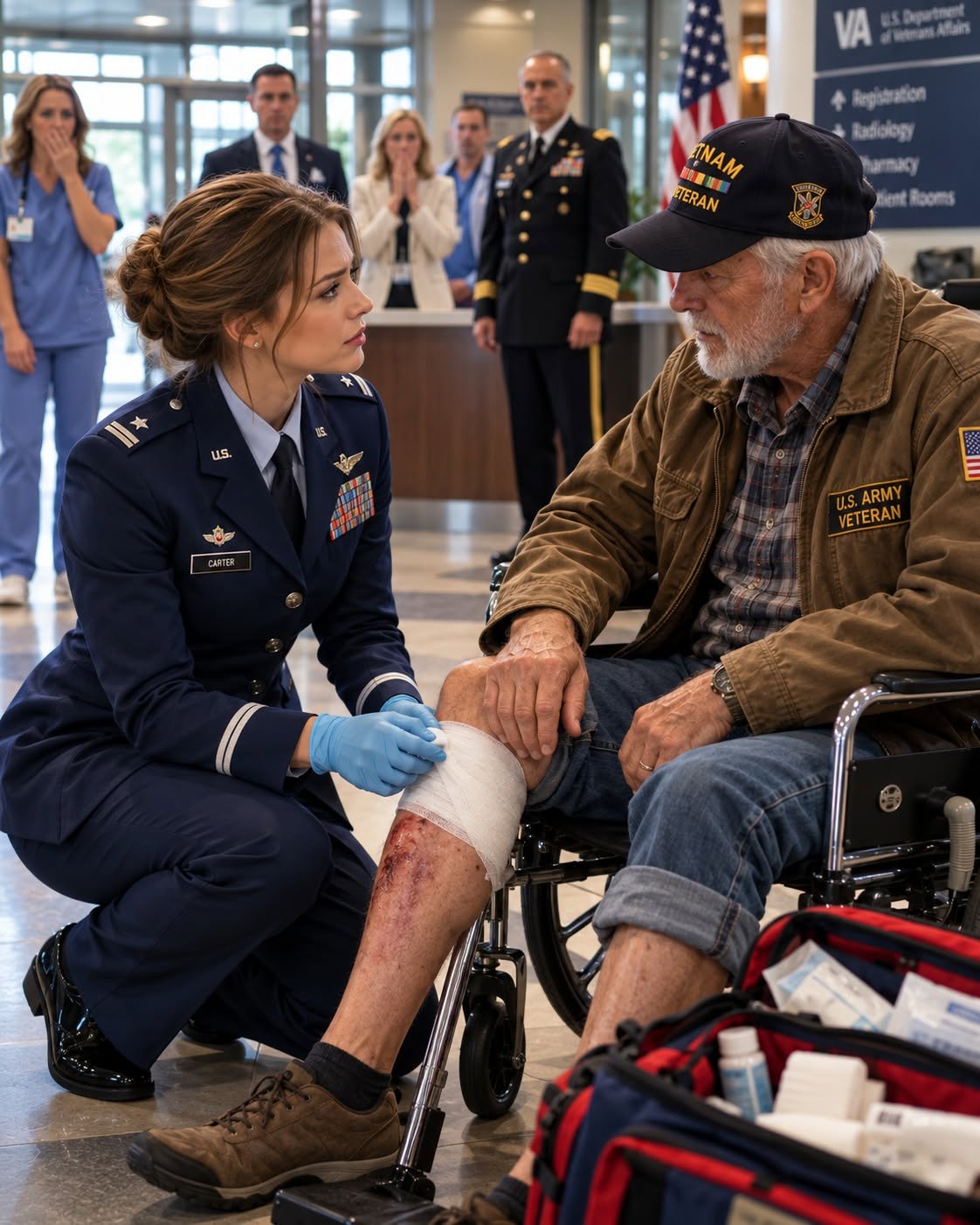
I cleaned an elderly veteran’s infected leg after a hospital refused to touch him without the right paperwork.
By sunrise, the Army had suspended me after eleven spotless years in uniform—but the next morning, a black government SUV stopped outside Riverside General, a four-star general walked into the lobby, saluted me, and revealed that my suspension was only the smallest part of what had gone wrong.
My name is Major Clare Morgan.
I had served eleven years in the United States Army, mostly in logistics and emergency field operations.
I wasn’t a doctor or a nurse, but deployments and combat lifesaver training had taught me what infection looked like.
That Wednesday afternoon, I saw Walter Briggs sitting alone inside Riverside General outside Columbus.
He was seventy-three, thin, sunburned, and wearing a faded Army cap.
His jeans were torn below the knee, exposing an angry wound that had clearly been neglected.
“I’m a veteran,” he told the clerk.
“I still need insurance documentation,” she replied.
“My leg’s getting worse.” “You’ll need the VA clinic downtown.” Walter looked down.
“I came by bus.” I stopped walking.
“Has anyone examined him?” “No, ma’am.” “Why?” “He hasn’t completed registration.” A hospital administrator stepped toward me.
“Major, please let our staff handle this.” Walter tried to stand.
His leg buckled.
I caught him.
That was enough for me.
I retrieved the military trauma kit I kept in my vehicle and knelt beside him.
“You cannot perform unauthorized treatment here,” the administrator warned.
“If someone examines him right now, I’ll stop.” Nobody moved.
So I cleaned the wound, applied antiseptic, dressed it, arranged transportation, and gave Walter the number of a veterans’ assistance coordinator.
“You don’t have to do this,” he whispered.
“Yes, sir.
I do.” Before he left, I noticed old rank stitching inside his cap.
“Take care of yourself, Sergeant.” Walter froze.
Then he smiled faintly.
“Haven’t heard that in a long time.” At 0600 the next morning, Colonel Nathan Pierce summoned me.
My entire career sat inside an open personnel file.
Two deployments.
Commendations.
No disciplinary history.
He pushed one paper toward me.
TEMPORARY SUSPENSION OF DUTIES.
“For helping an injured veteran?” “For acting outside your authority while in uniform.” “So I should have watched him leave?” “You should have followed procedure.” I removed my access badge and placed it on his desk.
“I’d do it again.” By that evening, the story was everywhere.
Then my phone received three messages from an unknown number.
He told me what happened.
You did the right thing.
I’m coming tomorrow.
The next morning, my sergeant called.
“Major, get to Riverside General.” When I arrived, government vehicles surrounded the entrance.
Colonel Pierce was already inside.
Then the elevator opened.
A silver-haired man stepped into the lobby wearing four stars.
Every service member snapped to attention.
His eyes found me through the glass.
Then he saluted.
A four-star general saluted a suspended major.
“Major Morgan,” he said.
“I’m General William Briggs.” Briggs.
Walter.
My chest tightened.
“Yes,” he said.
“Walter is my father.” The entire lobby went silent.
“My father served thirty-one years.
Yesterday, your hospital saw an old man without proper paperwork.” He looked toward me.
“But you saw a soldier.” Colonel Pierce started to object.
General Briggs raised one hand.
“I’ve read your report.” Then he opened a leather folder.
“Major Morgan’s suspension is no longer your biggest problem.” He placed several documents on the desk.
“The review triggered by my father’s treatment uncovered something involving veterans.” The hospital administrator stepped backward.
And for the first time, I didn’t see embarrassment on his face.
I saw fear.
Two federal investigators walked through the doors.
General Briggs looked at me.
“You’re going to want to stay for what happens next.” The two federal investigators who entered Riverside General did not look like the kind of people television had taught us to expect.
There were no dark glasses, no shouted orders, no dramatic display of badges.
One was a woman in her late forties named Dana Keene, with a gray suit, sensible shoes, and a leather notebook tucked beneath one arm.
The other, Thomas Reed, was younger, quiet, and carried a slim government laptop bag.
They walked into the lobby as though they had been there before.
Maybe they had.
General William Briggs stood beside the reception desk, one hand resting on the leather folder he had opened.
Colonel Pierce remained several feet away from him.
The hospital administrator, Martin Hale, had gone pale.
I looked from one face to another.
“What exactly did you find?” I asked.
General Briggs glanced at Dana Keene.
She answered.
“Major Morgan, yesterday’s incident resulted in a request for an expedited review of several veteran referrals through this hospital.” “Because of Walter?” “Because your encounter with Mr.
Briggs raised a question,” she said.
“Why would an elderly veteran with an obviously worsening wound be redirected without even receiving a basic clinical assessment?” Hale cleared his throat.
“I think we should be careful with terminology.
Mr.
Briggs was not denied emergency care.
There was a registration issue and—” Dana turned toward him.
“We’re being careful, Mr.
Hale.” Her tone never sharpened.
That made it more effective.
She opened her notebook.
“The problem is that Walter Briggs was not the first veteran redirected from Riverside General under nearly identical circumstances.” Nobody spoke.
Outside the tall lobby windows, morning traffic moved along Broad Street.
Somewhere down the corridor, a cart rattled across tile.
Normal sounds.
That was what I remembered most.
The world had not changed its volume simply because ours had.
“How many?” I asked.
“We don’t know yet,” Dana said.
General Briggs looked at me.
“That’s why I told you your suspension was the smallest part of this.” I folded my arms.
“With respect, sir, my suspension and the hospital review aren’t the same issue.” “No,” he said.
“They aren’t.” Colonel Pierce finally stepped forward.
“General, Major Morgan’s administrative status is a command matter.” Briggs nodded.
“I understand that perfectly, Colonel.” There was no anger in his voice.
“I also understand that Major Morgan was suspended before anyone outside your office reviewed the circumstances.” Pierce’s jaw tightened.
“I followed regulation.” “I’m not accusing you of anything.” That seemed to surprise him.
Briggs closed the folder.
“I’m asking you to participate in a broader review.” Pierce looked toward me.
For the first time since he had handed me the suspension order, he seemed less certain.
Not frightened.
Not ashamed.
Simply aware that the situation had grown larger than the rule he had used to contain it.
Dana Keene asked the hospital to provide a conference room.
Ten minutes later, eight of us were sitting around an oval table on the second floor.
The blinds were half open.
Rain had begun tapping softly against the windows.
I sat beside Sergeant Michael Torres, who had been the one to call me that morning.
He leaned closer while the investigators arranged their notes.
“You all right?” he whispered.
“I’m suspended, sitting in a federal review meeting, and a four-star general just told me his father started the whole thing.” “So that’s a no?” I almost smiled.
Torres had served with me for six years.
He had an extraordinary ability to make one sentence sound disrespectful and supportive at the same time.
Across the table sat Martin Hale and Riverside’s chief medical officer, Dr.
Evelyn Shaw.
Dr.
Shaw appeared genuinely confused.
That mattered.
Hale looked guarded.
That mattered too.
Dana began by placing five printed records on the table.
“These are referral summaries involving veterans over sixty-five who arrived at Riverside General during the past eighteen months.” She pushed them toward Dr.
Shaw.
“Each patient was eventually redirected to another facility before receiving full evaluation here.” Dr.
Shaw scanned the first page.
Then the second.
Her brow furrowed.
“These aren’t emergency department records.” “No.” “They’re intake summaries.” “Yes.” She looked up.
“I’ve never seen these.” Hale shifted in his chair.
“Evelyn, intake issues normally wouldn’t rise to your level.” “Patients with possible infections being redirected should.” “They weren’t necessarily classified that way at intake.” Dr.
Shaw looked down again.
“Who classified them?” Nobody answered immediately.
Thomas Reed opened his laptop.
“That is one of the things we’re trying to establish.” I studied the documents from where I sat.
One name caught my attention.
Harold Mercer.
Age seventy-eight.
Army veteran.
Complaint: persistent swelling and wound irritation.
Disposition: referred to alternative veterans’ provider.
Another.
Samuel Ortiz.
Age sixty-nine.
Vietnam-era service.
Complaint: dizziness, weakness, medication complications.
Disposition: directed to veterans’ outpatient services.
Another.
Louis Grant.
Age eighty-one.
Difficulty breathing.
Transferred after delayed registration review.
I felt something cold settle behind my ribs.
“These men all came here?” I asked.
“Yes,” Dana said.
“And someone decided their veteran status meant they should go somewhere else?” “That’s what we’re determining.” General Briggs sat quietly at the far end of the table.
He had not spoken for several minutes.
He looked less like a general now.
More like a son.
“When my father called me,” he said eventually, “he did not ask me to investigate this hospital.” I turned toward him.
“What did he ask?” “To make sure you weren’t punished for helping him.” Something about that answer caught me off guard.
“He called you that night?” “He called me from his kitchen.” Briggs rubbed one thumb along the edge of the folder.
“My father and I speak every Sunday.” He hesitated.
“Usually.” That single word carried more history than the rest of the sentence.
“He didn’t tell me his leg had gotten that bad.
He didn’t tell me he’d been trying to get treatment.
He didn’t tell me he’d been taking two buses to appointments.” His expression changed almost imperceptibly.
“I learned all of that because a stranger stopped beside him in a hospital lobby.” I looked down.
Walter’s face returned to me.
The worn cap.
The careful way he had spoken.
The embarrassment when his leg buckled.
“You didn’t know?” I asked.
“No.” There was no defensiveness in his answer.
Only regret.
“My father is very good at telling people he is fine.” Torres murmured, “Most old sergeants are.” General Briggs heard him.
A faint smile appeared.
“He would agree with you.” Dana brought us back to the records.
The review, she explained, had begun when Briggs’ staff contacted a veterans’ assistance liaison to confirm what options Walter had been given.
The liaison noticed something unusual.
Several veterans had recently complained about being redirected from Riverside despite arriving with conditions that should at least have received an initial medical screening.
No one complaint had seemed extraordinary.
Together, they formed a pattern.
The pattern had led to something else.
Billing irregularities.
Not dramatic embezzlement.
Not bags of cash.
Something quieter.
Riverside had an agreement with a private healthcare coordination company called Northbridge Patient Solutions.
Northbridge handled scheduling and referral management for certain government-supported patients, including veterans receiving approved outside care.
For every appropriately processed referral, the company received an administrative fee.
The system was supposed to help veterans navigate civilian treatment.
But somewhere along the way, some veterans arriving directly at Riverside had begun being categorized as referral cases even when they had not come through Northbridge.
That classification could trigger administrative payments.
More important, it also allowed Riverside intake staff to redirect the patient toward another contracted provider rather than immediately moving them into the hospital’s ordinary care process.
Dr.
Shaw removed her glasses.
“You’re saying someone turned walk-ins into paperwork.” Dana nodded.
“That is one possibility.” Martin Hale’s face hardened.
“That is a serious allegation.” “Yes.” “And you have no evidence anyone deliberately denied care.” “Not yet.” “Then I would appreciate it if we stopped speaking as though wrongdoing has already been established.” Dana regarded him steadily.
“We are establishing facts, Mr.
Hale.” He looked toward General Briggs.
“This entire process began because of who Mr.
Briggs’ son happens to be.” General Briggs did not react.
I did.
“That’s not fair.” Hale looked at me.
“Major, with respect, a federal review did not happen when Harold Mercer was redirected.
It did not happen when Samuel Ortiz was redirected.
It happened when Walter Briggs was.” Silence followed.
I hated that he was right about that.
General Briggs seemed to hate it too.
“That,” he said quietly, “is exactly why this review needs to happen.” Hale blinked.
Briggs leaned forward.
“If my father received attention only because of my rank, then we have discovered another problem, not an excuse to ignore the first one.” That ended the argument.
For the next three hours, investigators interviewed staff.
I should have left.
I was suspended.
I had no official role in the hospital inquiry.
But Dana asked me to remain because I had witnessed Walter’s interaction at intake.
So I told them what I remembered.
The clerk’s words.
The administrator’s warning.
Walter trying to stand.
Nobody examining him.
My decision to get the trauma kit.
When I finished, Dr.
Shaw asked a question.
“Major, what did the wound look like?” I described it clinically.
Heat.
Redness.
Swelling.
Drainage.
Walter’s difficulty bearing weight.
Her mouth tightened.
“He should have been assessed.” Hale looked at her.
“You weren’t there.” “No,” she said.
“But she was.” It was the first fracture I saw in the hospital leadership.
Not a dramatic fracture.
Just one person deciding that loyalty to an institution did not require pretending an obvious mistake had not happened.
At noon, Dana released me.
General Briggs asked if we could speak privately.
We walked downstairs to the small hospital café.
He bought two coffees.
Four-star general or not, the machine rejected his card twice.
He stared at the screen.
“I command more than sixty thousand people,” he said.
“Apparently I cannot operate a coffee kiosk.” I laughed before I could stop myself.
He handed me a paper cup.
For several seconds we stood near the window without speaking.
Then he said, “Thank you.” “You already thanked me.” “Not as Walter’s son.” The rain had stopped.
Water clung to the glass.
I remembered my own father, who had died six years earlier.
He had never served.
He had repaired industrial air conditioners and complained about every necktie he ever had to wear.
When he got sick, I had been deployed.
I made it home before the end.
Barely.
There are certain forms of guilt that are not logical.
You know you did everything you could.
They remain anyway.
“Your father reminded me of mine,” I said.
Briggs looked at me.
“That why you stopped?” “Maybe.” I thought about it.
“No.
I stopped because everybody else kept walking.” He nodded slowly.
“My father would like that answer.” “How is he?” “Embarrassed.” “That sounds promising.” “He’s at the VA hospital.
They’re treating the infection.
Doctors expect him to recover.” I released a breath I had not realized I was holding.
“Good.” “He wants to speak with you.” “I’d like that.” Briggs looked toward the hallway.
Then his expression became more serious.
“There is something you should understand about my father.” I waited.
“He does not like being known as General Briggs’ father.” “I gathered that.” “He spent thirty-one years in uniform.
Most of those years, I was just Bill.” A quiet warmth entered his face.
“When I was commissioned, he saluted me and then told me my shoes looked terrible.” I smiled.
“That sounds like a sergeant.” “He retired as a command sergeant major.” I stared at him.
Walter had told the clerk, I’m a veteran.
Nothing else.
No rank.
No decades of service.
No famous son.
“He never mentioned that.” “He wouldn’t.” General Briggs looked into his coffee.
“My father taught me that rank should open doors for responsibility, not privilege.” His gaze returned to mine.
“Which makes yesterday especially difficult.” I understood.
Walter had spent a lifetime believing a uniform meant people took care of one another.
Then he had sat unnoticed in a waiting room wearing the only evidence of that life on his head.
A faded cap.
We were interrupted by Sergeant Torres.
“Ma’am.” His tone had changed.
“What?” “Colonel Pierce wants you back at headquarters.” I looked at Briggs.
He nodded once.
“Go.” My suspension had not disappeared.
Not yet.
At headquarters, Pierce was alone.
The same personnel file sat on his desk.
This time it was closed.
He gestured toward the chair.
I sat.
He remained standing for a moment before lowering himself opposite me.
“I owe you an explanation.” I said nothing.
“I did not suspend you because you helped Mr.
Briggs.” “That is what the order says.” “The order says you performed treatment outside your assigned authority while identifiable as an Army officer in a civilian medical facility.” “And the difference is?” “The difference is that I received a complaint from Riverside before I ever spoke to you.” That was new.
“What complaint?” Pierce opened a drawer and removed a printed email.
“It came at 2140 Wednesday night.” I read it.
The message alleged that I had interfered with hospital operations, ignored instructions from hospital leadership, and created potential liability by providing unauthorized medical care.
The sender was Martin Hale.
But the email had not been sent directly to Pierce.
It had been forwarded through a regional military-community liaison office.
“Why didn’t you tell me?” “Because the complaint was part of an administrative review.” “You decided the review before asking me what happened.” Pierce’s face tightened.
“Yes.” The word surprised me.
I had expected justification.
Instead, he looked tired.
“I believed I was protecting the command.” “From what?” “From this becoming exactly what it became.” I sat back.
“A story?” “A public dispute involving an officer, a civilian hospital, veterans’ healthcare, and questions about medical authority.” He rubbed his forehead.
“I thought a temporary suspension would create distance while we established facts.” “You punished the person standing closest to the facts.” “Yes.” Again, no excuse.
That made it harder to stay angry.
Pierce had been my commander for fourteen months.
He was demanding, procedural, sometimes maddening, but I had never considered him dishonest.
“What happens now?” “I recommended this afternoon that your suspension be rescinded pending formal review.” I studied him.
“Because General Briggs arrived?” “No.” He met my eyes.
“Because I read the hospital incident report.” He turned another document toward me.
The report listed Walter as ambulatory and stable.
“No fall or collapse observed.” I stared at the line.
“He collapsed into me.” “I know.” “How?” “Three witnesses confirmed it.” He paused.
“Including the registration clerk.” Something had begun unraveling.
And Pierce had finally noticed.
He leaned back.
“Morgan, I made a decision based on incomplete information.” “That’s a careful way to say it.” “I’m still your commanding officer.” “Temporarily.” A corner of his mouth moved.
“Your sense of timing remains poor.” “So I’ve been told.” His expression sobered.
“I’m sorry.” Colonel Nathan Pierce did not apologize casually.
I believed him.
That did not make the last twenty-four hours disappear.
But it mattered.
“I accept that,” I said.
He nodded.
Then he handed me my access badge.
I looked at it.
“Already?” “Your duty status is restored at 1600.” I took the badge.
“Any restrictions?” “Yes.” “What?” “Do not treat patients in civilian hospital lobbies.” I looked at him.
He managed three seconds before smiling.
“Unless absolutely necessary.” “That is a very flexible order, sir.” “I have recently developed appreciation for flexibility.” My phone rang before I could answer.
Unknown number.
I nearly ignored it.
Then I remembered the messages.
I answered.
“Major Morgan?” Walter.
His voice sounded stronger.
“Sergeant.” He laughed softly.
“You found out.” “Your son filled in a few details.” “He tends to do that.” “How are you feeling?” “Like six doctors and my son have formed a committee devoted to asking whether I’ve taken my antibiotics.” “That sounds serious.” “Terrible situation.” I smiled.
“I hear you’re recovering.” “I am.” A pause.
“Major, I was wondering if you might come by.” “Of course.” “Not here.” I frowned.
“Where?” “My house.” “You’re being discharged?” “Tomorrow morning.” There was something in his voice.
Something careful.
“I need to show you something.” “What?” “If I tell you, you’ll think I’m an old fool.” “I already cleaned your leg in a hospital lobby.
I think we’ve passed formal introductions.” He chuckled.
“Tomorrow.
Eleven o’clock.” “I’ll be there.” Walter lived in a small brick house on the west side of Columbus.
The next morning, sunlight broke through a week of clouds.
A row of tomato plants grew beside the porch.
Someone had painted the railing recently, but not very well.
There were white streaks on the brick.
General Briggs’ SUV was parked at the curb.
So was a twelve-year-old pickup truck.
I knocked.
Walter opened the door with a cane in one hand.
“You clean up better when you’re not sitting on a hospital floor,” he said.
“You look better when your leg isn’t trying to kill you.” “Doctors say it was only planning a small rebellion.” He waved me inside.
The house smelled like coffee and furniture polish.
Photographs covered one wall.
Walter in uniform.
Walter younger, standing beside a woman with dark hair and a wide smile.
Two boys beside a Christmas tree.
One was unmistakably William Briggs, long before the stars.
The other boy was younger.
I looked closer.
Walter noticed.
“My other son.
Daniel.” “Where is he?” Walter’s expression softened.
“Arizona.” There was a distance in the answer that did not sound geographical.
General Briggs appeared from the kitchen carrying three mugs.
“My father believes recovering from infection requires enough coffee to create a second medical problem.” “Army medicine,” Walter said.
We sat in the living room.
For a while, nobody mentioned the hospital.
Walter asked where I had grown up.
I told him Pennsylvania.
He asked why I joined.
I gave him the answer I usually gave people.
Opportunity.
Service.
Wanting a life larger than the town I came from.
He listened.
Then he said, “That’s the official answer.” General Briggs closed his eyes.
“Dad.” “What?” “You’ve known her eight minutes.” “Long enough.” Walter looked back at me.
“What’s the real answer?” I surprised myself by responding.
“My father.” Walter waited.
“He wanted me to go to college.
We couldn’t afford much.
The Army gave me a path.” “That all?” “No.” I looked at the photograph wall.
“He believed people should be useful.” Walter nodded.
“That sounds like a man I would’ve liked.” “He would’ve liked you.” General Briggs handed me coffee.
Walter placed both palms over the top of his cane.
“Useful is a dangerous word.” I looked at him.
“How?” “Because eventually you get old enough that people start deciding you aren’t.” His voice remained calm.
“I spent most of my life being the person everybody called when something went wrong.
Then one day I retired and people started carrying my groceries.” “There are worse things.” “Oh, absolutely.” He smiled.
“But pride is not known for logic.” General Briggs looked at him.
“You could have called me.” Walter’s smile faded.
“I know.” “You could have called Daniel.” “I know.” “You could have told either of us what was happening.” Walter glanced toward the window.
There it was.
The real reason I had been invited.
Not the investigation.
A family wound older than the one on Walter’s leg.
“I didn’t want another argument,” Walter said.
William’s voice remained even.
“Helping you is not an argument.” “It becomes one.” “How?” “Because you think helping means taking control.” The general sat very still.
Walter continued.
“You send cars.
Assistants.
Doctors.
People who call me ‘sir’ because they know who you are.” “I’m trying to make things easier.” “For you.” William looked hurt.
Walter saw it.
His voice softened.
“Bill, I know you love me.” The use of his childhood name changed the room.
“But sometimes I need to be your father, not an assignment.” General Briggs looked down at his mug.
I suddenly felt intrusive.
“I can come back.” “No,” Walter said.
“You’re part of why we’re finally saying this.” Neither man argued.
That made it more painful, not less.
They loved each other.
There was no question about it.
But love had become tangled with responsibility.
William had spent his life solving problems.
Walter had spent his life refusing to become one.
“I wasn’t hiding the leg because I wanted to be stubborn,” Walter said.
General Briggs raised an eyebrow.
“Not entirely.” Walter conceded the point with a small shrug.
“I thought it would improve.” “It didn’t.” “No.” “And then?” Walter looked at me.
“Then I started going to appointments.” My attention sharpened.
“Appointments where?” “Different places.” General Briggs frowned.
“You told me you couldn’t get an appointment.” “I couldn’t get the right appointment.” Walter pushed himself upright.
“Come with me.” He led us down a narrow hallway to a back bedroom that had been converted into an office.
A desk stood beneath the window.
Boxes were stacked beside an old filing cabinet.
Walter opened the bottom drawer.
Inside were folders.
Many folders.
He took out a thick one secured with a rubber band.
“What is that?” William asked.
Walter looked almost embarrassed.
“Homework.” He handed it to me.
Inside were copies of appointment letters, referral notices, bills, transportation receipts, and handwritten notes.
Dates.
Names.
Locations.
Times.
I turned page after page.
“These are yours?” “Some.” “Whose are the others?” “Friends.” General Briggs stared at him.
Walter sat carefully in the desk chair.
“About a year ago, a man from my veterans’ breakfast group got a bill for an appointment he swore he never had.” “Who?” “Harold Mercer.” The name struck me immediately.
I looked at General Briggs.
He recognized it too.
One of Dana Keene’s five records.
Walter continued.
“Harold thought he was losing his memory.
His daughter thought so too.
Then Samuel Ortiz got a bill that didn’t make sense.” Another name from the table.
“And Louis Grant?” Walter’s eyes narrowed slightly.
“You know Louis?” “He was on the review list.” Walter leaned back.
“Well.” General Briggs slowly lowered himself into the chair beside the desk.
“Dad, what have you been doing?” “Trying to figure out whether my friends were confused or whether somebody else was.” My pulse quickened.
“You were investigating the referrals.” “I wouldn’t call it investigating.” “What would you call collecting eighteen months of records?” “Being organized.” General Briggs gave me a look that said this was exactly what growing up with Walter Briggs had been like.
Walter tapped the folder.
“At first I thought it was insurance nonsense.
Then I noticed the same company name.” “Northbridge.” He nodded.
“Some of the men were being scheduled through them.
Others weren’t.
But Northbridge kept appearing.” “Why didn’t you give this to anyone?” “I did.” The room went still.
“To whom?” William asked.
Walter turned to the filing cabinet again.
He removed a single envelope.
“I mailed copies six months ago.” “Where?” “To the regional veterans’ care office.” “And?” “They sent a letter saying the issue had been referred to the appropriate contractor.” “Northbridge?” I asked.
Walter nodded.
I almost laughed at the absurdity.
“You complained about Northbridge, and they sent the complaint to Northbridge.” “That was my impression.” “What did Northbridge say?” “That the discrepancies resulted from administrative coding errors.” Walter pointed toward another letter.
“So I started checking.” General Briggs stared at his father.
“You’ve been riding buses around Columbus for six months checking veterans’ medical referrals?” “Not every day.” “Dad.” “Tuesday breakfasts are slow.” “This isn’t funny.” Walter’s humor faded.
“No.” For a long moment, father and son looked at each other.
William’s anger was not the anger of a general.
It was the helpless anger of a son discovering that his elderly father had been carrying something alone.
“You should have told me.” “And what would you have done?” “I would have helped.” “You would have called three people, and by dinner everyone involved would know General Briggs was asking questions.” “Yes.” “That’s why.” William stood and walked to the window.
Walter watched him.
“I needed to know what happened when nobody important was asking.” The words landed softly.
That made them heavier.
I looked through the documents again.
Walter had recorded everything.
Not just suspicious bills.
Transportation problems.
Confusing phone calls.
Long waits.
Veterans who had misunderstood letters.
Patients who had been helped successfully.
He had been fair.
Almost painfully fair.
On one page, he had written: NORTHBRIDGE REP, LENA P. — VERY HELPFUL.
CALLED BACK SAME DAY.
On another: RIVERSIDE NURSE FOUND CORRECT CLINIC.
NO ISSUE.
This was not a man collecting grievances.
He was collecting truth.
“Why Riverside?” I asked.
Walter hesitated.
“That’s what I wanted you to see.” He reached into the folder and removed a photocopied internal-looking form.
At the bottom was an authorization line.
The signature was difficult to read.
But the typed name beneath it was clear.
MARTIN HALE.
General Briggs stared at it.
“What is this?” Walter answered slowly.
“A referral workflow change.
At least, that’s what Harold was told when he asked why he had been redirected.” I read the page.
It appeared to authorize intake staff to route certain government-supported patients through a centralized verification process before clinical placement.
It was dense bureaucratic language.
Nothing on the page said deny care.
Nothing said veterans should be turned away.
But I could see how an employee under pressure might interpret it that way.
“Where did you get this?” I asked.
“Harold.” “How did he get it?” “A woman at Riverside gave it to him.” “Who?” Walter reached for a yellow note clipped to the back.
One name was written there.
MELANIE ROSS.
I remembered the registration clerk.
The woman who had told Walter he needed insurance documentation.
“Is Melanie Ross the clerk from Wednesday?” Walter nodded.
“She slipped that note into my discharge transportation envelope.” I stared at him.
“She wanted you to have this?” “She wrote something else.” He handed me a smaller sheet.
Three words were written across it.
PLEASE KEEP ASKING.
General Briggs read it twice.
Then his phone rang.
He looked at the screen.
“Keene.” He answered.
“Briggs.” We watched his expression change as he listened.
“Yes.” A pause.
“When?” Another pause.
“I understand.” He ended the call.
“What?” Walter asked.
“Dana interviewed Melanie Ross this morning.” I waited.
“And?” William looked at his father.
“She says she tried to raise concerns about the referral procedure eight months ago.” Walter’s fingers tightened around the cane.
“With Hale?” “No.” William glanced at me.
“With someone at Northbridge.” “What happened?” “She was told the process had been approved by Riverside leadership.” “That doesn’t prove Hale knew patients were being redirected without assessment,” I said.
“No.” General Briggs looked at the photocopied form.
“But Dana found something else.” He hesitated.
“The version Riverside produced this morning is different from this one.” Walter looked up.
“Different how?” “The hospital’s copy includes a paragraph specifically stating that no referral procedure can delay initial clinical screening.” I looked back at Walter’s paper.
That paragraph was not there.
For several seconds, none of us spoke.
There were innocent explanations.
Drafts changed.
Policies were updated.
Old copies circulated.
That was what reasonable people were supposed to consider first.
But Walter had written a date on the upper corner of his copy.
Seven months earlier.
The hospital claimed its version had been active for nearly a year.
“Dana wants this document,” William said.
Walter nodded.
“She can have it.” Then he looked at me.
“That still isn’t why I asked you here.” I stared at him.
“There’s more?” Walter gave a tired smile.
“There’s always more when people start keeping records.” He reached into the filing cabinet one final time.
Instead of another medical form, he removed a photograph.
It was old.
Maybe twenty-five years.
Four soldiers stood in front of a canvas field tent.
Walter was one of them.
Younger, broader through the shoulders, wearing sergeant major insignia.
Beside him stood a man I recognized immediately.
Not because I had met him.
Because I had seen his face every Christmas of my childhood in a framed photograph on our living-room shelf.
My father.
Daniel Morgan.
I forgot how to breathe.
Walter watched my face.
“You know him.” I took the photograph with both hands.
“My father.” General Briggs turned toward me.
Walter nodded.
“I thought so.” I looked at the image again.
My father had never told me he served.
Because as far as I knew, he hadn’t.
“He wasn’t Army.” “No,” Walter said.
“He repaired industrial systems.” “He did.” “What was he doing there?” Walter’s eyes drifted toward the photograph.
“He was a civilian contractor attached to our unit during a humanitarian operation after a major flood overseas.” My mind searched through years of family stories.
My father had traveled for work when I was young.
Weeks at a time.
Sometimes months.
I had never asked where.
Children rarely ask the right questions while the people capable of answering them are still alive.
Walter tapped the photograph.
“Your father kept twenty-two soldiers and about sixty local families from losing access to clean water when a purification system failed.” I sat down.
“He never told me.” “He didn’t like attention.” “That sounds like him.” Walter smiled.
“He also complained constantly.” “That definitely sounds like him.” The room blurred for a second.
I blinked hard.
Walter continued.
“I remembered the name Morgan yesterday.
Didn’t make the connection until you mentioned Pennsylvania.” “You knew my father?” “For three months.” He pointed to himself and Daniel Morgan in the photograph.
“We argued almost every day.” “About what?” “Everything.” I laughed despite the pressure behind my eyes.
Walter’s smile faded into something gentler.
“But there’s something you should know.” He opened the back of the photograph frame.
A folded piece of paper had been hidden behind it.
The paper was yellow with age.
He passed it to me.
My father’s handwriting covered one side.
I knew it instantly.
Block letters.
All capitals.
The same handwriting that had labeled every toolbox in our garage.
Walter spoke while I unfolded it.
“Your father wrote that the day we left.” I read the first line.
WALTER— IF MY GIRL EVER DECIDES TO WEAR A UNIFORM, TELL HER THE JOB ISN’T ABOUT FOLLOWING EVERY RULE.
My vision blurred.
I kept reading.
IT’S ABOUT KNOWING WHICH RULES EXIST TO PROTECT PEOPLE AND WHICH ONES PEOPLE SOMETIMES HIDE BEHIND.
Walter’s voice became very quiet.
“He talked about you all the time.” I could not speak.
The final line was shorter.
IF YOU EVER MEET CLARE, TELL HER I KNEW SHE’D STOP.
I looked at Walter.
“How could he know?” Walter’s eyes shone.
“He didn’t know what you’d stop for.” A faint smile touched his face.
“He only knew you.” And suddenly the hospital lobby, my suspension, Walter’s faded cap, and the photograph in my hands no longer felt like separate events.
Something my father had done decades earlier had been quietly carried through Walter’s life.
Until the afternoon I happened to walk past the one chair where Walter Briggs was waiting.
My phone vibrated.
Dana Keene.
I answered.
“Major Morgan,” she said, “we found the original Riverside policy file.” I looked at Walter.
“And?” “There were three versions.” My grip tightened around the phone.
“Which one was actually sent to staff?” “That’s what we need to determine.” She paused.
“But Major—someone inside the hospital repeatedly removed the clinical-screening paragraph before distributing the document.” I looked down at Melanie Ross’s note.
PLEASE KEEP ASKING.
“Who?” “We don’t know.” Outside Walter’s window, sunlight fell across the tomatoes growing beside his porch.
Inside, an old photograph rested in my lap.
My father smiled from another lifetime.
For the first time since this began, I understood that the question was no longer simply why Walter Briggs had been overlooked.
It was how many people had quietly noticed something was wrong—and how long they had been waiting for someone else to stop walking.
Three days later, I returned to Riverside General through the same front doors where I had first seen Walter Briggs.
The lobby looked exactly as it had before.
Same chairs.
Same polished floor.
Same coffee kiosk humming beside the elevators.
But I had learned that buildings could remain unchanged while your understanding of them became entirely different.
Melanie Ross stood behind the registration desk.
She saw me and straightened.
For a moment, neither of us spoke.
Then she stepped away from the computer.
“Major Morgan.” “Ms.
Ross.” Her eyes moved toward my uniform.
“You’re back on duty.” “I am.” “I’m glad.” She looked exhausted.
Not guilty.
Not relieved.
Simply tired.
Dana Keene had asked me to attend a final round of interviews because the Army review of my conduct now overlapped with questions about the reports Riverside had provided to military officials.
I had agreed for one reason.
Walter.
Actually, two reasons.
Walter and my father.
The letter Daniel Morgan had written decades earlier was folded inside my breast pocket.
I had read it at least twenty times.
There were only nine lines.
I kept hoping a tenth would appear.
Walter had offered to let me keep the original.
I refused.
Instead, General Briggs had made a copy.
“You keep the original,” I told Walter.
“Why?” “Because he gave it to you.” Walter considered that.
Then nodded.
“Fair.” Before I left his house, he had said one more thing.
“Clare.” It was the first time he had used my first name.
“Your father didn’t predict the future.” “I know.” “He simply believed character repeats itself.” I had carried those words with me ever since.
Now, standing in Riverside’s lobby, I wondered whether institutions worked the same way.
Whether small choices repeated until they became culture.
Whether culture repeated until nobody remembered who made the first choice.
Melanie lowered her voice.
“I owe you an apology.” “For what?” “I was the one sitting there.” She nodded toward the desk.
“I should have gotten a nurse.” “You were following what you thought was policy.” “So were you.” That landed harder than she intended.
I looked at her.
“You’re talking about my suspension.” She nodded.
“I saw the news.” “It wasn’t quite that simple.” “It never is.” Her gaze moved toward the waiting area.
“I’ve been doing registration for nine years.
I used to believe that if I followed every line on the screen, patients would end up where they needed to be.” “What changed?” “Your sergeant.” “Walter?” She gave a small smile.
“He corrected me the first time I called him Mr.
Briggs.” I could hear him doing it.
“Then Harold Mercer came in.
Then Mr.
Ortiz.
Then others.” She folded her hands.
“I started noticing that whenever the computer marked someone as veteran-contracted care, the options changed.
Extra verification.
Extra numbers to call.
Different referral steps.” “Did you report it?” “Yes.” “To Hale?” “Eventually.” That surprised me.
“What did he say?” “He said the workflow had been approved.” “And you believed him?” “I wanted to.” There was no accusation in her tone.
She was admitting something more difficult.
“I have two daughters in college.
My husband’s business closed during the pandemic.
This job carries our health insurance.” She looked embarrassed by the confession.
“I wasn’t trying to ignore anybody.” “I know.” “But I also wasn’t brave.” “Bravery isn’t always immediate.” Melanie looked at me.
“Is that what you believe?” I thought about Colonel Pierce.
About myself.
About how easy courage seems when describing someone else’s moment of decision.
“I think most people need time to understand what a decision costs.” She nodded.
“That sounds more accurate.” Dana appeared from the corridor.
“Major.” She motioned for me to follow.
The meeting room upstairs now included attorneys from Riverside, representatives from the veterans’ care office, Colonel Pierce, Dr.
Shaw, Martin Hale, and two Northbridge executives joining by video.
General Briggs was absent.
Deliberately, I suspected.
He had said the night before, “This has to become a process that works without my stars in the room.” Walter was at home.
Also deliberately.
“I’ve spent enough time in hospitals this week,” he told me.
“Someone should check on my tomatoes.” Dana began with the policy documents.
There were, as she had said, three versions.
Version A had been drafted by Riverside’s compliance office.
It clearly stated that veterans and other government-supported patients should receive ordinary preliminary clinical assessment before any administrative routing.
Version B removed that paragraph.
Version C restored it.
The question was who distributed Version B.
Thomas Reed projected a series of emails onto the wall.
Most were boring.
Approvals.
Revisions.
Scheduling.
Then came one message from Northbridge.
The sender was a regional implementation director named Alan Voss.
The subject line read: WORKFLOW SIMPLIFICATION.
Dana summarized rather than reading it aloud.
“Mr.
Voss suggested removing language he considered duplicative because clinical screening was already required under hospital policy.” Dr.
Shaw leaned forward.
“So he removed the safeguard because he assumed another safeguard covered it.” “That appears to be the original reasoning.” One of the Northbridge executives shifted on screen.
“It was never intended to delay care.” “No one has established that it was,” Dana replied.
Martin Hale exhaled.
For the first time, some tension left his face.
I noticed.
Dana was not finished.
“The problem came next.” A second email appeared.
Hale had received the revised workflow.
His reply consisted of one sentence.
Approved for intake distribution.
He stared at it.
“I remember this.” Dr.
Shaw looked at him.
“You approved a clinical workflow without sending it through my office.” “It wasn’t presented as clinical.” “It determined which patients reached clinical staff.” “Yes.” Hale closed his eyes briefly.
“I understand that now.” The room remained quiet.
Dana continued.
“Riverside’s compliance department discovered the missing paragraph three weeks later and restored it.” “Then why were staff still using Version B?” Colonel Pierce asked.
Thomas changed the projection.
An internal shared drive contained Version C.
The registration software, however, still displayed instructions derived from Version B.
The written policy had been corrected.
The system staff actually used had not.
No conspiracy.
No secret scheme.
Something more ordinary.
And, in some ways, more disturbing.
A mistake everyone assumed someone else had fixed.
“How long?” I asked.
Dana answered.
“Approximately eleven months.” Melanie Ross had been right.
She had raised concerns.
The concerns had reached Hale.
Hale had contacted Northbridge.
Northbridge had reviewed the written policy and found it correct.
Nobody checked the registration software.
Because everyone assumed the problem lived somewhere else.
Dr.
Shaw spoke softly.
“So Walter Briggs sat downstairs untreated because two systems disagreed.” “Partly,” Dana said.
“There were also staffing decisions, training gaps, and failures of judgment.
No single document forced employees to ignore him.” She looked around the table.
“That matters.” It did.
Rules could explain behavior.
They could not completely erase choice.
Martin Hale folded his hands.
“I should have walked him back to triage.” Nobody answered.
He looked at me.
“When you asked if someone would examine him, I should have said yes.” “Yes,” I said.
His eyes dropped.
“I was concerned about liability.” “I know.” “I thought you were making a difficult situation worse.” “I know that too.” He looked up again.
“I was wrong.” I had imagined that moment more than once.
During the twenty-four hours I was suspended, I had pictured Hale admitting exactly that.
In those imagined versions, I always felt vindicated.
In reality, I mostly felt sad.
Because he was not a villain.
He was an administrator who had spent years learning to see risk everywhere.
Legal risk.
Financial risk.
Procedural risk.
He had become so practiced at protecting the hospital that, for several minutes in one lobby, he had forgotten the hospital existed to protect people.
“What happens to him?” I asked Dana later.
We stood near the windows during a break.
“That isn’t entirely my decision.” “Did he commit a crime?” “We have found no evidence of criminal intent.” “The billing?” “Most of the suspicious charges appear to be automated administrative fees caused by incorrect classifications.
Northbridge has agreed to reimburse disputed payments while the audit continues.” “So nobody was stealing from veterans.” “Not based on what we know.” That was almost a relief.
Not because the situation was acceptable.
Because reality was complicated enough without inventing evil where negligence explained more.
“What happens to Riverside?” “Corrective action plan.
Independent monitoring.
Revised intake procedures.
Staff retraining.
Review of prior cases.” “And the veterans who were redirected?” “Every one we can identify will be contacted.” She studied me.
“Were you expecting handcuffs?” “No.” “Most people do after seeing government vehicles.” “I’ve worked logistics.
I know most government vehicles contain paperwork.” Dana laughed.
“Accurate.” She grew serious again.
“The hardest institutional failures are often the ones no single person intended.” I looked through the glass at the city.
“Because everybody gets to say they didn’t cause it.” “Exactly.” At headquarters that afternoon, my own review ended.
Colonel Pierce asked me into his office.
This time there was no open personnel file.
Instead, there were two cups of terrible Army coffee.
He handed me one.
“Your suspension has been formally removed from your record.” I nodded.
“Thank you.” “The review found that your actions were outside ordinary duty parameters.” “That sounds ominous.” “It also found you acted in response to an immediate health concern after requesting hospital intervention and receiving none.” He sat down.
“You will not be disciplined.” I looked at him.
“That’s it?” “No medal.” “I wasn’t asking for one.” “Good.
Because I would deny it out of principle.” I smiled.
Then he became serious.
“I also changed our local guidance.” “What guidance?” “Personnel interacting with civilian facilities during community operations will receive clearer instructions on emergency intervention, reporting, and transfer of responsibility.” I stared at him.
“You changed policy because of me?” “No.” A pause.
“I changed policy because the existing policy did not help me make the right decision quickly enough.” That was about as close to humility as Colonel Pierce usually traveled.
“I appreciate that.” He nodded.
“Morgan, when you said you’d do it again, I thought you were being insubordinate.” “I might have been.” “You were.” “Thank you for clarifying.” “But I understand now what you meant.” He picked up a pen and rolled it between his fingers.
“You weren’t saying rules didn’t matter.” “No.” “You were saying the person mattered first.” I thought about my father’s letter.
“Yes.” Pierce looked at me for a moment.
“Where did you learn that?” I almost said training.
Instead I answered truthfully.
“My father.” That evening, I drove to Walter’s house.
General Briggs was there, but this time without the SUV.
He had borrowed Walter’s pickup.
I found both men in the backyard arguing about tomatoes.
“You cannot water them every time the soil looks dry,” Walter said.
“I have commanded operations across three continents.” “And yet you are drowning a tomato.” General Briggs noticed me.
“Major, please explain to my father that these plants were practically dead yesterday.” Walter snorted.
“They were thirsty.” “They were horizontal.” “They were resting.” I held up both hands.
“I’m logistics.
Agriculture is outside my authority.” Walter pointed at me.
“See?
She learned something.” We sat on the back porch.
The late afternoon was warm, and cicadas buzzed in the trees.
I told Walter what the investigators had found.
He listened without interrupting.
When I finished, he looked disappointed.
“That’s it?” I blinked.
“You wanted a bigger scandal?” “No.” He frowned.
“I wanted a clearer answer.” General Briggs leaned back in his chair.
“Life rarely gives those.” Walter gave him a sideways look.
“Don’t use general wisdom on me.” “It’s literally my job.” Walter ignored him.
“So nobody set out to redirect veterans?” “Apparently not.” “But people noticed.” “Yes.” “And didn’t fix it.” “Some tried.” He looked toward the yard.
“Harold will be furious.” “Why?” “He’s been telling everyone it’s organized corruption.” “Harold enjoys being furious.” “You’ve met him?” “No.” “You understand him.” We laughed.
Then Walter became thoughtful.
“Maybe this is worse for him.” “What is?” “Finding out nobody hated us.” I waited.
Walter rubbed his hands together.
“If somebody hates you, you know where you stand.
If somebody steals from you, you know what happened.” He gestured vaguely toward the city.
“But being forgotten because a computer screen, an old memo, and six busy people all point somewhere else?” He shook his head.
“That’s harder to explain over breakfast.” I thought about that.
He was right.
People prefer stories with villains.
Villains make responsibility easy to locate.
Real life often scatters responsibility until everyone holds only a small enough piece to feel innocent.
“Your notes made the difference,” I said.
Walter waved the compliment away.
“No.” “They did.” “Your stopping made the difference.” “Both can be true.” He studied me.
Then smiled.
“That sounds like your father.” General Briggs went inside to answer a call.
Walter and I remained on the porch.
After a while, I asked the question that had bothered me since seeing the photograph.
“Why did you keep his letter?” Walter’s expression changed.
“Your father’s?” “Yes.” He looked toward the open back door.
“Because I needed it once.” I waited.
He settled deeper into the chair.
“When we were overseas, your father and I had a disagreement.” “You said you argued constantly.” “This one mattered.” He described a flood-relief mission in a rural district where washed-out roads had isolated several communities.
Walter’s unit was supporting emergency water distribution.
My father had been responsible for repairing pumps and purification equipment.
One afternoon, an officer ordered the repair team to abandon a damaged system because replacement equipment was expected within two days.
My father refused.
Not dramatically.
Not disrespectfully.
He simply kept working.
Walter had been the senior enlisted leader on site.
“I told him he was done,” Walter said.
“What did he do?” “Told me I didn’t understand pumps.” I smiled.
“That sounds familiar.” “I told him I understood orders.” “What happened?” Walter looked toward me.
“He asked me how much water we had.” I knew where the story was going.
“Not enough.” “No.” The replacement equipment was delayed.
My father repaired the old system overnight.
Nothing heroic in the cinematic sense.
No danger.
No dramatic rescue.
He simply stayed beside a machine everybody had decided was no longer worth fixing.
By morning, clean water was moving again.
“The officer was angry,” Walter said.
“Were you?” “Furious.” “But?” “But your father was right.” Walter smiled faintly.
“I hated that part.” “What happened to him?” “Nothing.
The officer cooled down.
We wrote a report.
Your father complained about the food for another month.” I laughed.
Walter’s expression became distant.
“Before he left, he gave me that letter.” “Why you?” “He said I would understand it someday.” “And did you?” “Eventually.” He tapped the porch rail.
“My wife got sick five years after I retired.” I had seen her in the photographs.
“What was her name?” “Margaret.” His face softened immediately.
“She had a talent for knowing when I was pretending not to worry.” General Briggs had returned to the doorway but stopped when he heard his mother’s name.
Walter continued.
“She was ill for two years.
Nothing dramatic.
Just a long decline.” He looked down.
“I tried to manage everything.” Appointments.
Medication schedules.
Insurance.
Transportation.
Meals.
The house.
He approached Margaret’s illness the way he had approached a military operation.
Until one evening she asked him to stop.
“Stop what?” I asked.
“Being useful.” I thought of our earlier conversation.
Walter nodded.
“She said, ‘Walter, I don’t need a sergeant major tonight.
I need my husband.’” General Briggs lowered his eyes.
Walter continued.
“So I sat beside her.” His voice remained steady.
“No list.
No schedule.
No trying to improve anything.” A small smile appeared.
“We watched a terrible movie.” General Briggs laughed softly from the doorway.
“Dad hated that movie.” Walter turned.
“Your mother loved it.” “She loved anything with horses.” “Exactly.” Walter faced me again.
“After she died, I found your father’s letter in an old field box.” He paused.
“That line about knowing which rules protect people and which ones people hide behind.” He looked toward his son.
“I realized I’d spent my whole life hiding behind useful.” William stepped outside.
“Dad.” Walter lifted one hand.
“No, let me finish.” The general sat.
Walter continued.
“I made being useful the requirement for being loved.” William shook his head.
“Nobody asked you to.” “I know.” “I didn’t.” “I know.” The cicadas filled the pause between them.
Walter looked at his son.
“When your mother died, you tried to help me.” “Yes.” “I kept pushing you away.” “Yes.” “And when you became Chief of Staff for your command, I decided every phone call from you was an obligation.” William leaned forward.
“It wasn’t.” “I know that now.” The general’s eyes glistened.
Walter looked uncomfortable with emotion.
So did his son.
Neither man moved.
Then Walter said, “You overwater tomatoes.” William laughed unexpectedly.
“You are impossible.” “So your mother said.” The distance between them changed.
Not vanished.
Relationships rarely heal in one conversation.
But something opened.
Enough.
Later, while William washed coffee cups inside, Walter handed me another envelope.
“What’s this?” “A copy.” “Of Dad’s letter?” “No.” I opened it.
Inside was a page in Walter’s handwriting.
I looked at him.
“What did you do?” “Old men are allowed to be sentimental.” “You’ve spent four days claiming you aren’t old.” “Selective aging.” The letter began: CLARE— YOUR FATHER WAS RIGHT ABOUT YOU.
I looked up.
Walter gestured impatiently.
“Keep reading.” I did.
He had written that courage was usually described as a moment, but he believed it was more often a habit.
Stopping.
Looking.
Asking again.
Calling back.
Keeping records.
Admitting mistakes.
Accepting help.
He wrote about Melanie Ross.
About Dr.
Shaw.
About Colonel Pierce.
About General Briggs.
About himself.
Nobody in the story had done everything right.
But several people had chosen, eventually, to do the next right thing.
The final paragraph read: A PERSON CAN SPEND A LIFETIME WAITING TO BECOME IMPORTANT ENOUGH TO BE SEEN.
THAT IS THE WRONG WAY AROUND.
PEOPLE ARE IMPORTANT FIRST.
SEEING THEM IS OUR JOB.
I folded the letter carefully.
“I’m keeping this one.” “You’d better.” A week later, Riverside General announced a revised veteran-intake program.
There was no ceremony.
General Briggs insisted on that.
Dr.
Shaw established a policy requiring immediate clinical screening before administrative referral questions for anyone reporting urgent symptoms.
Melanie Ross joined the staff group redesigning the registration system.
At first she resisted.
“I’m a clerk,” she told Dr.
Shaw.
Dr.
Shaw answered, “Exactly.
You use the system every day.” Martin Hale remained at Riverside.
That surprised some people.
He was placed under administrative review and removed temporarily from direct oversight of intake operations, but he was not fired.
Months later, I asked Dr.
Shaw why.
She said, “Because accountability and exile are not the same thing.” Hale had made serious mistakes.
He had also cooperated fully with the review, helped identify older cases, and personally called several veterans whose care had been delayed.
Walter received one of those calls.
“What did you say?” I asked him.
“I made him apologize twice.” “Walter.” “I’m joking.” Mostly, he had listened.
Then he told Hale something I would remember.
“You don’t owe me perfection.
You owe the next man a better door.” Northbridge reimbursed improper administrative charges and updated its software procedures.
The federal review found no deliberate fraud.
It found poorly coordinated systems, vague responsibility, inconsistent training, and a failure to respond quickly when frontline workers raised concerns.
Harold Mercer remained disappointed by the absence of a conspiracy.
Walter invited me to meet him at their veterans’ breakfast anyway.
The restaurant was an old diner near Grove City.
Seven men occupied three pushed-together tables.
Walter introduced me.
“This is Major Morgan.” Harold, a broad man with enormous glasses, shook my hand.
“You’re the one who started all this.” “No, sir.” I pointed toward Walter.
“He did.” Walter shook his head.
“Absolutely not.” Samuel Ortiz looked between us.
“Then who did?” Nobody answered.
Finally Louis Grant said, “Probably whoever made the coffee.
We all started complaining after the second pot.” That settled it.
Three months passed.
Then six.
My life returned to normal.
Mostly.
I resumed duty.
Colonel Pierce remained irritating.
Sergeant Torres remained convinced this was one of his finest qualities.
General Briggs returned to Washington.
Walter learned how to use video calling, though he insisted on holding the phone so low that every conversation showed mostly his forehead.
Daniel Briggs—the younger son in the family photograph—came home from Arizona for Thanksgiving.
I did not attend.
That was their family time.
But Walter called me afterward.
“Bill and Daniel spoke for four hours.” “That good?” “Three of the hours were about football.” “So yes.” “Yes.” Apparently the brothers had drifted apart after Margaret’s death.
William became busier.
Daniel moved west.
Walter refused to admit he needed either of them.
The family had mistaken distance for independence until enough years passed that nobody knew how to cross it.
Thanksgiving did not repair everything.
It did something better.
It gave them another beginning.
In December, I visited Walter.
Snow covered the yard.
The tomato plants were gone.
General Briggs was home for Christmas and standing on a ladder attempting to hang lights.
Walter watched from the porch.
“He’s doing it wrong.” “Have you told him?” “Repeatedly.” William looked down from the ladder.
“I can hear you.” “That’s the idea.” Inside, a new photograph had appeared on Walter’s wall.
Thanksgiving.
Walter in the middle.
William on one side.
Daniel on the other.
All three looked slightly uncomfortable.
Which made it perfect.
Walter caught me staring at it.
“Took fourteen attempts.” “Why?” “Bill kept trying to stand at attention.” “I did not,” General Briggs called from outside.
Walter lowered his voice.
“He did.” I laughed.
Then I saw another frame.
My father’s old photograph.
The one from overseas.
Beside it, Walter had placed a more recent picture.
Me.
Kneeling beside him in Riverside General.
I had never seen the photograph.
“Where did you get that?” “Somebody in the lobby took it.” I frowned.
“I don’t like it.” “You look terrible.” “Thank you.” “So do I.” “That’s true.” We stood beside the photographs.
Young Walter.
Young Daniel Morgan.
Older Walter.
Me.
Two moments separated by decades.
“I used to think your father changed my mind that night overseas,” Walter said.
“About the water system?” “Yes.” He shook his head.
“He didn’t.” “What do you mean?” “He gave me something I needed later.” I looked at him.
“A person can hear the right thing years before they’re ready to understand it.” He tapped the frame.
“That’s why we keep letters.” Outside, William Briggs finally managed to switch on the Christmas lights.
Half worked.
Walter stared through the window.
“Terrible.” “They’re festive.” “They’re uneven.” “He’s a four-star general.” “Exactly.
Standards.” William came inside carrying the ladder.
“Next year, Daniel is doing this.” Walter looked at me.
“See?
Growth.” The three of us laughed.
A month later, Riverside invited Walter to speak at a staff training session.
He refused.
Then Melanie Ross called.
He accepted.
When I asked why, he said, “She asked better.” I attended.
Walter stood in front of forty hospital employees wearing his faded Army cap.
No uniform.
No medals.
No mention of his son.
He told them what happened.
Not dramatically.
He did not accuse anyone.
He described sitting in the lobby.
Being confused.
Being tired.
Not wanting to ask one more time.
Then he said, “The important person in my story is not the general who arrived the next day.” Everyone looked toward me.
Walter did not.
“It isn’t the major either.” That surprised me.
“The important person is the next patient.” He looked around the room.
“The one whose son isn’t a general.
The one who doesn’t meet Major Morgan.
The one who does not know which form to bring.” He paused.
“That’s who all these new rules are for.” Afterward, Martin Hale approached him.
They shook hands.
Nothing more.
Sometimes forgiveness looks less like an embrace and more like the willingness to continue standing in the same room.
Outside, Walter and I walked toward the parking lot.
His leg had healed.
He still used the cane.
Mostly because, according to him, “people move faster when they think you might swing it.” I did not believe him.
Mostly.
“Major,” he said.
“Yes, Sergeant Major?” He smiled at the full rank.
“Your father would be proud.” I looked toward the winter sky.
For years, people had told me that.
At graduations.
After promotions.
At his funeral.
They always meant well.
I had never known what to do with the sentence.
This time was different.
Walter had actually known him.
Not the father I remembered in his work boots.
Not the man who fell asleep in front of baseball games.
He had known Daniel Morgan somewhere else, in another country, beside a broken machine, making the exact kind of stubborn choice I had apparently inherited.
“Thank you,” I said.
Walter nodded.
Then he started toward his truck.
“Walter.” He turned.
“There’s one thing I still don’t understand.” “What?” “When you first saw my name at the hospital, did you recognize it?” He thought.
“No.” “Not at all?” “Plenty of Morgans in the Army.” “So when did you know?” He smiled.
“When you said, ‘If someone examines him right now, I’ll stop.’” I stared at him.
“That reminded you of Dad?” “Immediately.” “What would he have said?” Walter’s smile widened.
“He would’ve said you took too long.” I laughed.
He opened the truck door.
Then he looked back.
“Clare.” “Yes?” “Your father didn’t raise you to break rules.” “I know.” “He raised you to remember why they exist.” Walter climbed into his truck and drove away.
I stood in the hospital parking lot for another minute.
Riverside General rose behind me.
People moved through its doors carrying folders, bags, coffee cups, worries.
Most would never know about the review.
They would never know about Version A, Version B, or Version C.
They would never know why the registration software had changed.
They would simply arrive needing help.
And someone, I hoped, would see them.
My suspension had lasted barely two days.
For a short time, I had thought those two days might define my career.
They did not.
Neither did the general’s salute.
What stayed with me was smaller.
Melanie admitting she had been afraid.
Pierce admitting he had acted too quickly.
Hale deciding to face the people affected by his decisions.
William learning that loving his father did not mean managing him.
Walter learning that accepting help did not make him less useful.
And a letter my father had written decades before I understood why he had written it.
Eleven years in the Army had taught me that systems matter.
Procedures matter.
Authority matters.
They keep people safe when circumstances become confused.
But Walter taught me something else.
Systems are built from human choices.
And when a system begins turning people into categories, cases, numbers, or paperwork, somebody has to notice.
Sometimes that person is a clerk.
Sometimes an administrator.
Sometimes a colonel willing to reconsider a decision.
Sometimes an old sergeant major carrying six months of notes in a filing cabinet.
And sometimes it is simply the person walking past.
I still have Walter’s letter.
It sits beside a photograph of my father on my desk.
On difficult days, I read the final lines.
PEOPLE ARE IMPORTANT FIRST.
SEEING THEM IS OUR JOB.
There are more complicated definitions of service.
I have never found a better one.