The March wind cut across the long-term parking lot at Chicago O’Hare International Airport, carrying the wet, bitter cold that settles into your bones before you notice how badly you are shivering.
I had flown overnight from Seattle because my son, Daniel Foster, was turning thirty-two, and I wanted to surprise him before he could spend another birthday pretending that a phone call from his father was enough.
I expected coffee, laughter, and two five-year-old grandsons tackling my legs before I made it through the front door.
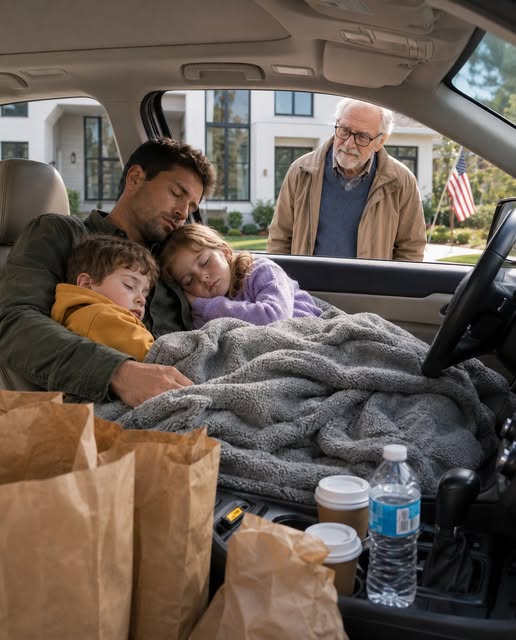
Instead, I found Daniel sleeping inside a silver Honda Civic.
The car sat in the cheapest section of long-term parking, far enough from the terminal that most travelers would never notice it.
Condensation coated every window from the inside.
When I recognized the license plate, a tightening in my chest told me something was wrong before my mind accepted what I was seeing.
I approached slowly and looked through a cleared patch in the glass.
Daniel was slumped against the driver’s door.
In the back seat, curled beneath one heavy blanket, were my twin grandsons, Caleb and Noah.
They were surrounded by clothes, fast-food wrappers, backpacks, stuffed animals, and plastic grocery bags.
For several seconds, I forgot the cold.
Then I knocked hard against the window.
Daniel startled awake with the wild panic of someone who had learned to sleep lightly.
When he recognized me, the fear on his face disappeared.
Something worse replaced it.
Shame.
He opened the door.
“Dad? What are you doing here?”
His voice sounded rough, exhausted, and much older than thirty-two.
“I came for your birthday. The better question is why my son and grandsons are sleeping in a parking lot.”
Daniel looked down.
“It’s complicated.”
“You are living in a car with two five-year-old boys during a Chicago winter. We have passed complicated.”
Movement came from the back seat.
Caleb sat upright and rubbed his eyes.
“Grandpa?”
The word almost broke me.
I forced my expression into something gentler.
“Good morning, buddy. How about you and Noah come with me for breakfast while your dad and I figure out what happens next?”
Noah woke beside him and immediately reached for his stuffed bear.
Daniel’s eyes filled.
“They think we’re camping.”
I looked at my son’s hollow cheeks, his worn boots, and the clothes folded into grocery bags.
Whatever had happened, humiliation had kept him silent long enough.
I was finished allowing it.
I rented two adjoining hotel rooms near the airport.
Before Daniel could protest, I handed the front-desk clerk my card.
“We’re staying at least a week.”
“Dad—”
“That wasn’t a question.”
Caleb and Noah attacked the breakfast buffet like they had not seen hot food in days.
I noticed Daniel barely touched his plate.
He kept cutting pancakes for the boys, pouring juice, wiping syrup from Noah’s sleeve.
Only when the twins were absorbed in cartoons in the adjoining room did I sit across from my son.
He stared into his coffee.
I said the only thing that mattered.
“Tell me everything, and do not protect anyone.”
His fingers tightened around the cup.
For almost a minute, he said nothing.
Then the story began.
Six months earlier, Daniel’s marriage to Melissa had finally collapsed.
I knew they had been having problems.
What I had not known was how bad things had become.
Melissa had filed for divorce and emergency temporary custody almost simultaneously.
She accused Daniel of being emotionally unstable, controlling, unpredictable, and dangerous around the children.
Not physically dangerous.
That would have required evidence she did not have.
Instead, she used language that was vague enough to be frightening.
“Erratic.”
“Obsessive.”
“Emotionally volatile.”
“Unable to regulate stress.”
Daniel had been working eighty-hour weeks building a software logistics company called HarborRoute.
He had not been sleeping enough.
He had been anxious.
He had gone to counseling twice after Melissa insisted he needed help managing stress.
Those two counseling appointments became the foundation of her case.
“She had a letter from a therapist,” Daniel said.
I frowned.
“What letter?”
He swallowed.
“It said I displayed symptoms consistent with severe anxiety, paranoia, and impaired judgment.”
“Did the therapist diagnose you?”
“No.”
“Did you authorize him to write that?”
“No.”
“Had you even seen him enough for him to make that determination?”
“Two appointments.”
I leaned back.
Something already smelled wrong.
Daniel continued.
Melissa also produced text messages.
They were technically his words, but the context had been stripped away.
One message read:
I swear I’m going to lose my mind if this keeps happening.
Daniel had sent it after a server crash cost HarborRoute an important client.
Another said:
I can’t do this anymore.
He had been talking about working through the night.
Melissa presented them as evidence of a psychological breakdown.
Then came witnesses.
Two HarborRoute employees testified that Daniel had become unpredictable at work.
One claimed he had shouted during meetings.
Another said he sometimes stayed at the office until three in the morning and seemed “agitated.”
Neither mentioned that HarborRoute had been facing a hostile takeover attempt.
Neither mentioned that Daniel had discovered unusual transfers from the company’s operating accounts.
Neither mentioned that one of those employees had been promoted days after Daniel was removed.
The temporary custody order arrived quickly.
Daniel went from seeing his children every day to supervised visits twice a week.
While he was fighting the custody case, HarborRoute’s board held an emergency vote.
Daniel’s business partner, Marcus Bell, argued that the allegations surrounding Daniel posed a reputational risk to the company.
Investors panicked.
Daniel was placed on temporary administrative leave.
Then Marcus presented documentation suggesting Daniel had authorized several questionable financial decisions.
Daniel denied it.
No one listened.
“I founded that company in my apartment,” he told me.
His voice cracked for the first time.
“I slept on the floor for two years so I could keep paying employees. Marcus came in later. He knew investors. He knew how to sell. I trusted him.”
“What happened to your ownership?”
“Frozen during an internal investigation.”
“And the investigation?”
“Marcus controlled the committee.”
Of course he did.
The legal bills came next.
Daniel had already spent most of his accessible savings supporting HarborRoute.
The custody fight drained the rest.
His lawyer eventually withdrew when Daniel could no longer maintain the retainer.
Then the mortgage payments fell behind.
Melissa refused to help because she had already moved into a luxury apartment in River North.
Three weeks earlier, the bank took possession of Daniel’s house.
I stared at him.
“You lost your house three weeks ago?”
He nodded.
“And you didn’t call me?”
“I was going to.”
“When?”
He looked toward the adjoining room.
“I don’t know.”
That answer hurt more than anger would have.
I had spent years telling myself Daniel was independent because I had raised him well.
Now I wondered whether I had accidentally taught him that needing help was failure.
“Why the car?”
“Cheap motels ran through what I had left.”
“What about shelters?”
“I tried.”
He looked ashamed again.
“The family shelters were full. One said they could take the boys but not me. I couldn’t do it.”
“And Melissa allowed this?”
His expression changed.
“She doesn’t know.”
I stared at him.
“What do you mean she doesn’t know?”
Daniel glanced toward Caleb and Noah.
“I was supposed to have them every other weekend. Last Friday, Melissa dropped them with me. She said she had a conference in New York and would be gone eight days.”
“She left two five-year-olds with a man she told a judge was unstable?”
Daniel gave me a bitter smile.
“That’s one of the things I started thinking about.”
Then he said something that changed everything.
“I think Marcus and Melissa were working together before the divorce.”
I did not respond immediately.
Daniel reached into his backpack and removed an old laptop.
The casing was cracked.
The battery was held in place with black electrical tape.
“I found something.”
He opened a folder.
Inside were screenshots.
Bank records.
Calendar entries.
Copies of emails.
Most were incomplete because Daniel had lost access to HarborRoute’s corporate systems after being removed.
But the pattern was there.
Marcus had approved consulting payments to a company called Northline Strategy Group.
The payments began eight months before Melissa filed for divorce.
Northline had no meaningful website.
No public employees.
No portfolio.
The business was registered to a mailbox in Delaware.
Daniel had traced one of its authorized managers.
A woman named Rebecca Hale.
Melissa’s maiden name was Hale.
I felt something cold settle inside me.
“Coincidence?”
“I thought so at first.”
Daniel opened another file.
A photograph showed Marcus Bell leaving a restaurant.
Beside him was Melissa.
The timestamp was four months before the divorce filing.
“How did you get this?”
“A HarborRoute employee sent it anonymously.”
“Who?”
“I don’t know.”
Another photograph showed Melissa getting into Marcus’s car.
Then another.
Different dates.
Different locations.
Same two people.
I looked at Daniel.
“Affair?”
“Maybe.”
“Financial arrangement?”
“Definitely.”
Daniel clicked open a spreadsheet.
Over eleven months, HarborRoute had paid Northline Strategy Group $418,000.
“What consulting services did Northline provide?”
“None that I can find.”
“Who approved the invoices?”
“Marcus.”
“And who else?”
Daniel hesitated.
“My electronic signature appears on seven of them.”
“Did you approve them?”
“No.”
That was when I stopped being simply an angry father.
For thirty-seven years, I had worked in corporate risk management.
The last twelve of those years were spent investigating procurement fraud, internal theft, conflicts of interest, and executive misconduct for multinational companies.
Daniel knew that.
What he apparently had forgotten was that retirement had not erased my instincts.
I turned the laptop toward myself.
“Send every file to me.”
“Dad, I don’t want you getting dragged into this.”
I looked directly at him.
“You were sleeping in an airport parking lot with my grandsons.”
He lowered his eyes.
“You should have called me six months ago.”
“I know.”
“No. Listen to me.”
He looked back up.
“You should have called me not because I could fix everything, but because you are my son. You do not have to earn the right to ask me for help.”
Daniel’s eyes filled.
I continued before either of us could lose control.
“Now take a shower. Shave. Sleep for three hours.”
“What are you going to do?”
“I’m going to start reading.”
By noon, I had made three phone calls.
The first was to my attorney in Seattle, Helen Ramirez.
The second was to an old colleague named Robert Lang, a forensic accountant who had spent twenty years tracing corporate fraud.
The third was to my younger sister Grace, who owned a three-bedroom condominium outside Chicago and was currently spending six months in Arizona.
Grace answered on the second ring.
When I explained the situation, she did not hesitate.
“Give Daniel the keys.”
“That’s why I called.”
“Give him the car too.”
“I think one vehicle is enough.”
“Thomas.”
That was my name.
Only Grace still used it in that warning tone.
“Fine,” I said. “I’ll tell him.”
By evening, Daniel and the twins had somewhere warm to live.
The next morning, Helen arrived from Seattle.
She met us in the hotel restaurant with two legal pads and the expression of someone who had already decided she disliked everyone involved.
Daniel looked nervous.
“I can’t afford—”
Helen lifted one finger.
“Your father already paid the initial retainer.”
Daniel glared at me.
I ignored him.
Helen continued.
“More importantly, I reviewed the temporary custody order. There are problems.”
“What kind?”
“For one thing, Melissa’s behavior is inconsistent with her claims. A parent who sincerely believes the other parent presents an immediate psychological danger does not voluntarily leave five-year-old children with that parent for eight days.”
Daniel nodded.
“Second,” Helen said, “the therapist’s letter troubles me. We need the underlying records.”
“What if he refuses?”
“We subpoena them.”
Daniel looked stunned.
Helen leaned closer.
“And third, the financial evidence may change everything. But we have to move carefully.”
That became our rule.
Carefully.
No angry phone calls.
No social-media posts.
No threats.
No accusations we could not prove.
I told Daniel the same thing every morning.
“Facts first.”
Robert arrived two days later.
He spent ten hours examining Daniel’s files.
At seven that evening, he removed his glasses.
“This is not sloppy bookkeeping.”
Daniel stared at him.
“What is it?”
“Someone built a pipeline.”
Robert turned his laptop around.
He had mapped HarborRoute’s payments.
Money flowed from HarborRoute to Northline Strategy Group.
Northline transferred portions of those payments to three other entities.
One of those entities had paid the lease on Melissa’s River North apartment.
Another had paid $38,000 toward a luxury SUV registered in her name.
A third had transferred $75,000 into an investment account opened three weeks after Daniel was removed from HarborRoute.
Daniel went pale.
“My company paid for her apartment?”
“Indirectly,” Robert said. “Which makes it harder to see.”
“Marcus.”
“Probably. But probably isn’t evidence.”
I nodded.
“What would be evidence?”
“Corporate banking records. Invoice approvals. Metadata. Communications.”
Helen smiled faintly.
“Then we ask for them.”
The custody hearing had been scheduled for late April.
We had six weeks.
At first, nothing happened.
Then the cracks began.
A former HarborRoute employee named Priya Shah contacted Daniel.
She had been the company’s senior financial analyst until Marcus fired her two months earlier.
She agreed to meet us at a coffee shop in Evanston.
Priya looked around twice before sitting down.
“I should have contacted you earlier.”
Daniel remained cautious.
“Why didn’t you?”
“Because Marcus threatened my career.”
“With what?”
“He said if I interfered, he would tell every company in Chicago that I falsified financial reports.”
“Did you?”
“No.”
Priya opened her bag.
“I found invoices for Northline. There were no work products. No presentations. No analysis. Nothing.”
Daniel leaned forward.
“I asked you about Northline.”
“I know.”
“You told me it was legitimate.”
Her eyes dropped.
“Marcus was standing behind you.”
Daniel’s jaw tightened.
Priya pushed a flash drive across the table.

“I copied the invoice archive before I was fired.”
Helen immediately covered the drive with her hand.
“Before anyone opens this, we need to establish how you obtained it and whether you were authorized to access those records.”
Priya nodded.
“I was.”
That flash drive gave us what we needed.
Northline’s invoices were vague.
“Strategic market positioning.”
“Executive advisory services.”
“Leadership optimization.”
The wording changed.
The amounts did not.
Every month, HarborRoute paid between $35,000 and $42,000.
More importantly, several invoices contained internal notes.
One said:
M.B. approved. D.F. authorization to be added.
Another said:
Use prior signature file.
Daniel read it twice.
“They copied my signature.”
Robert nodded.
“That appears likely.”
Then Priya showed us something else.
An email.
Marcus had written to HarborRoute’s finance director:
Daniel is overwhelmed right now. Route sensitive approvals through me until things stabilize.
The email had been sent three months before Daniel’s supposed instability became public.
Someone had been preparing the narrative early.
Helen sat back.
“This is becoming interesting.”
I did not like that word.
Interesting was what investigators called a situation when somebody else’s life had already been wrecked.
Daniel’s life was not interesting.
It was shattered.
Our next break came from an unexpected place.
Caleb.
We were eating dinner at Grace’s condominium when he casually said, “Mommy’s friend Marcus has a bigger TV than Grandpa.”
Every adult at the table stopped moving.
Daniel looked at his son carefully.
“You’ve been to Marcus’s house?”
Caleb nodded.
“Lots.”
Noah added, “He has the robot vacuum that eats socks.”
Daniel’s face drained.
I kept my voice casual.
“When did you go there?”
Caleb shrugged.
“When Mommy had work.”
“Was Daddy there?”
Both boys laughed.
“No.”
I saw Daniel grip the edge of the table.
Helen later warned us not to question the children further.
“They are five. Do not turn them into witnesses at home.”
So we did not.
But the revelation mattered.
Melissa had been taking the twins to Marcus’s home before the divorce.
Daniel sat alone on Grace’s balcony that night.
I joined him.
For several minutes, neither of us spoke.
Finally he said, “I kept thinking I must have missed something.”
“You probably did.”
He looked at me.
I continued.
“That’s not the same as causing it.”
He stared across the suburban rooftops.
“I worked constantly. Melissa complained. I told myself I was building something for the family.”
“I did the same thing when you were young.”
Daniel looked surprised.
“Your mother told me more than once that I knew the birthdays of corporate executives better than the schedules of my own children.”
“You were there.”
“Sometimes.”
I leaned against the railing.
“Being betrayed doesn’t mean you were perfect. It also doesn’t mean you deserved betrayal.”
Daniel nodded slowly.
The following week, Melissa returned from her “conference.”
When she learned the twins were staying at Grace’s condominium rather than sleeping in Daniel’s car, she became furious.
Not relieved.
Furious.
She called Daniel twelve times.
He answered only once, with Helen listening.
“Where are the boys?”
“With me.”
“You don’t have a suitable residence.”
“I do now.”
“Whose?”
“My aunt’s.”
“You had no right to move them.”
Daniel almost laughed.
“You dropped them with me for eight days.”
“That was before I knew you were living in your car.”
There was silence.
Helen wrote something on a legal pad.
Daniel said, “How did you learn I was living in my car?”
Melissa hesitated.
“You told someone.”
“No, I didn’t.”
“Well, somebody told me.”
Daniel looked at Helen.
She shook her head.
Do not push.
So he ended the call.
But the question remained.
How had Melissa known?
We found the answer three days later.
A private investigator hired during the custody dispute had photographed Daniel entering and leaving the airport parking lot.
Melissa had known for at least twelve days.
Twelve days.
She knew her sons would be sleeping in a car.
She sent them anyway.
Helen filed an emergency motion.
The hearing happened forty-eight hours later.
Melissa arrived with her attorney and Marcus.
Seeing Marcus sitting behind her told me more than any photograph could have.
Daniel noticed him too.
For a second, anger flashed across his face.
I touched his arm.
“Facts first.”
The judge entered.
Helen did not make speeches.
She simply presented dates.
Photographs.
Text messages.
The original custody allegations.
Then Melissa’s voluntary decision to leave the twins with Daniel for eight days.
Melissa’s lawyer argued that circumstances had changed.
Helen asked one question.
“If Mrs. Foster believed Mr. Foster presented a danger to the children, why did she leave them in his sole care while knowing he was living in a vehicle?”
The courtroom went silent.
Melissa whispered to her attorney.
The judge looked at her.
“You knew?”
Melissa finally answered.
“I knew he had housing difficulties.”
“That was not my question.”
She shifted.
“Yes.”
“Did you know he was sleeping in a car?”
“Yes.”
“With the children?”
“I believed he would arrange something.”
The judge’s expression hardened.
“You believed the man you have characterized as psychologically unstable and financially irresponsible would arrange safe housing after you left two five-year-old children in his care?”
Melissa did not answer.
The judge modified the temporary custody arrangement.
Daniel received equal parenting time pending further evaluation.
It was not victory.
But when we walked outside, Daniel stood on the courthouse steps crying silently.
“I get them half the week.”
I put my hand on his shoulder.
“Yes.”
He laughed through the tears.
“I get to make breakfast.”
That was the first time since I found him in the car that he looked like my son again.
But the company case was only beginning.
Once HarborRoute learned we possessed copies of the Northline invoices, its outside counsel contacted Helen.
They wanted a meeting.
Marcus did not attend.
Three board members did.
Robert presented the financial trail.
Nobody interrupted him.
When he finished, one director asked Daniel, “Why didn’t you raise this before?”
Daniel stared at him.
“I did.”
The director looked uncomfortable.
Another said, “Our information was that your concerns were symptoms of your deteriorating mental state.”
“That information came from Marcus.”
Silence.
Then Helen placed a document on the table.
It was the therapist’s letter used in Daniel’s custody case.
“Does this language look familiar?”
The directors read it.
One of them visibly stiffened.
“What?”
He looked at the others.
“This phrase. ‘Impaired executive judgment under prolonged stress.’”
Helen nodded.
“Why is it familiar?”
The director opened his laptop.
Two minutes later, he found an internal memorandum Marcus had circulated before Daniel’s removal.
It described Daniel as exhibiting:
Impaired executive judgment under prolonged stress.
Exact wording.
Daniel stared at the screen.
The therapist and Marcus had apparently been using the same language.
The board ordered an independent investigation that afternoon.
Marcus was placed on administrative leave.
He lasted four days.
Then he resigned.
But resignation did not end anything.
Because the independent investigators gained access to HarborRoute’s servers.
What they found was worse than Robert had predicted.
Marcus had exchanged emails with Melissa for more than a year.
At first, personal.
Then financial.
Then strategic.
One message from Melissa read:
He suspects the invoices. You need to move faster.
Marcus replied:
Once the board questions his stability, his objections won’t matter.
Another message:
The custody filing will reinforce everything. People believe patterns.
And another:
Make sure the therapist uses language that won’t look like a diagnosis. We just need concern.
Daniel could not finish reading.
He pushed the laptop away.
I finished for him.
There were discussions about his schedule.
His stress.
His counseling.
His arguments with Melissa.
They had taken real difficulties and turned them into weapons.
Marcus had even advised Melissa when to provoke arguments by text so Daniel’s frustrated responses could later be presented without context.
Then came the financial arrangement.
Northline belonged indirectly to Melissa.
Marcus had used the company to divert money from HarborRoute.
Melissa received a share.
In return, she helped create the instability narrative that allowed Marcus to remove Daniel from operational control before Daniel discovered the missing funds.
It was not merely an affair.
It was a partnership.
Daniel looked physically sick.
“I married her.”
Nobody answered.
“I told her everything.”
His voice cracked.
“My fears. The company. Problems with investors. She knew exactly what would hurt me because I trusted her.”
Helen closed the laptop.
“That trust is why her conduct will matter.”
The therapist was the next domino.
Faced with subpoenas for his notes and communications, he retained an attorney.
Within a week, his lawyer contacted Helen.
The therapist admitted Melissa had repeatedly contacted him after Daniel’s two appointments.
She described Daniel’s behavior.
She asked whether anxiety could impair judgment.
She then requested a letter for “family-court purposes.”
The therapist insisted he never intended his letter to be interpreted as a formal diagnosis.
But he had accepted Melissa’s descriptions without evaluating Daniel further.
Worse, records showed Marcus’s private foundation had made a substantial donation to a nonprofit organization on whose board the therapist served.
Maybe coincidence.
Maybe not.
Investigators would decide.
Daniel underwent an independent psychological evaluation.
He went willingly.
The report found stress.
Sleep deprivation.
Symptoms of situational anxiety.
Nothing remotely supporting the picture Melissa had painted.
When the permanent custody hearing finally arrived, the courtroom felt different.
Six weeks earlier, Daniel had walked into court believing every person in the room saw him as unstable.
This time, he wore a navy suit Helen helped him choose.
His hair was trimmed.
He had gained nine pounds.
He had been attending counseling voluntarily.
He had rented a modest townhouse near the twins’ school using money I loaned him.
Not gave him.
Daniel insisted on the distinction.
Melissa entered twenty minutes later.
Marcus was not with her.
He had bigger problems.
HarborRoute had referred its findings to federal authorities because some diverted funds involved interstate transactions and investor disclosures.
The company had also filed a civil suit seeking recovery.
Melissa looked different too.
Not poorer.
Not yet.
But less certain.
Her attorney spent the morning arguing that whatever had happened financially did not automatically determine parenting fitness.
Helen agreed.
That surprised everyone.
Then she stood.
“This case is not about punishing Mrs. Foster for financial misconduct. It is about whether the court can trust the representations she made when she sought to restrict a father’s relationship with his children.”
She presented the timeline.
Melissa’s relationship with Marcus.
The Northline payments.
The communications about Daniel’s supposed instability.
The staged text arguments.
The therapist letter.
The fact that Melissa knowingly sent the twins to stay with Daniel while he was living in a car.
Then came the emails.
Melissa’s attorney fought hard to exclude several.
Some were admitted.
Others were not.
The admitted messages were enough.
One contained six words that seemed to drain the entire courtroom of air.
If he looks unstable, we win.
Melissa had written it to Marcus.
The judge read it twice.
Daniel sat beside Helen without moving.
Then Melissa took the stand.
Her attorney tried to repair the damage.
Melissa testified that Daniel truly had been stressed.
That he had shouted.
That he had become obsessed with company finances.
That she had feared what he might do.
Helen approached calmly.
“Mrs. Foster, did Mr. Foster ever physically harm you?”
“No.”
“Did he ever physically harm Caleb or Noah?”
“No.”
“Did he ever threaten to?”
“No.”
“Did you believe he was capable of caring for the twins alone?”
“Sometimes.”
“Did you leave the twins with him for eight days in March?”
“Yes.”
“While knowing he was homeless?”
Melissa’s jaw tightened.
“Yes.”
“Why?”
“I had a work obligation.”
Helen paused.
“Your trip was not a work conference, was it?”
Melissa’s attorney stood.
“Objection.”
The judge looked at Helen.
“Basis?”
Helen handed over financial records.
The objection was overruled.
Melissa’s supposed business trip to New York had actually been a four-day stay at a resort in Scottsdale.
Marcus had joined her.
The hotel had been paid through one of Northline’s affiliated accounts.
Daniel closed his eyes.
Helen continued.
“You left your five-year-old sons with a man you told this court was unstable and dangerous so you could vacation with the business partner who was helping remove him from his company?”
Melissa snapped.
“He was their father!”
The courtroom froze.
Helen did not need to say anything for several seconds.
Finally, she asked softly, “Exactly.”
Melissa realized what she had done.
Too late.
She had spent months arguing Daniel was too unstable to parent.
Now, under pressure, she defended abandoning the twins with him by saying he was their father.
Both things could not be true.
The judge’s ruling came three weeks later.
Daniel was awarded primary residential custody.
Melissa received substantial parenting time, but exchanges and communication would be structured while the court reviewed the broader issues.
The judge’s written decision was careful.
It did not punish Melissa for her relationship with Marcus.
It did not decide the business allegations.
It focused on credibility.
Manipulation.
Misrepresentation.
And the children’s stability.
Daniel read the order at my kitchen table.
Then he looked toward the backyard, where Caleb and Noah were chasing each other with foam airplanes.
“They stay with me?”
“Yes.”
“For school too?”
“Yes.”
He put his hands over his face.
I said nothing.
Some moments do not need speeches.
HarborRoute’s board investigation finished in June.
The company concluded Daniel had not authorized the Northline invoices.
His electronic signature had been reused without permission.
The internal accusations against him were withdrawn.
Marcus’s shares were frozen pending litigation.
Three executives who helped remove Daniel were dismissed.
Then HarborRoute’s board asked Daniel to come back.
He refused.
That surprised them.
It surprised me too.
We were sitting in the same conference room where Robert had first presented the financial trail.
The board chairman said, “We are prepared to restore your title.”
Daniel shook his head.
“No.”
“Your compensation package would include—”
“I don’t want it.”
The chairman stopped.
Daniel looked around the table.
“You removed me without giving me a meaningful chance to defend myself. I brought concerns about suspicious payments, and instead of investigating them, you accepted the explanation that I was unstable.”
One director looked down.
Daniel continued.
“I built HarborRoute because I believed technology could make supply chains more transparent. Somewhere along the way, this company decided appearances were more important than truth.”
The chairman sighed.
“What do you want?”
Daniel slid a document across the table.
“A buyout of my shares at independent fair value. Full correction of the record. Payment of outstanding compensation. And reimbursement of legal costs related to the internal investigation.”
“That is substantial.”
“So was losing my company.”
The negotiation took three weeks.
Daniel got nearly everything.
Not because the board suddenly became generous.
Because the evidence had become expensive.
By August, Daniel had enough money to repay me.
He transferred every dollar I had loaned him.
Then he transferred an extra $500.
I called immediately.
“What is the five hundred for?”
“The hotel breakfast.”
“You’re ridiculous.”
“You bought six breakfasts.”
“They were pancakes.”
“Airport hotel pancakes.”
I laughed so hard I had to sit down.
It was the first normal argument we had experienced in months.
Marcus eventually faced civil fraud claims and additional legal scrutiny over HarborRoute’s funds.
I did not attend his hearings.
Neither did Daniel.
That surprised people.
They expected revenge.
They expected us to sit in the courtroom and enjoy watching him fall.
But by then Daniel understood something I had spent my life learning.
If you build your recovery around someone else’s destruction, they still control too much of your life.
Melissa’s situation unraveled more slowly.
The court did not take her children away.
Daniel never asked it to.
That mattered to me.
Whatever she had done, Caleb and Noah loved their mother.
Daniel refused to weaponize that love.
When Melissa called the twins, he handed them the phone.
When they made cards for her birthday, he bought the stamps.
When Caleb asked why Mommy did not live with them anymore, Daniel said only, “Sometimes grown-ups make choices that mean they can’t live together, but Mommy loves you.”
I asked him once how he managed it.
He looked at me.
“I know what it feels like when someone uses your children to hurt you.”
He would not become the person who had hurt him.
That was when I knew my son had truly survived.
Not when he got the house.
Not when he recovered the money.
Not when the judge ruled for him.
Then.
In September, Daniel started another company.
Much smaller.
Four employees.
A rented office above a dental practice in Oak Park.
No glass tower.
No investors demanding aggressive growth.
No executive assistants.
He called it ClearHarbor Systems.
I raised an eyebrow when I heard the name.
“Subtle.”
“I wasn’t trying to be.”
His first employee was Priya.
She became chief financial officer.
Her first policy required dual authorization for every consulting contract.
Her second prohibited executives from approving payments to entities connected to family members or romantic partners without independent review.
Daniel framed those policies and hung them beside the printer.
Caleb drew dinosaurs on the frame.
Daniel kept the drawings.
By Christmas, ClearHarbor had twelve employees.
The twins had started kindergarten.
Noah loved science.
Caleb loved anything involving glue, scissors, or catastrophic amounts of glitter.
Daniel rented a small brick house with a fenced yard.
The first night he slept there, he called me.
“You awake?”
“It’s nine-thirty.”
“You’re old.”
“You’re calling your old father at nine-thirty, so apparently you’re not doing much better.”
He laughed.
Then he became quiet.
“The boys are asleep.”
“That happens occasionally.”
“They each have their own bed.”
I understood what he was really saying.
Six months earlier, they had slept beneath one blanket in the back of a Honda Civic.
Now they had dinosaur sheets.
Night-lights.
Bookshelves.
A bathroom with plastic boats floating in the tub.
Ordinary things.
Ordinary things can feel miraculous after you lose them.
“I’m proud of you,” I said.
Daniel was quiet.
Then he answered, “Thanks, Dad.”
The following March, I flew to Chicago again for his birthday.
This time, Daniel knew I was coming.
He met me at O’Hare with Caleb and Noah.
The boys saw me first.
“Grandpa!”
Two small bodies crashed into my legs.
I nearly lost my balance.
Daniel stood behind them laughing.
He looked healthy.
Not perfect.
Not untouched.
Healthy.
On the drive from the airport, we passed the entrance to long-term parking.
Daniel became quiet.
I noticed.
He noticed that I noticed.
For a moment, neither of us spoke.
Then Caleb pointed out the window.
“Dad, is that where we went camping?”
Daniel’s hands tightened slightly around the steering wheel.
Noah brightened.
“The car camping!”
I looked at Daniel.
He smiled faintly.
“Yeah, buddy.”
“Can we do it again?”
Daniel laughed.
“No.”
“Why?”
“Because Grandpa hates camping.”
I played along.
“Absolutely terrible. Worst vacation of my life.”
The boys giggled.
Then Daniel drove past the entrance without looking back.
His birthday dinner was held in the little house in Oak Park.
Priya came.
Helen flew in.
Grace returned from Arizona and brought a cake too large for the refrigerator.
Caleb and Noah decorated the dining room with paper airplanes.
After dinner, Daniel handed me a small box.
“What’s this?”
“A present.”
“It’s your birthday.”
“Open it.”
Inside was a key.
I looked at him.
“Your house?”
He nodded.
“In case I ever get stupid enough not to call you again.”
I closed my hand around it.
“You won’t.”
“I might.”
“Then I’ll use the key.”
He smiled.
Later that evening, while everyone else was arguing over cake, I stepped outside onto the porch.
Daniel joined me.
The neighborhood was quiet.
Somewhere down the block, a dog barked.
Spring had not quite arrived, but the air no longer carried that brutal winter bite.
Daniel leaned against the railing.
“Do you remember what you said in the hotel?”
“I say many brilliant things.”
“You said I didn’t have to earn the right to ask you for help.”
I nodded.
“I kept thinking about that.”
He stared out toward the street.
“I think part of why everything got so bad was that I kept trying to prove I could handle it alone. The company. The marriage. The custody case. Losing the house.”
“You were scared.”
“I was embarrassed.”
“That too.”
He looked at me.
“I thought you would be disappointed.”
That hit harder than I expected.
“Daniel, when I saw that car, disappointment was the last thing I felt.”
“What did you feel?”
I considered lying.
Parents lie sometimes because the truth is too vulnerable.
But Daniel had spent enough time surrounded by manipulated truth.
So I answered.
“Fear.”
He waited.
“I was terrified I had almost lost you because you believed you had to hide from me until you had fixed everything.”
Daniel’s eyes lowered.
“I’m sorry.”
“I’m not asking for an apology.”
“What are you asking for?”
“Next time your life collapses, call before the airport parking lot.”
He laughed.
“Fair.”
We stood together for another minute.
Then Daniel said, “You know what everyone thought you were going to do?”
“What?”
“Destroy Melissa and Marcus.”
“I’m retired. That sounds exhausting.”
He smiled.
“I’m serious.”
“So am I.”
I looked through the window.
Caleb was trying to steal frosting from the cake while Noah acted as lookout.
Grace had clearly noticed and was pretending not to.
Helen was laughing with Priya.
The room was warm.
Full.
Alive.
“This is better,” I said.
Daniel followed my gaze.
For the first time in a long time, there was no anger in his face.
Only understanding.
Revenge would have been watching Marcus lose his company.
Revenge would have been watching Melissa lose her apartment.
Revenge would have been celebrating every lawsuit, every investigation, every dollar recovered.
I had wanted those things at first.
I will admit it.
The morning I found Daniel sleeping against that car door, I wanted everyone responsible to experience the same fear and humiliation.
But anger is useful only if you know when to put it down.
Daniel did.
Eventually, so did I.
What mattered was that he got his children back.
He rebuilt his career.
He recovered his name.
He learned to ask for help.
And Caleb and Noah never had to understand how close their father had come to disappearing beneath the weight of everything people had done to him.
Months later, the boys still called that terrible week “the camping adventure.”
Daniel never corrected them.
Maybe one day, when they were adults, he would tell them the truth.
Maybe he would explain how their father lost a house, a company, his reputation, and almost his belief in himself.
Maybe he would tell them that their mother made terrible choices without teaching them to hate her.
Maybe he would explain why Grandpa appeared one freezing morning in an airport parking lot and refused to leave.
But not yet.
For now, they were children.
They deserved childhood.
Before I returned to Seattle, Daniel drove me to O’Hare.
At the curb, he took my suitcase from the trunk.
“You sure you don’t want me to walk inside?”
“I’ve been navigating airports longer than you’ve been alive.”
“That’s exactly what an old person says before getting lost.”
I pointed at him.
“Respect your elders.”
He grinned.
Then the expression disappeared.
He stepped forward and hugged me.
Not the quick shoulder hug men in our family usually gave each other.
A real one.
“Thanks for coming last year,” he said.
“It was your birthday.”
“No.”
He pulled back.
“I mean thanks for finding me.”
I looked at my son.
“You weren’t supposed to need finding.”
“I know.”
“But if you ever do again, I’ll come.”
He nodded.
Behind him, Caleb and Noah waved from the car.
I waved back.
Then Daniel said something I still think about.
“I thought losing everything meant I had become nothing.”
I shook my head.
“Losing everything just shows you what was never actually part of you.”
He looked at me.
“The house was property. The company was paperwork. Money was numbers. Reputation was other people’s opinions.”
“And the boys?”
“Yours.”
He smiled.
“And you?”
I picked up my suitcase.
“Still my son.”
Daniel stood there as I walked toward the terminal.
One year earlier, I had arrived expecting birthday cake and found my family sleeping in a car.
I believed I was walking into the worst thing that had ever happened to my son.
Maybe I was.
But I was also walking into the moment when the lies finally stopped working.
Because people like Marcus and Melissa had relied on Daniel remaining ashamed.
Silent.
Isolated.
They needed him to believe asking for help would make him weak.
The moment he stopped protecting everyone else from the truth, their plan began falling apart.
Not because I was powerful.
Not because Helen was brilliant.
Not because Robert could trace money through seven companies.
Those things helped.
But the real change happened when Daniel finally sat across from me in a hotel restaurant, exhausted and terrified, and told the truth without editing it to protect the people who had hurt him.
That was the beginning.
Years later, ClearHarbor became more successful than Daniel expected.
Not enormous.
He did not want enormous anymore.
It grew slowly, carefully, and profitably.
Daniel implemented something he called the “second-chair rule.”
No important decision depended on one person.
No executive controlled financial approvals alone.
Employees could challenge senior leadership without risking retaliation.
Every quarter, Daniel personally met with junior staff and asked a single question:
“What are we pretending not to see?”
Priya told me that question had prevented more than one bad decision.
Daniel never forgot why he asked it.
Melissa eventually moved to another suburb.
Her relationship with Marcus ended before the civil case concluded.
She took a job in marketing and slowly rebuilt her own life.
Daniel never forgave what she had done.
At least not in the sentimental way people talk about forgiveness.
He simply stopped allowing hatred to organize his days.
Their communication became brief and practical.
School pickups.
Doctor appointments.
Soccer practices.
Birthdays.
When Caleb broke his wrist at age seven, Daniel and Melissa sat together in the emergency room for four hours without arguing once.
Afterward, Daniel called me.
“Progress?” I asked.
“Ceasefire.”
“Sometimes that’s enough.”
Marcus lost nearly everything connected to HarborRoute.
The civil case ended with a settlement.
The financial details were confidential.
Daniel never told me the amount.
I never asked.
The strangest thing happened three years after I found Daniel in that parking lot.
Marcus sent him a letter.
Not an email.
A letter.
Daniel brought it to my house in Seattle when he visited with the boys.
“You want to read it?”
“No.”
He seemed surprised.
“Why not?”
“Do you?”
“I already did.”
“And?”
Daniel shrugged.
“He says he was under pressure. Says things got out of control. Says he never expected it to go as far as it did.”
“Does he apologize?”
“Sort of.”
“What does sort of mean?”
“He says he regrets how things unfolded.”
I laughed.
“That is not an apology.”
“I know.”
“What are you going to do?”
Daniel looked toward the backyard where Caleb and Noah were kicking a soccer ball.
“Nothing.”
“Nothing?”
“He wants me to respond.”
“Probably.”
“He wants absolution.”
“Probably.”
Daniel folded the letter.
“I spent years responding to people who wanted something from me.”
He placed it back into the envelope.
“I don’t owe him my attention.”
Then he threw it away.
That was the last time Marcus Bell’s name was spoken in my house.
By the time the twins turned ten, they remembered almost nothing about the Honda.
Caleb vaguely remembered the blanket.
Noah remembered his stuffed bear falling between the seats.
Neither remembered hunger.
Neither remembered cold.
Neither remembered their father quietly crying after they fell asleep.
Daniel did.
I did.
Maybe that was enough.
Some memories should belong to the adults who survived them.
On Daniel’s fortieth birthday, our whole family returned to Chicago.
He had bought a house by then.
Not a mansion.
A comfortable two-story home with a maple tree in front and a basketball hoop above the garage.
Caleb and Noah were nearly as tall as their mother.
Daniel had gray beginning at his temples.
I told him it made him look distinguished.
He told me I had no credibility because I had been gray for twenty years.
After dinner, he disappeared into his office and returned carrying something.
A photograph.
It showed a silver Honda Civic.
The same one.
Parked outside Grace’s condominium after we moved him out of the airport lot.
I stared at it.
“You kept a photograph?”
“Yeah.”
“Why?”
Daniel turned it over.
On the back, he had written one sentence.
This is not where the story ended.
He handed it to me.
“I keep it in my desk.”
I understood.
Not as punishment.
Not as shame.
As evidence.
Evidence that a terrible chapter is not automatically the final chapter.
Evidence that losing everything visible does not mean everything valuable is gone.
Evidence that sometimes survival begins with the sentence you are most afraid to say.
I need help.
Daniel took the photograph back.
“You know what I remember most about that morning?”
“The cold?”
“No.”
“The boys?”
He shook his head.
“You knocking on the window.”
I smiled.
“You looked terrified.”
“I thought you were airport security.”
“That would have been less embarrassing.”
He laughed.
Then his expression softened.
“You knocked like you were angry at the glass.”
“I was angry at everything.”
“I know.”
He looked toward the dining room.
Caleb and Noah were arguing over the last piece of cake.
Grace, now well into her seventies, was telling them both to split it.
Priya had brought her husband and daughter.
Helen was drinking wine near the fireplace.
Life had filled the spaces that shame once occupied.
Daniel followed my eyes.
Then he said, “You know what the best part is?”
“What?”
“They don’t remember.”
He nodded toward the twins.
“They don’t remember sleeping in that car.”
I looked at my grandsons.
“No.”
“They remember Grandpa showing up.”
I felt my throat tighten.
Daniel smiled.
“That’s the story they tell.”
And maybe that is why I tell this story differently now.
For a long time, I thought it was about betrayal.
A wife who manipulated the truth.
A business partner who stole money.
A company that abandoned its founder when protecting itself became easier than asking questions.
A system that briefly mistook carefully arranged accusations for reality.
But that is not what stayed with me.
What stayed with me was a father sitting across from his adult son and realizing that pride can become another locked door.
What stayed with me was Daniel learning that silence protects the wrong people when truth is the only thing capable of setting you free.
What stayed with me was two little boys who believed they were camping because their father loved them too much to let them understand how scared he was.
And what stayed with me most was that freezing March morning.
The fogged windows.
The grocery bags.
The blanket.
My son opening the car door and asking why I was there.
I had thought I came to Chicago for his birthday.
I was wrong.
I came because sometimes the people we love can disappear without going anywhere.
They can still answer texts.
Still say they are fine.
Still tell you work is busy.
Still promise they will call next week.
Meanwhile, they are quietly losing ground one day at a time.
Daniel had protected me from the truth because he did not want me to worry.
He protected his sons because they were too young to understand.
He protected Melissa longer than she deserved because she was the mother of his children.
He protected former employees because he worried they would lose their jobs.
He even protected Marcus at first because part of him could not accept that a man he once trusted might have deliberately betrayed him.
That protection nearly destroyed him.
So when I told him, “Tell me everything, and do not protect anyone,” I was not promising revenge.
I was giving him permission to stop carrying everyone else’s consequences.
That turned out to be more powerful than revenge could ever have been.
Because revenge looks backward.
Daniel rebuilt forward.
He became a better father.
A wiser businessman.
A man who knew the difference between independence and isolation.
And me?
I became a better father too.
Even at my age.
Especially at my age.
I stopped assuming silence meant strength.
I started asking the second question.
When Daniel said, “I’m fine,” I asked, “Are you really?”
When the twins became teenagers and answered every question with “nothing,” I learned to stay in the room a little longer.
When someone I loved became distant, I stopped taking their first answer as proof they did not need me.
Sometimes love is gentle.
Sometimes it is patient.
And sometimes love is standing in an airport parking lot in freezing wind, knocking on the window until somebody finally opens the door.
 THE END! THANK YOU FOR READING!