The first time I met my boyfriend’s mother, I thought, That woman could bury a body and still make it home before dinner.
She was sixty, broad-shouldered, sun-browned, and built like somebody who had spent thirty years lifting things other people needed forklifts for. Her gray hair was cut blunt at her jaw. She wore work boots to a restaurant. She spoke in short sentences that sounded like verdicts.
Her name was Ramona Maddox.
She had raised her only son alone while building a small recycling and salvage business outside Pittsburgh.
Everybody warned me she was difficult.
That was exactly why I married her son.
My name is Darcy Sayer, and by twenty-four I had learned one important survival skill: if you are bad at standing up for yourself, find someone who is extremely good at it.
My own family had never considered me worth defending.
My parents, Marla and Colin Sayer, had two daughters.
My younger sister, Fallon, was the pretty one.
The smart one.
The one whose dance classes, private school tuition, braces, clothes, and college plans were always “investments.”
I was the practical one.
Which was family language for: Darcy can go without.
When I was eight, my grandmother died and I moved back into my parents’ house after spending most of my childhood with her.
I was thrilled.
For about a week.
Then I discovered why they had suddenly decided they were ready to raise me.
Fallon was three.
She needed watching.
I learned how to make grilled cheese before I learned long division.
I folded laundry, cleaned bathrooms, packed lunches, and entertained my sister while my parents worked or went out.
Fallon cried and got candy.
I cried and got told to stop being dramatic.
By sixteen, I had stopped asking for things.
By eighteen, I was working full-time at an electronics assembly plant.
My father controlled my first bank account because he had helped me open it when I was still a minor.
Somehow, every paycheck disappeared into “household expenses.”
When I complained, Dad said, “You eat here, don’t you?”
Mom called me ungrateful.
Fallon wore a new coat that winter.
I kept quiet.
That became my personality.
Quiet.
Useful.
Easy.
Then I met Reid Maddox.
He came to the plant to inspect a load of industrial wiring his company was buying for recycling.
He was tall, permanently grease-stained somewhere, and completely unimpressed by people who tried to impress him.
On our third date, he asked why I apologized every time I expressed an opinion.
“I don’t.”
“You just apologized for saying you don’t.”
I stared at him.
He smiled.
I fell in love slowly after that.
My family hated him quickly.
Not because Reid treated me badly.
Because they discovered his mother ran a salvage yard.
Dad called him “the junk man.”
Fallon started making jokes about me becoming queen of the landfill.
Then my parents introduced me to Grant Holloway, a fifty-one-year-old widower whose oldest son was only four years younger than I was.
Grant owned several commercial properties.
He also happened to be the father of one of Fallon’s former classmates.
I knew something was wrong when my mother put on lipstick for a dinner supposedly being held “for me.”
Grant spent the evening talking about how his late wife had understood that a successful man needed peace at home.
Then he looked at me and said, “I’m not looking for a career woman.”
My father smiled.
“You won’t have that problem with Darcy.”
I wanted to disappear beneath the table.
Three days later, I overheard my parents arguing in the kitchen.
Grant had offered to pay off a large portion of Dad’s gambling debt if the marriage happened.
He had also promised to cover Fallon’s first year at an expensive private college.
My mother’s exact words were, “Darcy should be grateful. A man like that could give her a life she’d never earn herself.”
I called Reid from the parking lot behind a grocery store.
“They’re trying to sell me.”
He went silent.
Then he said, “Where are you?”
We met forty minutes later.
He wanted to confront them.
I said no.
“They’ll deny everything. Then they’ll take my phone, lock me down, and turn it into another family war.”
“You’re twenty-four.”
“You don’t understand my parents.”
“Then help me understand.”
I did.
For the first time, I told him everything.
The money.
The years of unpaid babysitting.
The insults.
The way I instinctively watched my father’s hands when he got angry.
The fact that even now, as an adult, I sometimes felt twelve years old inside that house.
Reid’s face changed.
“Come live with me.”
“They’ll still interfere.”
“Then marry me.”
I laughed because I thought he was joking.
He wasn’t.
We went to the county courthouse two days later.
No flowers.
No family.
No white dress.
Just Reid, me, two IDs, and a clerk who told us to stand closer together for the photo.
I thought I would feel terrified.
Instead, when I signed my name, something inside me went quiet.
For once, a decision belonged entirely to me.
Our mistake was believing we could hide it.
Fallon found the marriage certificate in my bag.
By the time I came home from work, my parents were waiting.
Dad slapped me before I had taken off my coat.
My head snapped sideways.
Then he hit me again.
“You married that garbage picker?”
Mom grabbed the certificate.
“You humiliated this family for nothing.”
“For nothing?”
“Grant was willing to give you security!”
“He was willing to pay you.”
Fallon laughed from the sofa.
“Oh, please. Don’t suddenly grow a backbone because some guy with a scrapyard called you pretty.”
Dad pointed toward the door.
“You will get this marriage annulled.”
“No.”
The word came out so quietly that everyone stopped.
Dad leaned toward me.
“What did you say?”
My hands were shaking.
“No.”
He raised his hand again.
And then someone knocked hard enough to rattle the front door.
Fallon opened it.
Ramona Maddox stood on the porch carrying a cardboard box of fruit, homemade bread, and what looked like a casserole wrapped in foil.
She wore faded jeans, an old canvas jacket, and work boots powdered with dust.
Fallon looked her up and down.
“Can I help you?”
“I’m here for my daughter-in-law.”
Fallon actually laughed.
My father pushed past her.
“You have some nerve coming here.”
Ramona’s eyes moved past him and landed on me.
Then on my face.
The marks from Dad’s hand were still red.
Something changed in her expression.
Not dramatically.
Her mouth simply flattened.
She set the box down.
“Darcy.”
I had only met her twice.
I still almost ran to her.
“I’m here.”
Mom folded her arms.
“If your son wants our daughter, he can start by behaving like a man instead of sneaking around behind our backs.”
Ramona looked at me, not her.
“What do you want?”
It was such a simple question that I nearly cried.
Nobody in my family had asked.
Dad barked, “She doesn’t know what she wants.”
Ramona ignored him.
“Darcy?”
I gripped the marriage certificate.
“I don’t want an annulment.”
“Okay.”
“I want to stay married to Reid.”
“Okay.”
Mom’s voice rose. “You don’t get to decide that!”
Ramona finally turned.
“No. Darcy does.”
Dad stepped toward me.
“You ungrateful little—”
His hand came up again.
This time it never reached me.
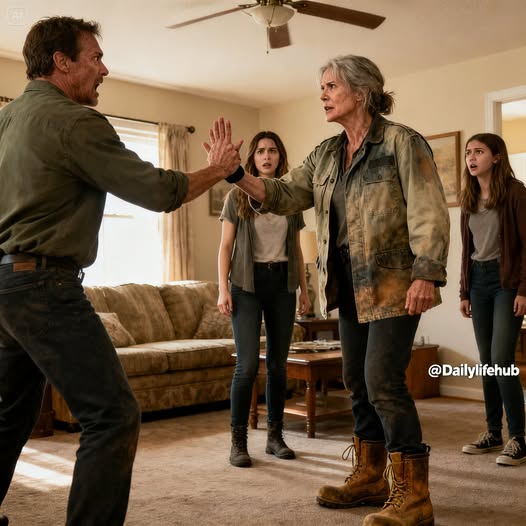
Ramona caught his wrist.
The entire room froze.
She did not twist dramatically or throw him across the furniture.
She simply squeezed until Dad’s face changed.
“Let go.”
Ramona’s voice stayed calm.
“You raised your hand to her twice before I got here.”
Dad tried to pull free.
She didn’t move.
“You do it again while I’m standing here, and we’re going to have a different kind of conversation.”
Then she released him.
Dad stumbled backward.
Fallon screamed, “She attacked him!”
Ramona looked bored.
“No. I prevented him from attacking somebody half his size.”
Mom started shouting about calling the police.
Ramona nodded toward the phone.
“Please do.”
That shut her up.
Fallon moved closer to me and softened her voice.
“Darcy, think. You’re throwing your life away. Grant has money. Reid’s family sorts trash for a living.”
“He owns a recycling company.”
“Same thing.”
“You marry Grant, then.”
Her mouth fell open.
It was the first time in my life I had ever said anything like that to her.
My heart hammered so hard I could hear it.
Fallon’s face turned red.
“I’m trying to help you!”
“If he’s such a great catch, marry him yourself.”
“He’s old enough to be my father!”
I stared at her.
“Exactly.”
Ramona made a small sound that might have been a laugh.
I immediately stepped behind her.
Yes, it was cowardly.
It was also fantastic.
My parents exploded.
Fallon called me jealous.
Mom called me selfish.
Dad said I had always been the difficult child.
Ramona stood there with her arms crossed until they exhausted themselves.
Then she spoke.
“My son married Darcy legally.”
Silence.
“She is an adult. She says she wants the marriage. That ends the discussion.”
Dad scoffed. “She’s still my daughter.”
“And apparently you forgot what that means.”
Mom’s eyes narrowed.
“Don’t lecture me about motherhood.”
Ramona looked at the fading marks on my face.
“I wouldn’t dream of competing with your example.”
I nearly choked.
Then she turned to me.
“Pack your things.”
I hesitated.
“My clothes—”
Ramona looked toward my bedroom.
Then at the washed-thin sweater I was wearing.
“Anything in this house worth taking?”
I considered it.
“No.”
“Good. Saves time.”
She picked up the gift box again.
“We’ll buy what you need.”
Mom shouted, “If she walks out that door, she is no daughter of mine!”
I stopped.
For one terrible second, the old Darcy returned.
The child who survived by making everyone happy.
The girl who believed one more chore, one more apology, one more sacrifice might finally earn affection.
Then Ramona reached back without looking.
Her rough hand opened beside mine.
She did not pull me.
She waited.
I put my hand in hers.
“Then I guess I’m not your daughter,” I said.
We walked out together.
Ten minutes later, Ramona had me buckled into the passenger seat of a battered pickup truck and was calling her son.
The second Reid answered, she exploded.
“Reid Maddox, you deceitful idiot!”
I stared straight ahead.
“You secretly get married, trick your mother into walking into a family ambush, and then you’re conveniently nowhere around?”
There was frantic talking through the speaker.
Ramona slammed the truck into gear.
“You better be waiting when I get home.”
I quietly put my phone back into my purse.
For the first time that evening, I felt sorry for my husband.
Twelve minutes later, Reid and I stood side by side in the recycling yard under the afternoon sun while his mother tore into him.
He kept his head down.
So did I.
Ramona pointed at him.
“You married her?”
“Yes.”
“You love her?”
“Yes.”
“Then act like it.”
“Yes, ma’am.”
“And if you ever make that girl regret choosing this family, I’ll personally make sure you regret being born into it.”
“Yes, ma’am.”
I glanced at Reid.
He glanced at me.
Neither of us dared smile.
Then Ramona turned toward me.
I instantly straightened.
“And you.”
My stomach dropped.
“Yes, ma’am?”
“Stop calling me Mrs. Maddox.”
I blinked.
“What should I call you?”
Her face remained severe.
“Whatever feels right.”
I looked at the woman who had known me for less than a month and had already stood between me and a hand that had been hitting me for years.
The answer came before I could overthink it.
“Mom?”
Ramona froze.
Reid froze.
I almost apologized.
Then she cleared her throat roughly and looked away.
“Dinner’s at six.”
That was all.
But later, when I opened the closet in the spare bedroom, I found three new sweaters, jeans in my size, thick socks, and a winter coat with the tags still attached.
On the dresser was a note in Ramona’s blunt handwriting:
YOU’RE TOO THIN. BREAKFAST IS NOT OPTIONAL.
I sat on the edge of the bed holding that note and cried.
I had escaped the woman everyone called my mother.
And somehow, I had landed in the home of the woman everyone warned me was terrifying.
For the first time in my life, terrifying felt a lot like safe.

PART 2
Living with Ramona was nothing like living with my parents. She was strict, loud, and deeply suspicious of anyone who skipped breakfast. The first morning, she put two eggs, toast, fruit, and oatmeal in front of me. “Eat.” “I’m not that hungry.” “That wasn’t a question.” Reid tried to help. “Mom, she’s an adult.” Ramona pointed her fork at him. “And you’re useless before coffee, so mind your business.” I hid a smile and ate. The strangest part was that her rules never made me feel trapped. If my sweater was too thin, she sent me back for a coat. If I worked late, she called to ask whether I had eaten. When Reid left a plate beside the sink and walked away, Ramona smacked the counter. “You married a wife, not a maid.” “I was going to do it later.” “Then later starts now.” I instinctively jumped up. “I can wash it.” Ramona turned on me. “No. You said you wanted to finish your GED and take college classes. Go study.” I stared at her. Nobody had ever told me housework could wait because my future mattered more. That night, Reid found me crying over an online algebra lesson. “Bad problem?” he asked. “No. Good mother.” He understood.
A month later, I quit the assembly plant and began helping part-time at the Maddox recycling yard while studying for an adult education program. My family heard about it almost immediately. One Sunday, while I was weighing cardboard bundles, Fallon’s voice floated across the yard. “Wow. You really did become queen of the landfill.” I turned. She stood between our parents wearing expensive boots she probably expected me to envy. Dad looked around the yard with disgust. “I spoke to your old supervisor. Your job is still available. You need to stop embarrassing yourself.” I continued typing the weight into my phone. “No, thanks.” “Darcy.” His tone carried the old warning. “You’re coming home.” I looked up. “Home is here.” Mom’s face twisted. “Look at you. Dirty apron, boxes everywhere. That woman has turned you into free labor.” “I get paid.” Dad laughed. “Paid? Reid’s mother controls everything.” “Actually, the first bank account nobody else can touch is the one I have now.” His expression changed. I added softly, “If I go back to the old factory, you’ll want access to my paycheck again.” Fallon snapped, “How dare you talk to Dad like that?” He stepped toward me. For the first time, I didn’t freeze. I moved backward and shouted, “Mom!” My mother answered automatically, “What?” I looked past her. “Not you.”
Ramona came out from the office carrying a heavy iron pry bar she had been using on a jammed pallet. She took one look at my family and planted herself in front of me. “Who invited you?” Dad puffed up. “I’m here for my daughter.” “She’s married and twenty-four. Try again.” Mom suddenly started crying. “We came because we’re worried. Look what you’ve done to her.” Ramona looked at my clean clothes, healthy face, and lunch container sitting beside my books. “Fed her?” she asked. “Terrible of me.” A few workers and neighboring shop owners had begun watching. Fallon changed tactics. “Darcy, we’re family. You really think these people love you? They sort trash for money.” A mechanic from the shop next door barked a laugh. “That ‘trash’ business owns three processing contracts and ships reclaimed metal out of state.” Another neighbor added, “Ramona cooks that girl lunch every day.” Someone else called out, “I thought Darcy’s parents were dead. Reid said nobody showed up when she needed help.” Fallon’s face went white. Dad tried to shout over everyone, but Ramona did it better. Ten minutes later, my family was retreating toward their car while half the block stared at them. Ramona turned to me. “You okay?” I grinned. “That was incredible.” “Don’t encourage me.” I handed her a bottle of water. “Hydrate before round two.” Her mouth twitched.
My confidence grew faster after that. I passed my equivalency exam, enrolled in community college courses, and discovered I loved bookkeeping and business analytics. Reid once told me, “You don’t have to work. I can support you.” Ramona nearly choked on her coffee. “That is the dumbest thing you’ve said this month.” “Mom—” “Her parents trained her to depend on people who used that dependence against her, and your solution is more dependence?” Then she turned to me. “You want marriage? Fine. You want children someday? Fine. You also want your own education, your own money, and the ability to walk out any door if you ever need to.” I sat up straighter. Reid raised both hands. “I surrender.” Ramona pointed at him. “Good husband.” Then at me. “Keep studying.” I did. During finals, I later learned, my parents tried several times to reach me. Ramona intercepted every visit. Once they even called police claiming Reid’s family had coerced me into marriage. Ramona calmly produced our marriage documents, photos, messages, and recordings of my parents demanding money in exchange for “letting me go.” The officer warned them to stop interfering. Ramona never told me while I was studying. “You had an exam,” she said afterward. “Drama can wait.”
Then came our actual wedding celebration. We had legally married months earlier, but Reid wanted one day that belonged to us instead of courthouse fluorescent lights and family panic. Ramona rented a renovated event barn outside the city. I wore a simple ivory dress. For two hours, everything was perfect. Then my parents and Fallon arrived carrying gifts. Dad held an envelope stuffed with cash. Mom carried a jewelry box. Fallon was crying before she reached me. “Darcy, I was awful. I’m sorry.” Guests went quiet. My parents apologized publicly, saying they had only been afraid I would struggle financially. Fallon said, “We’re sisters. Blood doesn’t disappear because we fight.” Even people who knew some of our history began softening. I felt Reid’s hand close around mine. Ramona stood on my other side and whispered, “Your choice.” I looked at the three people who had spent my entire life teaching me that love had to be earned. Then I saw Fallon glance past me at Reid. Not casually. Calculatingly. I knew that look. I had watched her use it whenever she wanted something. I turned toward my maid of honor. “Start the video.” My parents froze. Behind us, the large reception screen flickered on. Weeks earlier, I had placed a small security camera in my old bedroom before moving out because I knew my family too well. Their voices filled the barn. Dad: “We get close again, we get access.” Mom: “Once Darcy trusts us, we find out what the Maddox family is really worth.” Then Fallon laughed. “If she could marry Reid, I could take him from her in six months.” Every guest stopped breathing. Fallon stared at the screen in horror. And for the first time in my life, I wasn’t the one afraid of what my family would do next.
PART 3
The screen kept playing. My father’s voice came next: “If Darcy forgives us, we get invited into their circle. Then we figure out what Ramona owns.” My mother said, “And if Darcy refuses, we tell everyone she abandoned her family after marrying into money.” Fallon laughed again. “Either way, she loses.” When the video ended, nobody moved. Fallon recovered first. “You recorded us?” “Yes.” “That’s insane!” “Maybe.” I looked at her. “But useful.” My father lunged toward the screen, shouting that I had humiliated him. Reid stepped forward, but Ramona was faster. She planted herself between us. “You came to her wedding planning to manipulate her, and you’re worried about humiliation?” My mother started crying again, but this time no one rushed to comfort her. Fallon dropped the sweet-sister act completely. “You’ve always been pathetic, Darcy. Mom and Dad never wanted you. You were brought home because somebody had to watch me.” The words once would have destroyed me. Instead, I looked at Reid beside me and Ramona in front of me. “I know,” I said. Fallon stared. “That’s it?” “That’s it. You can’t hurt me with information I’ve already survived.”
They refused to leave quietly. My father shouted. My mother demanded the cash gifts back. Fallon accused Reid of being fooled by me. Venue security escorted them outside before police had to be called. Afterward, several guests apologized for doubting me. I realized I didn’t care whether they believed me anymore. That felt better than any apology. The wedding continued. Ramona fixed my crooked veil with rough fingers and muttered, “You cry and ruin that makeup, I’m charging your parents.” I laughed so hard the photographer had to stop. Reid and I exchanged vows under string lights while Ramona sat in the front row pretending not to wipe her eyes. Later, I offered her the money my parents had brought. She looked offended. “Why would I want their money?” “Then I’ll return it.” “Absolutely not. They publicly called it a wedding gift in front of sixty witnesses.” Her mouth curved. “Consider it an idiot tax.” We used part of it for tuition and saved the rest. My parents tried demanding it back anyway, but they had little legal ground. After several more angry calls, I changed my number.
Reid took me on a short honeymoon, but I called Ramona every day. On the fourth day she answered, “Darcy, if you call again before dinner, I’m blocking you.” “You miss me.” “I enjoy silence.” “You definitely miss me.” Reid laughed from across the hotel room. Ramona hung up. When we returned, I learned my family had shown up at the recycling yard twice. Ramona had sent them away both times. The second visit involved police because Fallon falsely claimed Reid had pressured me into marriage. Ramona handed the officers copies of our marriage license, text messages, and recordings of my parents discussing money. Nothing came of the accusation. My parents eventually stopped trying. Fallon did something stranger: she married Grant Holloway, the wealthy widower they had originally wanted for me. She announced online that she had “chosen security over childish romance.” Less than a year later, she was calling my mother daily complaining about his adult children, his rules, and the fact that his money was controlled by trusts she could not touch. I felt no satisfaction. Mostly I felt relief that I had escaped the life they had planned for me.
I finished community college, then transferred into a four-year business program while working in the accounting side of the recycling company. Ramona was relentless. If I studied too late, she ordered me to sleep. If Reid suggested I could slow down because he earned enough, she snapped, “Her education is not your emergency fund.” Once, when I thanked her for taking such good care of me, she shrugged. “Someone should have done it sooner.” Years later, Reid told me why she was so fierce. Ramona had been passed between relatives as a child, worked from her teens, survived a violent early marriage, and raised Reid alone after leaving with almost nothing. She built the salvage yard from hauling scrap in a borrowed truck because it was the only work she could find that paid cash immediately. “She thinks softness gets people hurt,” Reid said. I understood then why she loved through packed lunches, winter coats, locked doors, and blunt instructions. Her affection had never learned pretty language. It had learned protection.
Eventually Reid and I bought a house ten minutes from Ramona because she refused to live with us and I refused to let her live any farther away. When our daughter was born, Ramona arrived at the hospital with three blankets, six containers of food, and instructions for everyone. She held the baby like something sacred while insisting she was “not emotional.” I looked at the woman strangers still found intimidating and thought about the first day she stood between my father and me. My whole childhood had taught me that love meant staying useful enough not to be discarded. Ramona taught me something else: real love does not ask you to become smaller so someone else can feel powerful. It feeds you. It makes you study. It tells your husband to wash his own dishes. It stands in front of you when necessary and beside you when you are finally strong enough to stand for yourself. People still joked that I had married into the world’s scariest mother-in-law. I always smiled. “You have no idea.” Because the woman everyone else feared was the first mother who ever made me feel safe.