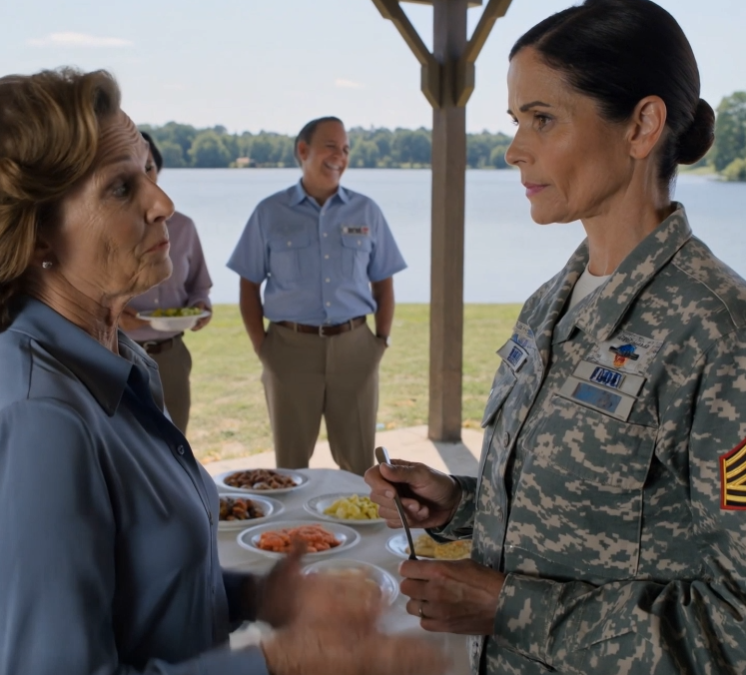
The lake sits in a bowl of hills. Pretty country, dead air. I remember thinking it was almost funny—a logistics officer standing in the one place in the county where nothing could reach her.
I want to be honest about the uniform because the uniform matters to the story. I had come straight from the airfield: five days of hurricane preparation exercises, a redeye military flight home, and a choice. Stop at my quarters to change and arrive at noon, or drive straight to the lake and keep a promise.
I had promised my cousin Tess I would be there for setup. So I set out folding chairs in my service uniform, dress shoes sinking into the grass, and I did it the way I once set out table settings at my mother’s diner. Six chairs to a table, squared to the edge.
Some jobs your hands never forget.
The diner is where all of this starts, so let me take you there.
Roots at Lorna’s diner
Lorna’s Diner sits on the corner of Third and Main in the town where I grew up. And it has my mother’s name on it because my mother is the kind of woman who puts her name on things.
In 1996, I was 14. Saturday mornings, I tied on a green apron and worked the counter from six to two. My father, Amos Calhoun, ran the kitchen. Eggs, hash, biscuits with sausage gravy that people drove two towns for.
My mother ran the front, and the front was a stage, and she was very good on it. She knew every name, every order, every grudge in the county. People loved her. She made sure of it.
Here’s what I learned at that counter. I learned to carry six plates up one arm. I learned to count change in my head while listening to three conversations. I learned that when a rush hits, you do not feel your feet. You just move station to station in an order that wastes nothing.
Years later, a battalion sergeant major watched me walk a supply yard and asked where I trained. I told him a diner in a town he had never heard of. He did not laugh. Sergeants major know where competence comes from. It comes from repetitions.
And I learned my mother’s arithmetic.
Every tip I made went into the family jar by the register. That was the rule.
“We are a family business, Meredith. Family businesses do not pay family.”
My tips bought the new coffee machine in 1998. Nobody ever said so out loud. I kept the receipt anyway. I was that kind of kid—quiet and keeping the receipt.
My father saw me. I want that on the record because so much of this story is about not being seen.
Amos Calhoun was a big, slow-moving man who smelled like griddle smoke and spoke maybe 40 words a day, and he saw everything. When the dinner rush broke, he would put one hand on my shoulder just for a second on his way to the walk-in.
That was the whole speech. It was enough.
My mother performed love loudly for the whole room. My father paid it quietly to the person in front of him. I have spent my life trying to be his kind of loud.
In the spring of 2000, my senior year, a recruiter set up a table at the high school. I walked past it twice, and then I sat down. I did not sit down because of the posters. I sat down because he said the word “logistics,” and I asked what it meant.
He said it means the people who make sure everybody else can do their job.
Something in my chest went quiet and certain, like a scale finally balancing. I had been doing logistics since I was 14. I just had not known the Army had a name for it, and ranks, and a future.
I signed the papers in May.
I told my parents at the counter after close. The three of us with coffee, chairs still up on the tables. My father looked at me for a long moment and then nodded once, the way he nodded at a repaired fryer.
Good. Fixed. Right.
My mother wiped her hands on her apron, and she said the sentence that would run my family for the next 26 years.
“You’re leaving a family business to go serve trays in a tent.”
I was 18. I did not have the words yet to explain the difference between serving and service. I’m not sure she would have heard them anyway.
My enlistment paperwork said food service specialist. And to my mother, that meant the Army had looked at her daughter and agreed with her assessment: a waitress, government issue.
She told the regulars that Meredith was going off to cook for soldiers. She said it lightly, the way you report a child’s phase. She never once said the word “soldier” about me. That word was reserved, apparently, for other people’s children.
Now come back to the lake with me.
June 13, 2026. Nine in the morning.
Reunion tensions arise
The chairs were out, the coolers iced, the pavilion swept, and my family arrived in waves the way they always do.
Tess came first because Tess is the other one who works. Thirty-eight years old, my cousin, a school nurse with a minivan full of paper goods and the only person in the family who ever asked me a follow-up question.
She hugged me hard, held me at arm’s length, and looked at the uniform.
“Straight from the airfield?”
“Straight from the airfield.”
“You look like a recruiting poster that needs a nap,” she said, and handed me a coffee from a gas station.
And I loved her for both halves of that sentence.
My uncle Walt came next. Seventy-two, my father’s older brother, retired first sergeant, 24 years in the Army, a man who irons his jeans.
He got out of his truck, saw me, and something crossed his face that I want you to remember for later. He read the uniform left to right, the way you read a sentence—the eagles on the shoulders, the rack of ribbons, the unit patch.
His jaw set just slightly, like a man doing math he already knew the answer to.
Walt knew exactly what I was. Walt had known for years and had been told by me, in a parking lot after my father’s funeral, to let it lie. He squeezed my shoulder the way my father used to.
He said nothing.
First sergeants can hold a secret at parade rest for decades.
Then came my brother.
Grady Calhoun, 41, arrived the way weather arrives—loudly and all at once. Two kids in swimsuits, a new truck, a laugh you could hear across the lake.
And behind him, my mother, 69 years old, in her good blue blouse, carrying a sheet cake like a crown on a pillow, already narrating.
Within 90 seconds, she had rearranged the buffet tables I had set, redirected the chairs I had placed, and introduced Grady twice to people who already knew him.
Grady sells houses. That summer, his face was on four billboards along the state route, and my mother mentioned all four of them before 10:00, individually, with map references.
Then she found me at the drink table, looked at the uniform, and her mouth did the small, tight thing it does.
She did not ask about the flight. She did not ask about the exercises because she did not know about the exercises.
She picked up the long serving spoon and held it out to me, handle first, without a word.
A tool passed to the help.
Old habit is a powerful thing. I took the spoon.
My mother had run every room she had ever stood in, and I had learned early which rooms were worth the fight. A lake pavilion full of potato salad had never made the list.
That was the arithmetic I had done for 26 years.
Keep the peace. Pour the coffee. Let her have the story.
I stood there with the spoon in my hand and watched her work the tables.
And somewhere behind the hills to the south, though I would not know it for three more hours, a storm was turning early off the coast. A duty officer at a joint operations center was dialing a phone that sat in a locker, ringing into steel and foam over and over, asking for me.
Military service and medals
The Army I joined in June of 2000 did not care whose daughter I was.
That is the kindest thing I can say about it, and I mean it as a great kindness.
Basic training first, then advanced individual training as a food service specialist. Ninety-two Golf in Army shorthand.
My mother was right about one thing. They handed me trays.
What she never understood is what a tray is.
A tray is a promise. It says somebody thought about you before you got here, and somebody will think about you after you leave.
An Army eats before it fights, and someone has to make that arithmetic work. And the ones who do are not waitresses. They are the reason the rifle company gets to pretend food appears by magic.
I took to it the way water takes to downhill.
Within a year, I was the soldier the mess sergeant sent to fix other sections’ problems. Within three, I was a specialist with a reputation—the kid from the diner who could feed 400 out of a kitchen built for 200 and make the line move faster, not slower.
Then, 2004. Iraq.
They put me at a forward operating base north of the capital, in a dining facility that was half tent, half plywood, all heat.
One hundred twenty degrees in the kitchen by ten in the morning. We fed 600 soldiers a meal, four meals a day, counting the midnight line for the tower shifts.
And then the mortars started.
Indirect fire is a coward’s weapon and an accountant’s problem. You cannot fight it. You can only plan around it.
The siren goes. Everybody drops. You count the impacts. You get up, and the bread is still proofing, and 600 people are still hungry.
The first week of it, we lost our headcount discipline, our cold chain, and very nearly our nerve.
So I did what my father would have done.
I rebuilt the kitchen around the siren.
Prep moved to the bunkered side. Kettles got staged so nothing fatal was ever midair at the same time. I drew a map of the facility with timings on it—how many seconds from every station to the shelters?
And we drilled it like a battle drill because it was one.
We went weeks under fire without missing a single meal service. Not one.
There was a night a round hit close enough to blow the screen door off its hinges and drop a shelf of trays like a cymbal crash. When we came up off the floor, flour in our hair, somebody’s radio still playing country music, I heard myself say, “Line opens in 20 minutes.”
And it did.
The battalion sergeant major, a man made entirely of gravel, stood in that line that night and looked at me.
“Ovens don’t stop for sirens, and neither does she.”
He said it loud enough for the room.
I have been given some compliments since. None of them ever landed harder.
They pinned a Bronze Star on me for that deployment. Merritorious service under fire.
I made sergeant the next year.
I called home from a morale tent, 11 hours ahead, and told my parents about the medal, holding the citation in my hand like a kid with a report card.
My father said, “Read it to me.”
So I read it. All of it. The stiff language. Sustained operations under repeated indirect fire attacks.
He was quiet.
And then he said, “That’s you, Mary.”
Two words for the medal and my name from Amos Calhoun.
That was a parade.
My mother took the phone and asked if I had heard that the Hendersons’ boy, the one who went to State, had made assistant manager at the bank.
Then she said, “Mind the burns, sweetheart. Kitchen scars show at weddings.”
That was the whole conversation.
I stood in the tent afterward and understood something clean and cold.
The story of me had already been written back home, and no fact was ever going to be allowed to edit it.
The Army, meanwhile, kept editing.
In 2006, my battalion commander called me into her office, closed the door, and said the words “Officer Candidate School” out loud, on purpose, about me.
She said the Army had enough people who could follow a recipe. It needed people who could feed a division that had not decided where it was going yet.
She said, “That is an officer’s problem, and you already think like one.”
I commissioned in the fall of 2006.
The secret financial support
Second Lieutenant, Quartermaster Corps. Twenty-four years old.
Commissioning comes with a small ceremony. Family pins the rank on you.
I reserved two seats and mailed the invitation in a card. And I called, and my mother said, “Of course, of course, June. We will see.”
One seat filled.
My father drove 400 miles alone with his one good suit hanging in the truck window. He pinned my gold bar on with hands that shook. Kitchen hands. Careful hands.
Then he stood back and looked at me the way he looked at a full dining room on a Saturday.
The other seat stayed folded.
She called that evening. The diner had been busy.
“Somebody had to run the register, Meredith.”
And then, with a little laugh she had rehearsed—I could hear it—she said, “So now they make you an officer for cooking.”
I want to be fair to my mother, so I will tell you what I believe with my whole chest.
She was not lying when she said the diner was busy.
The diner was always busy.
The diner was the country she was sovereign of, and leaving it, even for a weekend, meant becoming a guest in someone else’s. In mine. In a world with its own uniforms and its own language and a stage she could not run.
My mother has never once in her life volunteered to be an audience.
So she stayed sovereign.
And I stopped mailing invitations and started mailing after the fact, which she put in a drawer.
The promotions came the way they come to people who work.
First lieutenant in 2008. Captain in 2010 at 28. Company command a year later.
One hundred seventy soldiers, and I knew every name and every kid’s name because my mother taught me that. And I will give her that credit in the same breath as everything else.
The skills are hers. The arithmetic of attention is hers.
She just never spent any of it on me.
Then, 2012.
My father died on a Tuesday morning between the breakfast rush and lunch prep, wiping down the flattop.
Sixty-three years old. His heart just quitting the shift early.
I was a captain with a company, 30 years old, and I flew home to bury the only person in my family who had ever read my citation.
At the reception after the funeral, in the church basement with the casseroles, my mother held court in black and told diner stories.
And she was magnificent. I mean that.
She kept 200 grieving people fed and laughing for three hours. It is the family gift.
I stood at the coffee urn refilling cups because, at Calhoun gatherings, that is my station.
Uncle Walt found me there.
Walt had read about the Bronze Star in the veterans’ newsletter years before. He had never said a word at a family table because he had watched me not say one and followed my lead the way you follow the ranking soldier’s lead in someone else’s area of operations.
In the church parking lot afterward, he said, “Your mother tells people you cater for the government.”
A question with no question mark.
I said, “Let it lie, Top. It costs me nothing.”
He looked at me for a long time.
Then he said, “Wrong, kid. It costs you retail. You just pay it in installments.”
First sergeants.
Here is where I have to tell you about the money because the money is a load-bearing wall in the story.
My father, it turned out, had been quietly losing the fight with the diner’s books for years. New highway bypass. New chain restaurants by the exit.
When he died, the debt surfaced like things float up after a flood.
The diner had maybe six months.
My mother did not know. She did the front of house. The books were the kitchen’s job, and the kitchen was gone.
I was a captain with deployment savings and no mortgage.
I called the family lawyer, a tired, decent man, and set up transfers through an account with a boring name.
The instructions were simple.
The diner shortfalls get covered, and the paperwork says the business refinanced.
If my mother ever asks a direct question, tell her the truth.
She never asked a direct question.
Sovereigns do not audit good news.
But my brother knew.
Grady was in the lawyer’s office signing something else the week it was set up. The lawyer, assuming family meant family, mentioned the arrangement.
My brother looked at the papers and understood them and said nothing.
Not that year.
Not for 14 years.
And when my mother stood in her rescued diner telling the regulars, “Thank goodness Grady has a head for business. That boy saved this place,” my brother let the sentence stand.
He did not build the lie. He just moved into it the way you move into a house someone else paid for.
I told myself it did not matter whose name was on the rescue.
The diner stayed open. Mom stayed proud. I stayed a waitress. Everyone got to keep their story.
And I got to keep writing checks.
That is what I told myself quarterly for 14 years.
And I am telling you now because you deserve to know exactly what kind of fool I was.
The competent kind.
The kind who can supply an entire Army and cannot invoice her own family for the truth.
Afghanistan in 2013.
Advancement and isolation
A distribution hub this time.
Thirty-one years old, watching pallets that fed three provinces swing off the back ramps of aircraft into thin mountain air.
Major in 2016. Staff years. Planning years.
Lieutenant colonel in 2021, at 39.
Battalion command. Two years of it. Eight hundred soldiers.
My command photo went home in a card drawer.
The ceremonies kept happening, and her reasons kept shrinking.
She missed my majority for a diner anniversary. Missed my battalion change of command for a cruise with the church group.
By then, the reasons had stopped being reasons and become policy, and I had stopped reading them as anything but weather.
Meanwhile, the family gatherings had acquired an audience worth performing for.
Grady married Kendra, who is kind and busy and comes with a country club circle. New in-laws, new neighbors, people who had never heard the cannon.
My mother is at her very best in front of a fresh crowd.
Old material lands like new.
You should understand what Grady was in all this because it took me until this year to understand it.
He was not cruel. Not once, not ever.
He was a man handed a comfortable seat in a theater and no reason to stand up.
The billboards were real. The success was real, mostly.
He hugged me at gatherings and called me “Sarge.” Wrong in every particular.
And he told his kids, “Aunt Mary works for the Army,” the way you would say someone works for the water company.
It was not a knife. It was a shrug, lifelong.
And some days the shrug cuts deeper because you cannot even get angry at it properly.
I should slow down on battalion command because those two years explain everything I did afterward, including the thing I did at a picnic.
A battalion is 800 soldiers, and a sustainment battalion is 800 soldiers whose job is everyone else’s worst day.
From 2022 to 2024, I commanded one, and I ran it the way my father ran a kitchen.
Feed people first. Fix the fryer before the sign. Walk the line every day and learn the names, and learn the kids’ names.
There was a young specialist in my fuel platoon, 19 years old, whose mother called the staff duty desk one night in a panic over a family emergency back home.
No plan. No money for a flight.
My headquarters had her son on emergency leave with a funded ticket in 11 hours.
I know it was 11 hours because I watched the clock the whole way.
And when it was done, my command sergeant major looked at me across the desk and said, “You would think we had rehearsed that.”
We had.
Every day, on smaller things.
That is what a rehearsal is.
Two weeks later, a card arrived at the battalion, addressed in a grandmother’s handwriting, thanking “the colonel who got her grandson home.”
I was a lieutenant colonel, but grandmothers round up, and I did not correct her either.
I pinned the card to the wall of my office.
And I am going to tell you the truth about why.
Somebody’s mother had watched what I do for a living from four states away, for 11 hours, and had seen it more clearly than my own mother had seen it in 22 years of trying not to look.
My change of command, when I gave the battalion up in 2024, had a reviewing stand, a band, a chaplain, and two reserved seats in the front row.
Tess drove six hours and filled one.
The other one had a printed card on it that said FAMILY, and the wind kept trying to take the card, and a private first class kept straightening it.
I have never told anyone how closely I watched that little war.
My mother had a reason by then. I no longer listened to the reasons, only to the pattern.
And the pattern held like good weather.
Walt called that night.
He had wanted to come. His hip had him in a chair that month. Doctor’s orders.
And he had obeyed the doctor with the same grace he obeyed every order he ever hated.
He asked me to describe the whole ceremony. The pass in review. The colors. The old song.
And I did, sitting in an empty set of quarters with my jacket still on.
When I finished, he was quiet a moment.
Then he said, “Your dad would have stood the whole time, bad knees and all.”
That is the only time in this story I cried.
I want that on the record too.
And then we will move on.
The binder came next because the Army looks at a soldier who has just finished pouring herself out and says, “Good. Now think.”
They moved me to headquarters as a colonel select and handed me the regional hurricane response sustainment plan, which at the time was 200 pages of good intentions and expired phone numbers.
Fourteen months, I rebuilt it.
I walked the ports myself. I stood on a pier at a fuel terminal in a hard hat, timing the unload of a tanker with a stopwatch, doing diner math at industrial scale.
How many trucks through that gate in an hour? How many gallons before the generators at the hospitals go quiet? How many pallets of water before a shelter with 2,000 people in it starts to fray at the edges?
If the numbers are wrong, the plan is a lie with a cover page.
And lies with cover pages are how strangers die in parking lots waiting for a truck that was never really coming.
Page one of my rewrite had one sentence on it, alone before the maps and the matrices:
People are fed and watered first, and the paperwork apologizes later.
A two-star review board tried to strike it as unprofessional tone.
The old general running the board read it twice and said, “Leave it. Somebody in this building had a father.”
I did not tell my family any of this.
And here is the part I have to own with both hands.
It stopped being silence somewhere along the way and became a kind of vault.
At Christmas in 2025, at Grady and Kendra’s big house with Kendra’s parents there, my mother told the table that Meredith “does catering for the government.”
The table laughed politely the way tables do near my mother.
And I looked at her over a casserole dish and felt nothing move in my chest at all.
Not anger.
Just inventory.
I had a folder of photographs in a drawer at her house, two decades of them mailed one at a time, and I knew the drawer had never once been opened for company.
And I passed the green beans anyway.
Tess cornered me in the kitchen that night with a dish towel over her shoulder.
She is the only one who ever tried, and she tried the way nurses try—without anesthesia.
“You know, this is not humility anymore,” she said. “It was humility maybe 10 years ago. Now it’s a wall you keep paying to maintain, and I can’t tell anymore which side of it you built it for.”
“It keeps the peace,” I said.
“It keeps the myth,” said Tess. “Peace is different. You’d know that if you’d ever had any.”
I dried the same glass twice and told her what I had told Walt in a funeral parking lot 13 years before.
“Let it lie. It costs me nothing.”
Tess looked at me the way she looks at a patient who has just described their chest pain as “probably nothing.”
And she let it go because family triage is knowing which arguments the patient can survive tonight.
But she was right.
And the glass in my hand knew she was right.
I stood in my brother’s bright kitchen, a colonel select with a binder that could keep a coastline alive, unable to requisition one true sentence for my own mother.
Colonel came in 2025.
Forty-three years old. Twenty-five years in uniform.
They sat me down as the senior sustainment planner at a headquarters whose job is to be ready when the coast has a very bad week.
I wrote the plan.
The hurricane response sustainment plan for the region. The whole logistics architecture—fuel, water, generators, food, the ports, the routes.
Fourteen months of my life.
My name on the front page of a binder that exists so strangers do not die in a parking lot waiting for a truck.
My mother knew none of this.
Not the eagle. Not the binder.
And I want to be precise about the burying because this channel is called what it is.
She buried my rank.
Yes.
Every year. Every table. One joke at a time.
But I handed her the shovel again and again because silence was cheaper by the visit.
That is the part I own.
The rank was buried by two people.
Only one of us ever planned to dig.
The staff car intervention
The first week of June 2026, a storm system organized off the islands early season, moving wrong.
My headquarters ran a five-day exercise against my plan.
Long days. The whole architecture walked end to end.
I came off the last day with two hours of sleep, boarded the redeye home, and drove to a lake to keep a promise to Tess, with my dress shoes in the grass and my phone in a dead zone, and my mother arranging a stage I did not yet know I was standing on.
By June, the storm had a name.
My family still did not know mine had an eagle in front of it.
Noon at the pavilion.
Sixty-some people. Three generations. Two folding tables of food.
And my mother in the exact center of all of it, wearing the good blue blouse and a hostess smile you could read from the boat ramp.
Kendra’s people had come.
That is the detail that set the stage.
Her parents, her sister, a cluster of country club neighbors who had never met the extended Calhouns.
Fresh audience.
My mother moved through them like a candidate. A hand on every forearm. A story for every stop.
I kept my station at the buffet line, spoon in hand, keeping the potato salad iced and the line moving because it is genuinely easier to serve than to mingle.
And old aprons fit no matter what you wear over them.
I heard her voice come down the line before I saw her.
She was steering Kendra’s parents, a nice couple in golf clothes, straight toward me.
I knew the tone.
Stage tone.
And I knew, the way you know a mortar by its whistle, roughly where this was going to land.
“And this is our little waitress,” my mother announced to the whole pavilion, loud enough for the parking lot.
She said it with her hand out toward me, presenting, warm as pie.
That is what people miss about a line like that.
It arrives wrapped in affection.
The room hears teasing.
Only the target hears inventory.
Kendra’s mother looked politely confused, eyes going from my shoulders to my chest.
Ribbons asked questions.
My mother answered them.
“Don’t mind the uniform. It’s from a costume shop.”
A ripple of laughter down the buffet line.
Not cruel laughter.
Permission laughter.
The kind a room gives when the hostess signals a joke is safe.
Somebody’s teenager actually looked up from his phone to see.
Twenty-six years.
I had taken this ride quietly.
Weddings. Funerals. Graduations.
I felt the old arithmetic run.
Keep the peace.
Pour the coffee.
And then, I think because I was so tired, one honest sentence got out of the yard.
“Mom, don’t do this today.”
Quiet. Level. Five words.
She rolled her eyes for the crowd the way you would at a sensitive child, patted my arm, and said to Kendra’s mother in a stage whisper built to carry, “So serious. She gets that from her father.”
And that, of all of it, is the sentence that made my ears ring.
She was right.
I do.
I took the tray anyway.
I poured coffee for a man in a golf shirt whose name I never learned.
My hands did the work while the rest of me stood very still somewhere behind my own eyes.
And I remember thinking, with no heat at all:
This is the last one.
I did not yet know what I meant.
The day was about to explain it to me.
I want to hold this next stretch of minutes for you honestly because everyone at that reunion remembers them differently now, and I am the only one who was standing where I was standing.
My mother resumed the tour.
That is the detail people forget.
The line landed. The laugh rippled. And she moved on down the buffet with Kendra’s parents in tow, pointing out Aunt Charmaine’s potato salad and the framed photo of the diner someone had propped by the desserts.
Resuming the show because, to her, nothing had happened.
That is the part that took me years to understand and one afternoon to finally see.
It was never a campaign.
There was no war room where my mother planned my smallness.
There was only a story she had written a long time ago, back when the ink was cheap, and a woman who had never once gone back to check a fact in her life.
Tess appeared at my elbow with a stack of napkins she did not need and said under the crowd, “Say the word, and I will spill iced tea on that blouse with full nurse precision.”
“Stand down,” I said.
And she almost smiled because she had heard me on the phone with soldiers once or twice and knew a command voice hiding in a picnic sentence.
I checked my phone out of habit, standing there with the tray.
No bars.
12:40 in the afternoon. June 13.
I remember deciding two things in that exact minute.
Both of them quietly.
Both of them final in the way tired decisions are.
One: I would leave at four, before the horseshoe tournament, and drive back into coverage because five days of exercises leaves an itch you cannot scratch at a lake.
Two: this was the last reunion I would attend as the waitress.
I had no plan attached to the second decision.
No speech drafted.
Just a page turning somewhere in the back of a binder I had been keeping on myself for 26 years.
Walt was watching me from the horseshoe pits.
Seventy-two years old, paper plate in one hand, and he had not taken his eyes off me since the costume-shop line.
Later, he told me why.
It was not the insult. He had heard the insults for years.
It was my face.
“You had your convoy face on, kid. The one that means the route is about to change and nobody in the trucks knows it yet.”
Gravel.
That is the first thing everyone heard.
A car coming up the park road faster than park roads expect, then braking to a courteous crawl for the picnic area because the driver had been trained to arrive hard and stop soft.
A black government sedan rolled past the minivans and the new trucks and stopped at the curb nearest the pavilion.
Clean as a blade.
Small flag stanchions on the front bumper, covered.
And on the bumper plate, two silver stars on a red field.
Uncle Walt saw the plate first.
Seventy-two years old, and he came up off his folding chair on old reflexes, halfway to attention with a paper plate still in his left hand.
When a retired first sergeant stands up like that in a public park, everyone near him goes quiet without knowing why, the way birds go quiet.
The rear door opened before the driver could get around.
A woman stepped out.
Late 20s. Army service uniform. Captain’s bars. Aiguillette. Aide-de-camp.
She had a phone in one hand and a folder in the other, and she scanned that crowd with a triage face, sorting 60 civilians in golf clothes and swimsuits, looking for one silhouette.
My mother, who has never in her life let an arriving stranger go ungreeted on her stage, was already moving toward her.
Hostess hand rising.
Half a welcome sentence launched.
The captain walked straight past her.
I have replayed that 90 seconds more times than I will admit.
My mother’s hand hanging in the air over her own untouched welcome.
The captain’s dress shoes coming across the grass, sinking exactly the way mine had at seven that morning.
Sixty heads turning together.
Buffet line frozen.
A serving spoon in my hand.
She stopped in front of me at a respectful distance and said it clearly because aides are chosen for clarity.
“Colonel Calhoun, we’ve been calling for six hours.”
There is a sound a crowd makes when it is not making any sound.
Sixty people not chewing.
The lake slapping the dock.
Somewhere behind me, a cooler lid closed very carefully.
The way you close a door in a house where something enormous has just been said.
“My apologies, Captain,” I said. “Dead zone.”
Executing the logistics plan
“What’s moved?”
“Everything, ma’am.”
She handed me the folder and lowered her voice into brief mode, fast and flat.
The storm had jumped its forecast track overnight and put on strength. Landfall projections had moved up. The mobilization brief had been pulled to the left—tonight instead of Wednesday.
The plan on the table was mine, and General Voss had a seat on a plane in three hours.
When my phone went unanswered, the operations center had tried the emergency contact card, gotten as far as the county, and the general had done the arithmetic and simply diverted his own car and his own aide on his way to the airfield.
“He said…” And here the captain permitted herself one degree of humanity. “‘If the author is at a picnic, go stand in the buffet line.’”
I read the top page of the folder.
The pavilion stayed silent.
Sixty people watching a woman in uniform read.
And I will tell you the truth.
Whatever else was cracking open inside that silence, the page came first.
The page said the coast had two fewer days than anyone had planned for.
My plan.
My binder.
Mine to walk into a room and make true.
“Trunk’s open on the sedan under the oak,” I told her. “There’s a go bag behind the driver’s seat. Two minutes.”
She moved.
Aides are chosen for moving too.
I turned around.
Sixty faces.
My nephew with his mouth actually open.
Kendra’s mother with her hand flat on her chest.
Tess grinning like a woman watching a lottery ticket come in, both fists at her collarbone.
Walt at parade rest. He probably could not feel himself holding it. Eyes bright. Jaw tight.
I handed my brother the coffee pot.
He took it the way you take something you have not been trained on.
“Grady, the ice run at two. Tess has the list.”
“Mary,” he said. “What…?”
And the sentence just ended there.
The whole question of my adult life stuck in his throat at a picnic.
“Aunt Charmaine’s potato salad goes back on ice by one or it turns,” I said, because logistics is love and somebody had to say something human into all that quiet.
Then I looked for my mother.
She was standing exactly where the captain had passed her, on the grass between the buffet and the curb, holding the long serving spoon in both hands in front of her blue blouse.
And for the first time in my whole life, I watched my mother stand on a stage with no line ready.
She looked small.
I had waited 26 years for the record to correct itself.
And I want to be honest with you about what it felt like when it finally did.
It did not feel like a trumpet.
It felt like watching a wall I had built myself finally fall on someone I loved.
“Meredith,” she said.
Small voice.
Real one, I think.
The first real one in years.
“Duty calls, Mom,” I said.
Level. No blade in it.
I was raised better than the moment deserved.
“Enjoy the reunion. The brisket’s ready at three. Walt knows.”
The captain held the rear door of the staff car.
I got in the way you get into cars like that—which is to say, the way you get into every car, except 60 people are watching you do it and recalculating your entire biography by the way the aide squares the door.
Gravel again.
Soft this time.
The driver walked the sedan out past the minivans.
I looked in the side mirror once.
I should not have.
The whole pavilion stood motionless around the buffet like a photograph of itself.
And in the middle of it stood my mother, still holding the serving spoon.
The last thing I saw before the trees took the mirror was Walt’s hand coming up.
Not a wave.
The operations center smelled like burnt coffee and cold air, which is the smell of the country taking something seriously.
Setting clear boundaries
By 1900 that evening, I was standing at the map boards, walking two generals and 40 staff officers through my own binder, page by page, while the storm turned its slow saw blade toward the coast.
General Voss found me at the coffee urn during a break, which I appreciated as a piece of theater I never got to explain to anyone.
Fifty-seven years old, reading glasses pushed up on his head, the kind of man who speaks quietly because he has never needed volume.
“Sorry about your reunion, Colonel,” he said. “How’d my captain do?”
“Walked past the hostess, sir. Straight to the target. I’d keep her.”
Something happened around his eyes.
“The hostess?”
“My mother, sir.”
“Hm,” he said into his coffee.
And that was all.
It was somehow the most tactful sentence anyone had aimed at my family in years.
The task force stood up at midnight.
I will keep the storm short because this is not a story about a storm.
Landfall came in four days.
The plan bent and did not break.
Fuel moved. Water moved. Generators moved.
There is a version of the after-action review where I tell you about the port that flooded and the route we rebuilt around it in 19 hours.
But the summary is the one that matters.
The trucks were where the people were.
I did not sleep much.
And it was the best work of my life.
And my family watched me do it on the local news because that is the thing about a staff car at a picnic.
Sixty people go home and make phone calls.
My personal phone came back to life the first night and did not stop.
The family group chat, which I mostly haunt in silence, ran to 400 messages.
Tess forwarded me the highlights at midnight like a wire service.
Forty relatives replaying one sentence.
“Colonel?”
“Did you know?”
“Did you know?”
Somebody found my official photo on a public affairs page.
Somebody’s teenager found the Bronze Star citation in a database and read it out loud at a kitchen table two towns from the diner.
And I know that because his mother texted me an apology for every Thanksgiving since 2009, which I had not asked for and did not know what to do with.
Walt left one voicemail.
Eleven seconds.
“Your dad knew, kid. Sergeants always know. Call when the wind stops.”
From my mother?
Nothing.
Four days of storm. Three weeks of recovery operations.
The silence from her house held through all of it.
I checked it the way you check a gauge.
Every other line in the family was lit and humming.
Hers sat dark.
And I understood the darkness.
The whole county was asking my mother the same question at once.
The regulars. The church group. The neighbors.
All with the same delighted horror.
“You never said your daughter was a colonel.”
There was no answer she could give that did not cost her the story she had run for 26 years.
My mother does not do corrections.
She does silence and waits for the room to change the subject.
I sat in a headquarters at two in the morning coordinating water trucks for strangers, reflecting on the fact that I could resupply a flooded county faster than my own mother could dial 10 digits.
The storm passed in four days.
The silence from her house did not.
Grady and Kendra’s anniversary party came in early July, three weeks after landfall, in their backyard with the string lights and the good grill.
Recovery operations had wound down to the point where colonels are allowed to attend backyards again.
I went because Tess asked and because I had made a decision at a buffet line in June, and a decision you have not said out loud yet is just a mood.
I came in civilian clothes.
A sundress, for the record, because I want you to have the full picture of what happened next.
There was no uniform in that backyard for anyone to explain away.
For the first hour, nothing.
The family had spent three weeks metabolizing me.
There were new questions, awkward and warm.
My nephew asked if I had ever driven a tank.
I told him no, but I had once signed for 400 of them on paper, which impressed him more because he is a child of spreadsheets like his aunt.
Then the cake came out.
The neighbors clustered.
My mother arrived at the center of the patio by the gravity that moves her.
And someone from Kendra’s circle, meaning no harm, said, “You must be so proud of your daughter, the colonel.”
I watched my mother’s face do its arithmetic in real time.
The room was fresh.
The old material was right there.
And she reached for it the way a falling person reaches for a rail.
“Oh,” she said with the little laugh. “Well, she’ll always be my waitress.”
The patio smiled politely and started to move on.
Twenty-six years of practice moved on with it.
And I stood up from the picnic bench.
Not fast.
The way you stand up to make a toast.
And I said it level, clear, no blade in it.
“No, Mom. I am your daughter, and I am a colonel in the United States Army. You can have both. You cannot have the waitress anymore.”
She retired in June.
Nobody laughed because it was not a joke.
Nobody gasped because it was not an attack.
It was a correction read into the record once.
The silence afterward was not the pavilion silence.
It was smaller.
More honest.
Kendra’s friend looked at her shoes.
Grady put his hand flat on the table like a man feeling a train coming.
My mother’s face went through outrage first because outrage is load-bearing for her.
“You embarrassed me,” she said, low and furious.
And there it was.
The whole cosmology in three words.
The staff car. The general. The six hours. The storm.
None of it had happened to me in her accounting.
It had all happened to her.
“You embarrassed me in front of everyone at that park,” she said louder, for the jury. “That circus. Those cars. You couldn’t just have a normal job like your brother?”
“The car embarrassed no one, Mom,” I said. “The introduction did.”
She tried the next weapon in the rack.
The oldest one.
“After everything I did for you? That diner fed you.”
“And I fed it back,” I said.
And stopped there.
One foot on a bridge I had promised myself I would not cross in anger.
She did not know yet what that sentence meant.
Grady did.
I watched my brother close his eyes.
I set the terms then, quietly, in front of the family, because boundaries whispered in kitchens do not survive contact with women like my mother.
“Here is how it works. From now on, I will come wherever I am introduced by my name. Meredith or Colonel Calhoun. Either one. I answer to both. I do not answer to ‘the waitress’ anymore. That is the whole rule. There is no fine print.”
And then, because dignity is not a scene, I sat back down.
I ate a slice of anniversary cake.
And I asked Kendra’s mother about her garden.
The party limped forward the way parties do.
My mother went home early with a headache that I believe was real.
Sentences you have dodged for 26 years hit like weather when they finally land.
It was the quietest sentence I ever said and the loudest thing my family ever heard.
The story cracked without me after that.
That is the strange mercy of small towns.
You do not have to prosecute the myth.
You just have to stop feeding it, and the town does the rest.
The county paper ran its storm feature in mid-July.
“Local woman at the heart of the response.”
There is a photograph of me on the operations floor, sleeves rolled, pointing at a map board, looking exactly as tired as I was.
The diner’s regulars, who have loved my mother loyally for 40 years and are not fools, cut it out and pinned it to the corkboard by the register while she was in the kitchen.
She left it up.
I have thought a long time about the fact that she left it up.
And I have decided it was the first sentence of an apology she did not know how to write any other way.
But the neighbors asked questions now.
“Why did you never say all those years, Lorna?”
And there was no answer that did not cost her the story.
So she paid in silence.
And the silence cost more.
The final ceremony
Then the money surfaced because money always does.
Grady came to see me on a Tuesday evening at my quarters.
Alone.
No Kendra. No kids.
Carrying a manila folder like it was heavier than paper.
He had been to the lawyer.
He had pulled 14 years of quarterly transfers.
Every one dated, totaled.
And he had done the thing I never asked anyone to do.
He had shown the folder to our mother.
“I told her it was you,” he said, standing in my doorway, not coming in until invited, which was new. “The refinancing. The roof in 2019. All of it. I told her I let her believe it was me, and that it was never me. Not one dollar. And that I have been living in a house you paid for since I was 27 years old.”
He looked at the floor.
“She hung up the phone when I finished. Then she called me back four minutes later and asked me to repeat the numbers.”
That is my mother.
Check the arithmetic twice.
The story once.
And then nothing.
“You know, Mom, the curtains are closed and the sign says OPEN.”
He put the folder on my table like a man laying down a rifle.
“I’m not asking you to forgive me tonight. I didn’t come for that. I came because Dad would’ve come, and it took me until this summer to figure out that somebody in this family had to be him now. And it was never going to be me while I was still renting my life from your money and her myth.”
My brother, ladies and gentlemen.
Forty-one years old.
And the storm got him too.
The good ones rebuild.
My mother called me once in late July.
I saw her name on the screen.
Three seconds.
And the call ended before I could answer.
Hung up before the second ring.
I did not call back.
Not out of spite.
Out of accuracy.
A hung-up phone is a sentence too.
And I had promised myself I would stop translating her sentences into kinder ones than she had actually said.
Meanwhile, the Army, which does not pause for family weather, cut my orders.
Brigade command.
The change of command was set for the 18th of July.
A parade field. A band. The colors passing to my hands in front of God and everybody.
My name went out in the official announcements, and Tess, who reads everything, organized the family like a motor pool.
Rides. Blocks of seats. Her minivan detailed for the occasion.
Some houses renovate.
My mother’s just closed the curtains.
And I stopped standing outside them.
I want to tell you that felt like victory.
It felt like folding a flag.
Necessary and careful and nothing at all like a parade.
Trust came back to my family the way supply comes back to a flooded county.
Not everywhere at once.
Route by route.
Grady did the work.
There’s no other way to say it.
He did not send one big apology and consider the account settled.
He showed up repeatedly, on schedule, like a man running a route.
He drove out with the kids and asked, in front of them, if I would tell them about the Bronze Star because, and I quote, “They should know what their aunt did before some idiot at a barbecue tells them wrong.”
He fixed the credit line at the diner so my transfers could finally stop.
And he did it with his own money this time.
He called the lawyer and had 14 years of records corrected so the paper trail, at least, would never lie to anyone again.
Kendra sent me a photograph of my old commissioning picture, the one from the drawer.
She had found it at my mother’s house, framed it, and hung it in their hallway.
“The drawer is over,” she wrote. “In this house, anyway.”
Walt appointed himself my protocol officer for the change of command.
He called me four times about the uniform, whether the old Army service uniform still buttoned across 72 years of shoulders.
It did.
And if you think a retired first sergeant does not keep his uniform serviceable, you have never met one.
“Front row is family,” he said on the last call. “I will be in it. Tess has the seating chart like it’s an OPORD. Your brother’s bringing the kids in collared shirts.”
A pause.
Radio-silence length.
Deliberate.
“One seat’s still in question. You want me to make the call?”
“No, Top,” I said. “She knows the date.”
And she did know the date because a card came in the mail that week.
My mother’s stationery.
The cream kind with her initials that she uses for thank-you notes to important customers.
No apology in it.
My mother has never in her life apologized on paper where it could be entered into evidence.
Just five words in her sharp diner-order handwriting:
“I never learned to say it.”
I stood at my kitchen counter and read it maybe 30 times.
Twenty-six years of introductions, and this was the closest pass.
And here is what I did.
Because I had learned something at a buffet line about the difference between a wall and a boundary.
I mailed her the ceremony program, the official one with my name on it, and the parking pass, and one line on a card of my own.
“Front row seat has your name on it. It says Lorna Calhoun because that is how we do introductions now.”
Trust is a convoy.
It moves at the speed of the slowest honest vehicle.
And you do not leave the route open for anyone who will not at least start their engine.
I had started mine.
Hers sat in the drive.
And the date came on anyway.
The 18th of July came in clear and already warm at 0530, and I was on the parade field before the sun cleared the tree line because commanders walk their ground and my father’s daughter checks the ovens.
The colors hung still.
The reviewing stand had its bunting on straight.
My father’s watch, the plain steel one that lived on his wrist through 40 years of breakfast rushes, sat on mine, one link removed.
I had worn it at every promotion since 2012.
It keeps terrible time.
It keeps everything else.
The family arrived at 0800 in convoy order, which is to say Tess first with the seating chart.
Walt stepped out of her minivan in his dress uniform, creases you could file paperwork with.
First sergeant chevrons riding where they had earned the right to ride.
And when he crossed onto the field, he came to a soft, unconscious attention, the way old soldiers do on parade grounds.
The body remembering the address of its own respect.
Grady in a collared shirt.
His kids also in collared shirts.
Kendra with a camera she had practiced with.
Front row.
Six seats.
Five filled early.
The sixth had a printed card on it.
Lorna Calhoun.
Tess had made it herself.
Laminated, on the theory—and I am quoting a school nurse now—that weatherproof invitations are harder to throw away.
I did not watch the parking lot.
I want that understood.
I was a brigade commander with a ceremony to execute, and I had made my peace at a kitchen counter with a cream-colored card.
Whatever seat stayed empty, the ones that were full had come a long way.
General Voss said nearly the same thing to me under the stand at 0840, reading glasses up in his hair, quiet as always.
“Whatever seat is empty, Colonel, count the full ones. Some officers never fill five.”
The band formed up.
The adjutant’s voice went out over the field, the old words unchanged since before any of us.
“Bring forth the colors.”
I took my post facing the flags.
Back straight.
Father’s watch ticking wrong on my wrist.
And I did not look at the front row again.
The question sat behind me in a folding chair, laminated.
And the ceremony began.
And I will tell you on the other side of it whether the seat was filled when I finally turned around.
The colors passed at 0900 sharp.
The outgoing commander let them go the way you let go of anything you have carried well—slowly.
And the colonel of the brigade that fed a coastline took them in both hands.
For one long breath, the only sound on that field was flag cloth in a small wind.
I have been handed many things in my life.
Trays.
Spoons.
Orders.
A folded flag once at my father’s funeral.
Nothing has ever weighed like those colors.
And nothing has ever weighed less.
My remarks ran 30 seconds because troops stand in formation in July and a commander who loves them is brief.
Half of those seconds belonged to my father.
I told the field what he taught me in a diner kitchen in a town none of them will ever visit.
“Feed people first. The paperwork apologizes later.”
Eight hundred soldiers laughed once.
Short and real.
And somewhere in that sound, I retired the last of my mother’s introductions for good.
Pass in review.
Boots in step.
Walt stood for the whole thing, hip be damned, with tears he did not wipe and would not discuss.
And he did not have to because every soldier on that field would have understood every one of them.
And the seat?
You have waited with me this whole story, so I will not make you wait through the reception too.
The seat stayed empty.
She did not come.
There was no crisis.
No flat tire.
No headache entered into evidence afterward.
My mother sat this one out the way she had sat out all of them, in her kingdom on the corner of Third and Main, with her curtains closed and her sign turned to OPEN.
And the honest accounting, the one I promised you at the start, is this:
It cost me.
Standing under new colors with five full chairs and one laminated name, I paid the last installment on 26 years of quiet.
And the win and the cost arrived in the same envelope, the way they usually do.
If someone tells you the truth is free, they have never built a family for it.
But here is what the cost bought, and why I would pay it again by return mail.
At the reception, my nephew wore my cover down over his ears and saluted everything that moved.
Kendra photographed the empty chair once, deliberately.
Then Tess unclipped the laminated card, folded it into my palm without one word, and squeezed my hand shut around it.
Family triage.
Some things you amputate.
Some things you just dress and keep walking.
That night at my quarters, with the colors cased and racked and my father’s watch losing its faithful four minutes, my phone lit once.
My mother.
A text.
“Saw the photo. Your father would have known what to say. I don’t yet.”
I looked at it a long while.
There was a version of me, younger, that would have translated it into the apology it was not, driven the six hours, and set the table for a reconciliation nobody had actually cooked.
That version poured her last coffee at a lake in June.
I put the phone face down.
And I slept like a colonel with fed troops.
In the morning, I answered with the only true thing I had left, which turned out to also be an open door.
“The diner opens at six. So do I.”
She has not walked through it yet.
She may never.
That is her route to run.
And I have finally learned the difference between keeping a seat open and holding a convoy for someone who will not start the engine.
The seat stays open.
The convoy rolls.
So let me leave you where I actually live now, which is at peace most days, with a laminated card in my desk drawer that I have never thrown away.
If someone in your life has renamed you smaller than you are, hear me on this.
You do not owe them the argument.
And you do not owe them the wall you built to survive them.
You owe yourself the truth, said once out loud in your own name.
The people who show up get to hear it first.
The people who love you will stand for the whole ceremony, bad knees and all.
And if anyone ever asks you what I do, tell them the truth.
I serve.
There was never a costume.
There was only a uniform.
And it was mine the whole time.
Thank you for staying with me through this one.
It took me 26 years to say one true sentence out loud, and I would love to know what yours would be.
If you had been standing at that buffet line when the staff car pulled up, would you have gotten in without explaining like I did, or would you have set the record straight right there in front of everyone?
And the empty front-row seat?
Would you have made the call Walt offered to make, or left it to her the way I did?
Do you think my mother will ever walk through that door at six?
Tell me in the comments. I read them all.
If this story meant something to you, hit that like button, subscribe, and share it with someone who has ever been introduced as less than they are.
You are not the costume people dress you in.
You are the name you answer to.