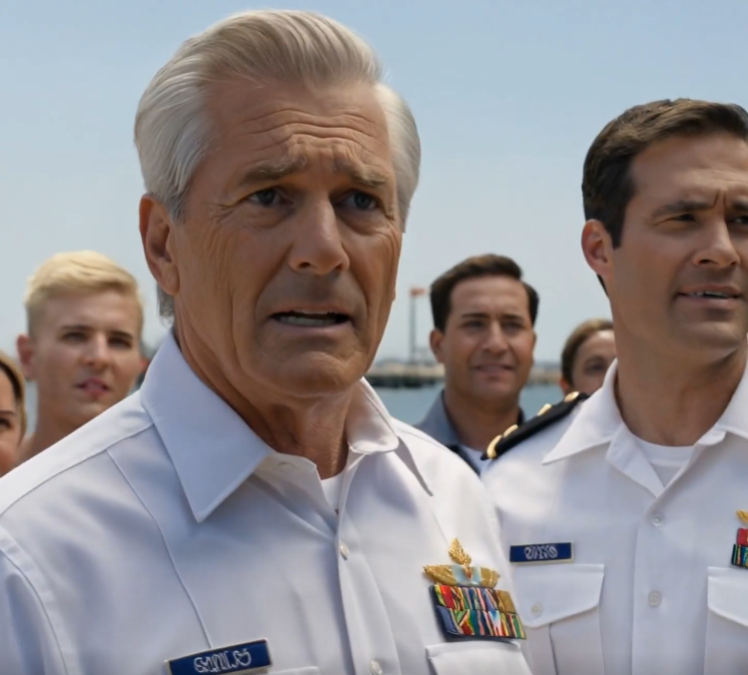
I grew up in Erie, Pennsylvania, in a house that sat downwind of my father’s machine shop, close enough that the smell of cutting oil came home on his clothes and stayed in the curtains.
My father did four years in the Navy before I was born. He spent them in the fire room of a destroyer tender, and he came out with a third-class crow, a coffee mug from Subic Bay, and a complete and permanent understanding of the entire naval service.
That was the family joke.
That was not a joke.
At our dinner table, the Navy was not a subject. It was his subject. He would hold up his fork and say it the way other men quote scripture.
“Four years in the fire room. That is what the Navy is. Everything else is paperwork.”
My mother, Jeanie, kept the peace the way some people keep bees—carefully, with a veil on. She loved him and she loved me. And when those two loves pulled in different directions, she went quiet and made another pot of coffee.
I do not say that with bitterness anymore. It took me until I was 43 to stop saying it with bitterness. And this story is about how.
What I remember about being a daughter in that house is the trying. When I was 11, I pulled the carburetor off the shop’s dying lawn mower, cleaned it, rebuilt it, and had it running by dinner because I had watched him do it once through the shop window.
He listened to it idle, tapped the housing with one knuckle, and said the float was probably still sticking. Then he went inside.
I stood in the yard next to a running engine I had fixed with my own hands and understood something I would spend 30 years trying to unlearn.
In my father’s shop, there was one mechanic, and the position was filled.
My brother Kyle came along when I was 15, a surprise baby with colic and a smile that arrived early and never really left. I did the 3:00 a.m. walks with him up and down the hallway so my mother could sleep, his hot little face against my collarbone. I taught him to ride a bike in the shop lot between the pallet stacks.
If you want to know why I never fought harder against the story my family told about me, that is part of the answer. Some of the people inside the story were people I had rocked to sleep.
The scholarship letter came in the spring of 2001. Navy ROTC. Penn State. Tuition paid. A commission at the end of it.
I put it on the kitchen table next to the salt shaker and watched my father read it twice. He set it down and looked at me the way he looked at a part that had come back from a supplier out of tolerance.
“Women on a warship,” he said. “That is a social experiment, not a career. You want to serve? Fine. They will have you typing somewhere. At least it is steady.”
My mother said, “Gordon.”
Just his name. The whole sentence.
He shrugged and went out to the shop, and the screen door made the sound screen doors make.
And that was the last real conversation my father and I had about the United States Navy for 20 years.
Here is the part I want to be honest about, because everything that follows leans on it.
Living a double life
He gave me the story, but I moved into it.
I furnished it.
When I was commissioned in May of 2005, 22 years old, standing in whites I could not fully believe I was wearing, my family was not there.
“It was a busy season at the shop,” my mother explained on the phone, apologizing in her soft way for a decision she had not made.
My father got on the line for 40 seconds. He asked what my job would be.
I stood in a hallway at Penn State with my brand-new ensign shoulder boards and a paper bag under my arm, and I looked down that hallway at the years of arguments waiting for me. Every holiday. Every phone call. Every explanation of what a division officer was to a man who would wave it off as paperwork with a salute in it.
And I said, “I will be doing admin on a ship. Office stuff, mostly.”
It was not entirely a lie. Every officer alive does paperwork.
It was worse than a lie.
It was a door.
I closed it because the room on the other side was cold. And once a door like that has been closed for a while, it grows into the wall. You stop seeing it.
The family stopped seeing it.
“Elise does admin for the Navy in Norfolk” became one of those facts a family keeps in the junk drawer next to the spare fuses. Nobody ever took it out and tested it.
“I did not lie to my father” is what I told myself for years.
I just stopped correcting him, which is a slower way of doing the same thing.
So the two truths of my life pulled apart calmly, like continents.
In one truth, I stood midnight bridge watches in the Strait of Hormuz, as a lieutenant junior grade, learned the exact sound a five-inch gun makes through a steel deck, qualified as a surface warfare officer, and found out I was good—not lucky, good—at the particular art of keeping 300 people and 9,000 tons of warship pointed at the right piece of ocean.
In the other truth, the Erie truth, I filed things.
In the first truth, my wardroom called me unshakable.
In the second, my father carved the turkey every Thanksgiving I missed and told whoever was at the table that his daughter was sorting mail in Norfolk, and everybody passed the stuffing.
The cover story fit so well it grew into the furniture, and for a long time I told myself it cost nothing.
The years did what years do at sea. They went by in watches.
Lieutenant Junior Grade in 2007.
Lieutenant in June of 2009, 26 years old, standing my own bridge watches by then, writing my own evaluations of sailors older than my father had been when he got out.
Shore duty.
Then back to sea in 2013 as a department head on a Norfolk destroyer. First weapons, then combat systems. Three years of four hours of sleep and the flat gray love of the job that either eats you or becomes you.
It became me.
In September of 2015, I pinned on Lieutenant Commander, 32 years old, and called home from the pier afterward.
My mother said, “That is wonderful, honey,” and asked if a lieutenant commander was like a manager.
I said, “Close enough.”
My father was in the shop.
My grandmother died in 2014. My mother’s mother, the one who kept peppermints in her purse for Kyle and told me once, privately, that she had wanted to be a telephone operator in Buffalo and her father had said no—and that I should notice she still remembered it at 80.
I was in the Western Pacific when she went.
The message reached me four days out from a port call, and the math did not work. I stood on the bridge wing that night doing the one thing sailors are allowed to do with grief, which is give it a heading and let it stream.
At the funeral, which I did not attend, my father told the receiving line that Elise could not get away from her filing.
My aunt repeated it to me years later, still puzzled by it, because even she had noticed that you do not say it that way unless the sentence tastes good in your mouth.
That was the year I understood the story had stopped being a misunderstanding and become a possession.
He was not wrong about me by accident anymore.
He was wrong about me the way a man keeps a favorite chair.
I flew home every year or two. The visits had a shape. My father would ask within the first hour whether the Navy had figured out yet what to do with me. I would say something soft and deflecting.
Kyle, growing up in the gap between us, watched it all the way kids watch weather.
Then came 2016, and everything that was quietly wrong got loud.
Tension and mounting debts
They found the lump in my mother’s breast in February of that year while I was in the Arabian Gulf running a combat systems department through a deployment that had zero slack in it.
The shop was already failing by then, though my father had told no one. Machine work had been leaking overseas for a decade. He had been financing payroll on credit cards with the stubbornness of a man bailing a boat with a coffee mug and calling it seamanship.
I found out about the diagnosis 11 days after they got it, in a two-line email from my mother that ended with, “Do not worry about us. You have your work.”
I took emergency leave.
It took four days of flights and gray airports to get home, and I had four days on the ground before the ship’s schedule pulled me back like a tide.
I spent those four days in an oncology waiting room holding my mother’s coat and in the office of the family lawyer, quietly asking what the shop actually owed because my father would not say the numbers out loud.
The evening I flew back, the town threw the benefit dinner for the shop at the fire hall.
Spaghetti. Raffle tickets. A coffee can with a slot cut in the lid.
I was on a plane.
My seat at that dinner sat empty, and it was the emptiest chair in the history of Erie County if you ask the right people.
And everybody asked the right people.
Denny Kroll made the toast that night.
Denny is my father’s oldest friend. VFW post, hunting camp, the whole liturgy. My mother told me about it later, apologizing while she did it, which is how our family delivered its worst news.
“He said, ‘At least your boy stayed.’”
My mother told me he meant it kindly, honey. It was about Kyle helping in the shop. That is all.
At least your boy stayed.
And there it was.
Eighteen years of absence, folded and pressed and laid out flat in five words.
My marriage ended that same winter, quietly, the way tide goes out. He was a good man who wanted a wife who came home, and I have no villain to offer you there.
The divorce finalized while I was underway.
In Erie, the two facts arrived together.
Cancer year, and Elise could not even keep a husband.
My father, who was watching his shop and his wife and his certainty all take fire at once, did what frightened men do.
He found somewhere to put it.
He called me on a Sunday. I was in a stateroom off the coast of Bahrain.
It was the only time in my life my father ever said the word out loud to me.
“Your mother needed you, and you sent flowers,” he said. “That is what you are now, Elise. A deadbeat with a government parking pass.”
I sat with the phone against my ear and the ship humming through the deck under me.
And I did not tell him that the flowers were the least of what I had sent.
I did not tell him anything.
Silence had been working for me for 11 years, or I thought it had, so I gave it one more job.
Here is what the silence was carrying by then.
That spring, through the family lawyer, I had routed $38,000 into the shop as a manufacturer’s relief grant from a state program that did not exactly exist.
The liens on the big lathes were cleared by summer.
My father told the VFW that some paperwork had finally gone right for the little guy.
He framed the grant letter.
My mother’s oncology bills came back with a billing adjustment that the hospital’s finance office would only describe as “a review outcome,” because I had asked them to describe it exactly that way.
I paid for the roof in 2019 through a warranty claim that was not a warranty claim.
I paid the shop’s debts under a name that was not mine.
It seemed cheaper than the argument.
It cost more.
It always costs more—paying to keep a wrong story standing, because the story compounds, and the payments never show on anyone’s statement but yours.
And Kyle.
In 2018, my brother was 20, one semester into community college and sinking, working nights at a distribution center and coming home smelling like cardboard and going nowhere in a town that had stopped making places to go.
He called me—not our parents, me—at 11 at night and said, “How do I get a life like yours?”
“You would have to like paperwork,” I almost said out of pure reflex.
Instead, I stayed on the phone with him for two hours.
Then I made a call to a recruiter I trusted, a chief I had served with, and I told her, “This one matters to me. Do it right.”
She did it right.
Kyle shipped to Great Lakes that fall and found the thing the Navy gives people like us, which is a place where the work you do is the whole argument.
He became a gunner’s mate, made third class, then second class in 2023. Orders to a destroyer out of Norfolk called the USS Tmaine.
At his sendoff cookout, my father stood by the grill with his thumbs in his belt and told the yard, “I made a man of him.”
I was home for that one.
I stood by the fence with a paper plate and said nothing, which by then was a fully load-bearing structural element of my personality.
When Kyle hugged me goodbye, he held on one beat too long and said into my shoulder, “Thanks, sis, for the college advice.”
We both knew he did not mean college.
Neither of us said so.
I filed it, because that is what clerks do.
And by then, in Erie, that is what I was.
The verdict was in.
The verdict was old enough to vote.
What I could not see, because I had decided not to look, was that my little brother had never signed it.
The text came on a Wednesday in late May 2026.
The invitation to the pier
Kyle. Three sentences. No punctuation to spare.
“Ship’s friends and family day, June 13th. You should come. No big deal if not.”
I read it in my office on the squadron staff in Norfolk, which is a thing I had by then.
I need to catch you up quickly, the way the years catch you.
Executive officer of the destroyer USS Callahan in 2018 and 2019. Commander in June of 2020. And then the job—the one every surface officer either gets or grieves.
In August of 2022, they gave me the Callahan.
My ship.
My name on the watch bill.
312 souls.
From October of 2023 to May of 2024, the Callahan operated in the Southern Red Sea. Seventy-one days on station across two stints.
I will not dress it up for you, and I am not allowed to undress it much either.
So here is the releasable arithmetic.
Eleven one-way attack drones and two anti-ship cruise missiles came at ships under our protection, or at us, and all 13 of them stopped existing before they reached anything with people inside it.
My crew did that.
I stood in a darkened combat information center at 3:00 in the morning, drinking coffee that tasted like the pot, and I watched 23-year-olds do the most precise work of their lives at the speed the missile allows—which is not a speed anything human should be asked to work at.
And they did it over and over.
And they did it perfectly.
You do not sleep much commanding that.
Afterward, the Navy said generous things, pinned on a medal I keep in a drawer, and in June of 2025 made me a captain, one look early, 42 years old.
They sent me back to the Norfolk waterfront as deputy commodore of a destroyer squadron.
Different squadron than the Tmaine’s.
I checked the day Kyle got his orders, because family and chain of command should never share a wall.
In Erie, none of this existed.
In Erie, I still filed things.
My change of command had an audience, a gun salute from a saluting battery, and my family was not there because my family was never asked.
Because asking would have meant opening the door I had grown into the wall 20 years before.
You see how it works by now.
The lie was load-bearing.
You do not pull a load-bearing wall on a Tuesday.
So when Kyle’s text came, I read it the way I read everything from home: through the old smoked glass.
You should come.
I decided it was pity or protocol. The little brother inviting the family ghost so nobody could say he had not.
I typed, “I will try.”
Then, because some part of me was tired in a way coffee was not fixing, I deleted it and typed:
“I will be there.”
June 13th was a Saturday, and it came up the way good days at Norfolk do—hazy first, then hard blue.
Friends and family day is the Navy at its most human. The ship gets scrubbed to her seams, the crew stands around in summer whites being introduced to grandmothers, and for one day the pier belongs to strollers and folding chairs and name tags.
The Tmaine sat at the pier with a banner on her rail and bunting on the brow. Under the white tent at the pier head, there were coffee urns and boxes of donuts from the exchange and a hundred families wearing their sailors’ ships like a decoration.
I came in civilian clothes—khaki slacks, a linen shirt, sunglasses, hair down.
I want to be precise about my intentions that morning, because later everyone assumed I had planned what happened, and the truth is smaller and sadder.
I planned to be furniture.
I planned to stand at the back of my brother’s day, drink one cup of coffee, tell his captain he had a fine gunner’s mate, hug him, and drive home before anyone asked what I did.
My parents were already there when I walked up the pier 20 minutes early, because Fairbanks are early the way other families are Lutheran.
My mother saw me first, and her face did the thing it always did.
Joy arriving, then checking itself against my father like a boat coming alongside.
My father was holding court under the tent with a paper cup of coffee. Around him stood Denny Kroll, two other families, and a trim man in summer whites with three gold stripes on his shoulder boards whom I recognized from the waterfront the way you know colleagues you have not met.
Commander Marcus Teal, commanding officer, USS Tmaine.
Breaking the silence
My father was telling him about the fire room.
“Four years down there,” my father was saying. “Steam you could not see. That was the real Navy. No offense to your air conditioning, Captain.”
He called Teal “Captain,” which is correct for a commanding officer and which my father knew was correct because my father knew everything about the Navy.
Teal was being gracious about it.
COs on family day have the patience of monuments.
Kyle spotted me.
My brother in dress whites was a sight I had never gotten to see in person, and it stopped me on the concrete.
The crow and the two chevrons on his left arm. Gunner’s Mate Second Class. The collar squared away, the cover level, 28 years old and standing on his own pier next to his own gun mounts.
His face opened up.
“Sis,” he started to say.
My father turned and saw me, smiled the smile he had been keeping warm for 20 years, and raised his paper cup to the tent like a man proposing a toast.
“Well, look at that,” he said. “Even the deadbeat showed.”
The two other families laughed because strangers laugh at things like that, assuming the joke must be safe if a father is making it in public.
Denny chuckled into his coffee.
Commander Teal did not laugh.
My mother looked at the donuts.
Kyle’s jaw set, and he took half a step.
I caught his eye and moved my chin half an inch.
No.
It was his day.
It was not going to become this instead.
“Wouldn’t miss it, Dad,” I said.
That was all I said.
Twenty years of practice will give a person excellent trim and ballast.
I got my coffee.
I asked one of the laughing families where they were from.
“Ohio,” they said, still smiling.
“Lovely,” I said.
In a few minutes, the line formed to go aboard, and I folded into the middle of it between a stroller and a grandfather in a Korea veteran ball cap.
My family drifted forward ahead of me, my father explaining the difference between a destroyer and a frigate incorrectly to Denny.
At the shore end of the brow, a young officer of the deck was checking identification against the guest list. An ensign, 24, ribbon-new and doing it exactly right.
Card after card. Name after name.
“Welcome aboard.”
“Welcome aboard.”
My parents crossed. Kyle went up ahead of them to be at the top.
The grandfather ahead of me was waved through with a look of plain respect for the ball cap.
I handed the ensign my identification card the way you hand someone a live wire—flat and calm.
She read it.
She read it again.
I watched the training pick her up like a current.
Her spine reorganized itself. Her heels found each other, and her eyes came up off the card with that particular brightness the very young get when the day has just handed them something real.
“Ma’am,” she said quietly. “Will you be boarding now?”
“No fuss, Ensign,” I said just as quietly. “It is my brother’s day. I will follow the stroller.”
She swallowed.
She was polite and she was sorry, and she was not going to bend, and I will love her a little forever for the next sentence.
“Ma’am,” she said, “it is the captain’s standing order. All officers are logged and announced. I cannot fail to see you.”
I cannot fail to see you.
There are worse sentences to wait 20 years for.
I stepped onto the brow.
My father was 10 feet onto the quarterdeck, mid-explanation, coffee raised toward the aft missile deck where his son worked.
The petty officer of the watch, on the nod from an ensign doing her job with her chin up, reached for the bell and struck it twice.
Clean.
Brass.
Final.
Then he keyed the 1MC, the loudspeaker that talks to every space on the ship and half the pier, and gave the announcement the Navy has been making since before my father was born—the one for an officer of my grade crossing onto a warship.
Ding. Ding.
“Captain, United States Navy, arriving.”
Sound does something to a pier.
The forklifts were quiet, and the gulls had the good taste to wait.
A hundred conversations stopped at once, and every head under that tent and along that rail turned toward the brow, looking for the captain.
And found a woman in khaki slacks and a linen shirt, with her sunglasses pushed up into her hair, standing exactly where the announcement said the captain was standing.
My mother’s hand went to her mouth.
Denny Kroll went still with a donut half raised, like a man in a photograph.
And my father turned around with his coffee stalled at the height of his sternum and looked at me, then looked around for the other explanation, then came back to me because there was no other explanation on the brow.
There was just his daughter.
Kyle’s cover came out from under his arm and hit the deck.
He did not notice.
My little brother stood beside the aft five-inch mount he loved and stared at me with his whole face coming apart into something I had not seen since he was seven years old and I fixed his bike chain with two sticks at the bottom of the shop lot.
Wonder.
It was wonder.
Immediate fallout
Master Chief Vern Dorsy came through the quarterdeck the way weather comes over the lake—fast and without apology.
Command Master Chief of the Tmaine. Forty-eight years old. Built like a bollard.
He had been my command master chief on the Callahan through every one of those 71 days, and he stopped three feet from me, came to attention with a snap you could have set a watch by, and said in a voice sized deliberately for the whole tent:
“Captain Fairbank, welcome aboard, ma’am.”
And then, because master chiefs know exactly what they’re doing at all times, he turned half a step toward the families and added:
“Folks, some of us slept in the Red Sea because this officer did not.”
Commander Teal arrived a heartbeat later, read the entire situation off the faces the way commanding officers do, and put out his hand.
“Captain, you honor us,” he said. “Master Chief tells me you had the Callahan.”
His eyes went once, very briefly, to my father and came back.
He said nothing else, which was its own kind of fluency.
I shook his hand.
I said what was true.
“You have a beautiful ship, Commander, and a gunner’s mate named Fairbank you should keep an eye on. He is the best of us.”
Then I turned toward the tent—to my mother’s covered mouth, Denny’s suspended donut, and my father’s cooling coffee.
And I gave them the only sentence I had left after 20 years.
I kept it level because the bell had done all my shouting for me.
“I was never any good at paperwork,” I said. “I should have said so.”
Nobody laughed.
My father stood on the quarterdeck of his son’s destroyer, a small gray man in a golf shirt beside 9,000 tons of the thing he thought he knew everything about.
And for the first time in my life, he looked at me the way you look at weather coming over the lake.
Like something that was going to happen to him regardless.
The ship rode quiet against her camels.
The bell only rings twice.
It was enough.
Family day went on because ships are gracious hosts and the Navy does not cancel donuts for anybody’s feelings, but it went on around a crater.
I did the tour with everyone else. I made myself small in doorways and let the crew show their spaces.
Twice, a chief came sidling down a passageway to introduce himself because word had gone around the ship at roughly the speed of sound below decks.
The Ohio family who had laughed found other places to stand, embarrassed the way decent people are when the joke turns out to have been on them all along.
Denny Kroll appeared at my elbow near the torpedo magazine with his ball cap in both hands, doing arithmetic behind his eyes.
“Elise,” he said. “Captain.”
He tried the word on like a coat two sizes strange.
“Your dad never said.”
“I know, Denny,” I said gently, because Denny was never the problem.
He nodded for a while at nothing, then said, “Seventy-one days,” shook his head, and put his cap back on.
In Erie terms, that was a 21-gun salute.
The ensign found me on the mess decks near the end of the tour, cover under her arm, and apologized for the bell with her chin still up.
“Ma’am, if I overstepped—”
I stopped her right there.
“Ensign, you executed your captain’s standing order in front of 200 guests with a flag officer’s worth of pressure on you, and you did it without blinking. Do not ever apologize for doing it right. Twenty years from now, some lieutenant will be glad you never learned how.”
She flushed to the ears and thanked me and squared off down the passageway like the deck was hers, which that afternoon it was.
The grandfather in the Korea veteran ball cap, the one who had stood ahead of me in line, worked his way over to the coffee urn where I was hiding and stood beside me in companionable silence for a minute.
Then he said, without looking at me, “I was a signalman. Sixty years I have watched people find out what somebody actually is. Never gets old.”
He tapped his cap, said, “Captain,” and shuffled off toward the cake table.
And that was the best conversation I had all day.
My father said almost nothing for two hours.
He walked the passageways with his hands behind his back like a man inspecting a plant he used to own.
My mother stayed close to him and kept looking back at me, apology and pride having a quiet collision on her face all afternoon.
They left before the cake.
At the pier gate, while my mother hugged me, my father stood a few feet off looking at the ship.
Then he came close enough that only I would hear it.
And I got to learn what he had been machining in his head all afternoon.
“Twenty years,” he said. “You let me stand in living rooms and be wrong in front of Denny, in front of everybody. That is what you did to me.”
His voice did not rise at all.
“You did not bury a rank, Elise. You buried us.”
And he walked to the truck.
My mother pressed my hand.
“He needs time, honey. It is a lot of ship to take in.”
Then she followed him.
I stood at the gate and watched the truck go.
And the worst part—the part I would not say out loud for weeks—was that a piece of what he said had landed true.
I knew it.
And I was not ready to know it yet.
Confronting the truth
Kyle found me before I reached my car.
He had his cover back on and his face closed up, which is not how gunner’s mates look on the best day of their year.
He stopped six feet away, keeping the distance on purpose.
“The Master Chief knew my sister better than I did,” he said. “I stood on my own quarterdeck and found out who you are from the bell.”
He looked at the ship, then back at me.
“I used to defend you, you know. Every Thanksgiving. And I did not even know what I was defending.”
He walked back toward the brow before I could answer, which was fair because I did not have an answer that was worth his time yet.
That night, I sat in Renee Vasquez’s kitchen with two glasses of iced tea sweating on the table between us.
Renee and I had been department heads together a lifetime ago. She runs the squadron’s material readiness now and has known me since before I had smoked glass installed between me and everything.
I told her the whole day.
The toast.
The bell.
The gate.
“You want me to say your dad had it coming?” she said. “He did. Decades of it. But you did not hide a rank from those people, Elise.”
She turned her glass a quarter turn, her version of choosing a weapon.
“You hid yourself, and you billed them for the storage.”
She looked at me.
“Say it plain. It felt good being owed. Every check you wrote in the dark. Every holiday you stood by the fence saying nothing. You liked having the receipts they did not know about. It is the only way you ever let yourself win.”
I sat with that the way you sit with an inspection result you cannot dispute.
Twenty years of being wronged politely, and I had made it a load-bearing wall of my own.
The bell had knocked a hole in it, and now everyone could see in.
Including me.
I had been wronged.
That was true.
I had also, for 20 years, preferred it that way.
Both things were true at once, and holding them both was the first honest work I had done in a long time.
The letter took me three evenings to write, and it fit on one page.
I sat at my desk at home with the harbor lights in the window. The first two drafts were speeches, and I threw them away because speeches are just silence wearing a costume.
The third draft said what was true plainly.
And I will give you the heart of it as I gave it to them.
I wrote that I had let a wrong story stand for 20 years because correcting it felt like a war I could not win, and that this was my failure before it was anyone else’s.
I wrote that the manufacturer’s relief grant of 2016 had a name, and the name was mine. That the hospital’s billing review and the roof warranty had the same name. And that the family lawyer was released to show them the file.
All of it.
Dates and figures.
$38,000 and the rest.
I wrote that as of the first of July, the standing transfers would stop.
All of them.
Forever.
Not as punishment, but as honesty, because a family should run on the truth, or at least know what the truth costs.
And I wrote one term.
The only one.
“You may keep the version of me you built. I am no longer paying its rent.
“If you want the daughter instead of the story, the price is curiosity.
“Be curious about who a person is before you decide who they are.
“That is the whole bill.”
I enclosed the single releasable paragraph the Navy lets a person like me have: rank, command of the USS Callahan, the dates of the Red Sea deployment, and one sentence about what the ship did there.
The same sentence the Navy put out in its own words two years ago.
Four lines.
Twenty years.
Four lines.
They fit in the envelope with room to spare.
I mailed it to Erie on a Monday.
I called the lawyer that afternoon and stopped the transfers, and his silence on the line had 20 years of professional discretion audibly rearranging itself inside it.
“Done,” he said finally.
Then, “For what it is worth, Captain, I have wanted to tear up that grant-letter charade since the day you made me draft it.”
“It is worth something,” I said.
That evening, I made a list for no one but myself of everything the dark money had actually been protecting.
It was not the shop.
And it was not the medical bills.
Not really.
The hospital has payment plans.
The state has real grants.
The ripple effect
What the money protected was the silence.
Mine.
The arrangement where I got to be generous and wronged at the same time.
Invisible saint and family disappointment, both accounts fully funded.
Written out on paper in my own hand, it looked less like devotion and more like a fortress I had been provisioning for 20 years.
You cannot hold a fortress and a family at the same time.
You have to walk out of one of them.
My father called on Thursday.
I took it standing at the window.
“You made a fool of me in front of the whole pier,” he said.
No greeting.
The voice was shop-floor flat, the voice for supplier disputes.
“Denny cannot look at me. Half the post has heard it from the other half. My own son watched it. That bell was you telling the world your father is an idiot.”
“No, Dad,” I said. “The bell was the Navy doing its job. And I did not make a fool of you. I stopped being one.”
There was a difference.
“And I will wait while you find it.”
He hung up.
On Saturday, the envelope came back.
My own letter, resealed inside a fresh one, with two words on a torn piece of shop notepad in his machinist’s block printing.
NO THANK YOU.
I sat at the kitchen table with it for a while.
Then I put it in the drawer with the medal, which felt correct.
The two most expensive pieces of paper I own.
Late that night, my phone lit once.
My mother, texting from the bathroom probably, the way she texted anything my father could not vote on.
Five words.
“He read it twice first.”
I held the line.
No rescue call.
No explanation.
No softening wire of money sent sideways through Kyle.
For the first time in 20 years, nothing left my accounts in the dark.
And I will tell you the truth about how that felt.
It did not feel like victory.
It felt like a fire room going cold and me standing in it, finally off watch, with no idea what a person does with their hands up here where everyone can see them.
Then the consequences went to work without me, which is what consequences are for.
Erie is a small pond, and the bell was a big stone.
The story traveled from the pier to the post inside a week because two of the families under that tent had Erie cousins.
Because of course they did.
Denny Kroll, to his lasting credit, did not tell it as a scandal.
He told it the way a man tells about the fish that pulled him out of the boat.
“Two bells,” he would say, holding up two fingers. “Loudspeaker. Captain, United States Navy. And she is standing there in street clothes like she is anybody. Gord’s girl.”
The VFW absorbed this the way institutions absorb corrections—slowly, with beer.
The retired chief who ran the post canteen, a man who had actually served on ships in the years my father served near them, put it to him publicly and not unkindly on a Friday night in front of the dartboard.
“BT3,” he said. “Your daughter had a destroyer in a shooting lane while you were in here telling us she filed. You have been buying yourself rounds on that fire room for 50 years. Tonight, you buy the round.”
My father left early instead.
My mother told me that, too, later, when telling me things had become possible again.
The aunts called me, both of them in the same week, fishing with dynamite.
“Is it true what Denny is saying?”
I confirmed the outline and declined the color commentary pleasantly, twice.
The Erie paper left a voicemail asking whether the local captain would sit for a feature.
“Hometown girl makes good.”
I did not call back.
It was never the town’s apology I wanted.
And a feature would have handed my father a public flogging on my behalf, which is revenge with a byline.
I had already chosen the other road.
My mother, meanwhile, performed the single bravest act of the entire year, measured in Fairbank units.
At church in the fellowship hall, when a woman from the choir said something gentle and pitying about how hard it must be—all this business with Elise—my mother set down the coffee pot she was carrying and said, clearly enough for the room:
“The hard business is that my daughter is a Navy captain, and I found out from a loudspeaker. There is nothing hard about the rest of it. We are proud, and we are ashamed of ourselves, and both of those are ours to carry, not hers.”
Then she picked the pot back up and kept pouring.
Reconnecting with her brother
Erie talked about that almost as much as the bell, because the lawyer’s file did what the letter alone could not.
My mother drove to the office herself and read it.
Every page.
The grant that was not a grant.
The billing review that was not a review.
The roof.
Then she sat at her kitchen table with the folder in front of her and, by her own account, did not make coffee, which in Fairbank terms is a constitutional crisis.
She looked across at my father and said, “We took her money for 10 years and called her a deadbeat at the fire hall.”
My father said nothing.
And she said, “I am not asking you, Gordon. I am telling you what I did. I let this family decide who she was, and I never once asked her.”
Then she started her letter to me, which took her nine days and which I will get to because it deserves its own light.
But the thing that broke me open that month was not in Erie.
It was in Norfolk, in my own office, wearing dress whites on a Tuesday for no reason a Tuesday could justify.
Kyle.
He had gone to Master Chief Dorsy on ship’s business first. Then, standing in the Master Chief’s doorway, he had asked about the Callahan.
Dorsy, who does not hand out sea stories like samples at a counter, had made him sit down and had given him the whole 71 days.
The drones on the scope at 3:00 in the morning.
The two missiles.
The voice on the net that never once came up out of its calm.
And my brother had listened with his cover in his hands.
Then he requested a day of leave, put on his whites, and drove to my squadron building.
He stood in my office door the way he used to stand in my bedroom door when the thunder got loud.
“I owe you an apology,” I started, because I had one loaded.
“No. Me first,” he said.
And what he said next rearranged the last year of my life.
“The invitation was not the ship’s idea, sis. It was mine.
“A year ago, I heard a chief on the pier say the name Fairbank like it meant something. Captain of the Callahan. Red Sea. I thought it could not be you. Files. Norfolk. All that.
“But it would not leave me alone. So I put you on the guest list myself. I did not tell Dad you were coming. I wanted you on my pier. One person there who was mine.
“And then I got angry on the quarterdeck like a kid because finding out from a bell felt like being robbed. But I have done the math since.
“You did not rob me.
“You carried it so none of us had to.
“Same as the 3:00 a.m. walks. Mom told me about those, too.”
I had spent a year reading that text message as pity.
I had spent 20 years reading my little brother as our father’s echo, filing him where I filed everything from Erie—unopened.
He had been standing on piers defending me at Thanksgivings I did not attend and wondering at the sound of my name and hoping.
I had been wronged by people who never checked their story about me.
And I had run the exact same instrument on him and never checked mine.
I came around the desk and hugged my brother in my office, in front of the flags and the squadron charts.
Neither of us said anything for a while because gunner’s mates and captains are both terrible at this, and it did not matter at all.
I was sorry.
And I said so plainly.
He waved it off.
“You fixed my bike chain with sticks. We are square.”
Then he looked at the chart table and the photographs and said, “So this is what admin looks like.”
And grinned exactly like a seven-year-old.
I laughed until my eyes needed attention for the first time since the bell.
The story I had stopped paying for was telling itself all over two states now.
It told on my father.
I had expected that and let it come.
What I had not expected was that it would tell on me a little too, and that my brother would be the one to read that part aloud gently, wearing the whites I helped him find.
Repair, when it finally came, did not come as a scene.
It came as paperwork, which I am told I am good at.
Kyle started spending the odd Saturday at my place or my office, and we built, brick by ordinary brick, the adult friendship the family story had priced out of our reach for 20 years.
He asked questions the way good sailors ask them—specific, unembarrassed.
“What does a deputy commodore actually do?”
“What was the worst watch of the deployment?”
“Did you ever get scared?”
“And where does it go when you cannot use it?”
I answered all of it that I was allowed to answer.
Where the line was, I showed him the line.
He nodded at it with professional respect because he lives on the working side of lines like that, too.
I gave him the unclassified page from the Callahan’s cruise book.
The crew on the flight deck in the Gulf of Aden, squinting into the sun.
He looked at it for a long time.
“You look tired in this,” he said.
“I was.”
“Good tired?”
“The best.”
The change-of-command program came back to Norfolk with Kyle after his next trip home, and I almost missed what mattered about it.
The margins were full of pencil.
My father had annotated my ceremony the way he annotated blueprints.
Small block capitals.
Question marks.
Arrows.
Next to the words “Commanding Officer,” he had written a single underlined word.
VERIFY.
And then farther down, beside the list of the Callahan’s deployments, in smaller letters, a note he never meant anyone to read.
She was there while I was saying it.
I taped that page inside my desk drawer at the squadron where I keep the things that recalibrate me.
My father’s first apology arrived by phone in July, and it was about the pier.
“I am sorry for how the whole thing looked,” he said. “For the scene. People have been talking, and your mother is upset, and I want it behind us.”
There it was.
An apology addressed to his embarrassment.
Copy furnished to me.
The old me would have accepted it just to end the call.
Filed it.
Paid the difference quietly.
The new me had a term in writing.
“That is an apology to the pier, Dad,” I said. “The pier accepts. I will wait for mine.”
Silence.
Then, gruffly, “Well, what do you want me to say, Elise?”
“Nothing tonight. When you find it, you will not have to ask me what it is.”
We hung up civil, unfinished.
And I did not lie awake about it.
Which was new.
My mother’s letter came that same week.
Five pages, both sides, her church-bulletin handwriting.
I will keep most of it, but two lines belong to this story.
“I watched him build the wrong daughter out of spare parts,” she wrote, “and I handed him the tools.
“I told myself keeping the peace was love. It was just quiet, honey. I know the difference now because the house has real quiet in it these days, and I can finally hear.”
I called her.
We talked for two hours, the longest conversation of our lives.
And near the end of it, she asked me questions about my job.
Actual questions.
My mother, curious.
The term was being paid.
I sat with the phone warm against my ear and let it be paid.
And my father, in his way, in his shop-floor way, went and read the record.
Kyle had printed things and left them on the kitchen table in Erie without a word.
The Navy’s own release about the Callahan’s deployment.
A piece from the Norfolk paper.
The program from my change of command with my name in it over the words “Commanding Officer.”
My mother reports that he read them with his glasses on and a short pencil in his hand, twice through, annotating as if truth were a blueprint you check for tolerances.
Which, for him, it is.
The second call came 39 days after the bell.
The father’s apology
Quieter voice.
No agenda for the pier.
“I decided who you were when you were 18,” my father said.
“Standing right in the kitchen. ‘Social experiment.’ I remember saying it.
“And I never once checked my work.
“Fifty years in the trade, and I never checked the work.
“That is the whole apology, Elise. There’s no version of it that makes me look better.”
“That is the one,” I said when I could.
Thirty-nine days for a Fairbank is fast.
Some families never get the micrometer out at all.
July moved along the waterfront the way it does.
Heat shimmer on the flight decks.
Thunderstorms at 1600 you could set your watch by.
I had the duty over the Fourth and spent it on the squadron pier at 2100, watching the city’s fireworks come apart over the harbor.
The ships lit up in their berths, the water taking each burst and smearing it into paint.
Around me, the waterfront went on with its low, all-hours hum.
I thought about the fire hall in Erie. The spaghetti dinners. The coffee can with the slot in the lid.
Both of these are America, I thought.
And I have spent my whole life being loyal to each of them in secret from the other.
Walking back from the fireworks, I passed the Tmaine’s berth, and Master Chief Dorsy was on the pier by the brow, watching the last colors fade over the water the way master chiefs do, as if supervising them.
He fell in beside me without asking.
We walked a hundred yards of pier before he spoke.
“My old man ran a hardware store,” he said. “Thirty years, he told people I was in the Coast Guard. Could not keep it straight. I quit correcting him around ’98.
“Then he was at my chief’s initiation. Saw the whole thing, all the tradition, and he cried in the parking lot after.
“Told me he had been describing a rowboat, and I had been building a ship.”
He looked out at the harbor.
“They catch up or they do not, Captain. The good ones catch up. Yours strike me as the catching-up kind.”
Then he peeled off at his brow, said, “Ma’am,” to the ensign’s nod, and went aboard.
I walked the rest of the pier with my eyes stinging, blaming the fireworks smoke and convincing no one, there being no one to convince.
The ask came through Kyle midmonth, relayed with his hands in his pockets, offhand on purpose.
“Dad wants to know if there is any world where he could see the waterfront someday. Your world, I mean.
“He will not ask you himself. He figures he does not have the right. Not yet, is what Mom says.”
“Not yet,” I said before I had decided to say it.
Kyle nodded and did not push.
After he left, I stood at my window trying to find the why.
It was not punishment.
I checked honestly, the way my father checks a blueprint now.
It was fear.
The last of it.
The pier was the one place the two truths of my life had never been in the same room except by force, on family day, with a bell.
Inviting him meant doing it on purpose.
Then the voicemail came on a Tuesday evening.
I saw Erie on the screen and let it ring out.
An old reflex with a long half-life.
He left 40 seconds, and I stood in my kitchen and played them twice.
“Elise, it is your dad. I have been thinking about the ocean.”
He cleared his throat.
The sound of a man in his truck outside his own house working from notes.
“I used to tell you the ocean between us was your doing. All those years you were out on it.
“I was wrong about the ocean.
“I helped dig it.
“Four years in the fire room and 50 telling it, and my girl had the bridge, and I never asked one question.
“So I am asking now.
“I told the ocean story wrong my whole life.
“Come tell it right, or let me come hear it.
“Okay.
“It is your dad.”
It is your dad.
Twice, at both ends, like he was worried I would not know the voice.
I knew the voice.
I had been waiting for it since I was 11 years old, standing next to an engine I had fixed with my own hands.
The next morning, there was a blank visitor pass request on my desk, and my own hand printed GORDON FAIRBANK in the name block before the coffee was cool.
Then it stopped at the sponsor signature line.
I folded the form and carried it in my breast pocket for two days like a live round.
Forgiveness was not the question anymore.
The question was the older one.
The 11-year-old’s question.
The one that had run the whole machine my entire life.
If I let him all the way in, would he want the daughter or just the redemption?
There was one way to find out.
And it was a dawn pier.
And I knew it.
I signed the pass on a Tuesday.
What happened with it is the part of this story I had been turning over at night.
It is also the part I opened with.
And now you have earned the rest of it.
They drove down on a Friday.
Nine hours.
My mother navigating with the printed directions because she does not trust the phone about them.
Kyle met them at the hotel.
At 0545 on Saturday morning, in that hour when the gulls have started and the forklifts have not, my parents stood at the pier gate in the visitor line.
My father in a clean flannel shirt despite July, holding his pass with both hands the way you hold a boarding ticket for something you do not fully believe.
I came down the pier to meet them in summer whites.
Four stripes on the shoulder boards.
Ribbons.
My cover square.
Because Kyle had asked me to.
And because hiding was over.
I watched my father watch me come a hundred feet of concrete.
The longest and easiest walk of my life.
My mother’s face did its joy without checking with anyone this time.
He did not say good morning.
He stopped in front of me and looked at the shoulder boards, the ribbons, the cover—the whole grammar of a life he had never let himself read.
Then he said quietly, “They wear four now. The stripes.”
“They do when they make you a captain, Dad.”
He nodded slowly.
A man confirming a measurement.
And we walked.
I will keep most of that walk.
It belongs to the two of us.
But I will give you its shape.
He asked questions.
Real ones.
One after another for two hours.
The questions of a man who had kept boilers alive asking a woman who had kept a crew alive what the watch rotation is in a shooting lane.
How you sleep afterward.
Whether the 23-year-olds are really that good.
“Better than we ever were,” I said.
And he said, “We,” and smiled at the water and let the word include the both of us.
Once.
Quietly.
Like a tug easing something enormous off a fender.
At the head of the pier, where the flags on the sterns were coming up with morning colors, my father stopped and stood still through the whole bugle call.
A new family dynamic
An old boiler technician third class, with his hand over his heart and his eyes aft.
And when it ended, he stayed put one extra second, squared his shoulders in a flannel shirt, and gave the water a single slow nod.
Which, from Gordon Fairbank, was a broadside.
Dinner was at my place that night.
My mother arrived carrying a dish of the funeral potatoes that, in our family, attend all major emotional events regardless of denomination.
She went to my mantel and set something there, straightening it twice.
The program from my change of command.
Where she got it, I still do not know.
Kyle claims innocence in a way that convicts him completely.
Midway through dinner, my father stood up.
No coffee cup this time.
He took out his phone, dialed, put it on the table on speaker, and Denny Kroll’s voice came through.
“Gordy, what?”
My father looked at me the whole time he said it.
“Denny, I am at my daughter’s table in Norfolk.
“My daughter, Captain Elise Fairbank, United States Navy.
“She had a destroyer in the Red Sea, and the whole time you have known me, I have been telling her story wrong.
“I am buying at the post till Labor Day.
“You will want to stand up for this part and tell the room.”
Through the phone, faintly, we heard chairs move.
More than one.
My mother laughed and cried at the same time into the funeral potatoes.
My father sat down and looked at me with the micrometer finally away.
Kyle raised his glass of iced tea and gave the toast that has since become law at every Fairbank table.
“Four words to the quiet ones.”
A week later, a card arrived in the mail, addressed to my parents, forwarded from Erie.
Master Chiefs find out everything.
Do not ask me how.
It said, in a hand like block steel:
“Thank you for the captain who did not sleep so the rest of us could.”
It is on their refrigerator now, at eye level, where the shop calendar used to hang.
I want to leave you with the thing I finally understand.
Standing where you can see me.
A ship announces you the moment you step aboard.
Two bells.
A voice on the loudspeaker.
And every soul aboard knows exactly who has arrived.
No argument.
No audition.
It costs the ship nothing.
It is simply the truth rendered out loud as a courtesy and an honor.
Some families take longer than the Navy.
Some take 20 years to ring the bell they had in their hands the whole time.
Mine did.
And I had to stop paying the rent on a lie before anyone reached for the rope.
So here is what I did with all of it.
Not revenge.
I never wanted my father small.
I wanted him curious.
And one dawn on a Navy pier, at last, he was.
The people who decided who you are without ever asking—they do not need your anger.
Anger is just more rent.
They need the truth said out loud once, at cost, and then they need to choose.
If someone in your life decided who you were without ever asking, and you carried it anyway, tell me your story in the comments.
I read them.
The bell only rings twice.
But I promise you this.
It rings.
Thank you for staying with me to the end of this one.
I spent 20 years letting a wrong story stand because correcting it felt like a war I could not win.
And in the end, it took two strikes of a brass bell to say what I never found the courage to say at a dinner table.
If this story meant something to you, I would love to hear from you.
Have you ever let a wrong story about you stand because keeping the peace felt cheaper than the truth?
Was there a moment when someone finally announced you out loud in front of the people who had you wrong?
And who rang that bell for you?
And if the people who misjudged you asked to walk your pier tomorrow, would you sign the visitor pass?
Tell me in the comments. I read every one.
If you believe in quiet dignity over getting even, and in telling the truth about who you are before someone else writes it for you, please like this video, subscribe, and I will see you at the next story.